
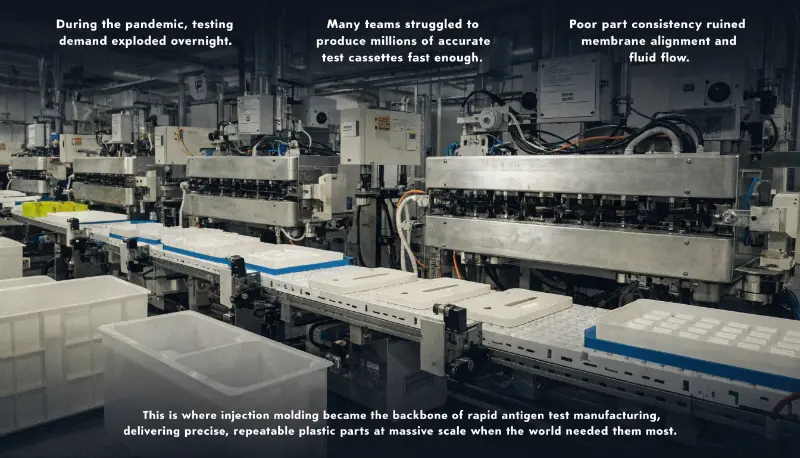
During the pandemic, testing demand exploded overnight. Many teams struggled to produce millions of accurate test cassettes fast enough. Poor part consistency ruined membrane alignment and fluid flow. This is where injection molding became the backbone of rapid antigen test manufacturing, delivering precise, repeatable plastic parts at massive scale when the world needed them most.
Featured Answer
Injection molding is widely used for COVID rapid antigen test devices because it supports high-volume, low-cost production of precise plastic parts like cassettes, housings, swab components, and buffer bottles. The process delivers consistent dimensions, tight tolerances, and repeatable geometry needed for membrane alignment and fluid control. Combined with cleanroom manufacturing, thin-wall molding, and automated inspection, injection molding enables fast ramp-up during demand surges while protecting the assay from contamination and moisture.
I have worked on diagnostic consumables that scaled from prototype to millions of units. Let me walk you through what actually matters when you mold these parts.
Why Does Injection Molding Fit COVID Diagnostic Devices?
You need parts that fit together perfectly, every single time. If one dimension drifts, the membrane shifts and the test fails. Many teams underestimate this until they see failed assays in production. Injection molding solves this by giving you repeatable geometry at high volume.
Quick Answer
Injection molding fits COVID diagnostics because it produces dimensionally stable parts with repeatable geometry. This consistency matters for aligning the membrane, controlling fluid pathways, and protecting the assay from contamination. The process also supports fast ramp-up when demand spikes, which was critical during COVID-19 testing surges. High cavitation tooling and automation allow millions of parts per week with tight quality control.
Dive Deeper
Let me explain why consistency is everything in a rapid antigen test. The test cassette holds a nitrocellulose membrane. Buffer fluid must flow across that membrane at a controlled rate. If the internal channels or wells vary even slightly, the flow speed changes. That changes how the sample reaches the test line. In diagnostics, this can create false results.
I once helped a customer whose test line looked faint and inconsistent. The membrane was fine. The problem was the cassette. The well depth varied cavity to cavity because the mold cooling was uneven. We fixed it by rebalancing the cooling channels and tightening process controls. After that, the flow became stable across all cavities.
This is why injection molding works so well. Once the mold is validated, every part looks the same. Here is what the process gives you:
| Requirement | How Injection Molding Delivers |
|---|---|
| Membrane alignment | Tight tolerances, often ±0.05 mm |
| Fluid control | Repeatable well and channel geometry |
| Contamination protection | Cleanroom molding, sealed housings |
| High volume | Multi-cavity tools, automation |
| Fast ramp-up | Proven, scalable process |
For diagnostic parts, I recommend validating your process early. Run IQ, OQ, and PQ. Lock the parameters. Do not let operators adjust settings freely. Small changes in pressure or temperature can shift dimensions.
A good supplier will also run capability studies. You want a Cpk above 1.33 on critical dimensions. This proves the process stays inside your tolerances. Without this data, you are guessing. In medical work, guessing is expensive and risky.
What Parts Are Commonly Molded for Rapid Antigen Tests?
Not every part carries the same risk. Some hold fluid. Some touch the sample. Some just protect the assay. If you treat them all the same, you waste money or miss a critical control. Understanding each part helps you plan tooling and material choices correctly.
Quick Answer
Common injection-molded parts include test cassette housings, sample collectors, swab-related components, buffer bottles, sealing caps, and internal cartridges or microfluidic structures. The cassette housing protects the membrane and controls fluid flow. Buffer bottles and tubes store and dispense reagents. Some advanced formats use molded microfluidic channels for more controlled fluid handling in point-of-care testing platforms.
Dive Deeper
Let me break down the main molded parts and what each one needs.
Cassette housing. This is the visible plastic case. It holds the membrane and sets the sample well and result window. It needs tight dimensions and clean surfaces. The window area should stay clear and free of flow lines so users can read results easily.
Buffer bottles and caps. These store the extraction fluid. They need good chemical resistance and reliable sealing. A leaking cap ruins the product. I always push for leak testing on these parts.
Swab components. Some COVID tests use molded swab handles or holders. Polypropylene works well here because it is safe for sample contact and flexes without breaking.
Internal microfluidic parts. Newer platforms use molded channels to control fluid more precisely. These are harder to mold. Thin walls and small features need careful mold design and process control.
Here is a simple guide:
| Part | Common Material | Key Concern |
|---|---|---|
| Cassette housing | Polypropylene, Polystyrene | Dimensions, clear window |
| Buffer bottle | Polypropylene, HDPE | Chemical resistance, sealing |
| Swab handle | Polypropylene | Biocompatibility, flex |
| Microfluidic insert | COC, PP | Thin walls, fine features |
A practical tip from my experience: design the cassette in two halves that snap together. This makes automated assembly easier and cheaper. But keep the snap fits robust. A weak snap fit that opens during shipping is a real failure I have seen.
Match your tooling investment to the volume. A snap-fit two-part housing at high cavitation is usually the smart choice for mass diagnostics.
What Design and Manufacturing Needs Matter Most?
You can have a perfect design and still fail in production. Contamination, moisture, or a tolerance stack-up can wreck the assay. Many teams learn this the hard way. Getting the manufacturing setup right from the start saves you months of rework and painful validation delays.
Quick Answer
COVID test devices require cleanroom production, careful medical-grade material selection, and automated quality checks. Key needs include thin-wall molding, tight tolerances, user-friendly housing design, and inspection systems to confirm parts fit and function. Moisture and contamination control protect the assay. Process validation and traceability support regulatory compliance under ISO 13485 and relevant medical quality systems.
Dive Deeper
Let me share the things that actually cause problems in real production.
Cleanroom molding. Diagnostic parts are sensitive to particles. I recommend at least ISO Class 8 cleanroom molding for these components. This limits dust and contamination that could interfere with the assay. Buffer bottles and cassette interiors especially need clean handling.
Moisture control. Antigen assays hate moisture. Your housing design and packaging must keep moisture out. During molding, wet resin also causes defects. Always dry the material properly before molding. Polypropylene and polystyrene both need controlled drying.
Tolerance stack-up. When two housing halves meet, all their tolerances add up. If you ignore this, the parts may not close or the membrane may sit wrong. I run a stack-up analysis early. This tells me which dimensions need tight control and which can relax.
Automated inspection. At high volume, you cannot check every part by hand. Vision systems catch short shots, flash, and dimension errors. This keeps bad parts out of your assembly line.
Here is a practical checklist I use:
- Validate the mold with IQ, OQ, PQ.
- Confirm Cpk above 1.33 on critical dimensions.
- Use ISO Class 8 or cleaner molding.
- Dry resin to material specs.
- Run leak testing on fluid parts.
- Set up vision inspection.
- Keep full lot traceability.
One more point on materials. Polypropylene resists many buffer chemicals and is safe for contact. Polystyrene gives clarity and stiffness for windows. Choose based on the part function, not habit.
Regarding scalability, some newer platforms move toward foil-based or roll-to-roll processes. These can reduce cost for certain formats. But for classic cassettes, injection molding remains the proven, reliable path.
Finally, work closely with your molding partner during design. Early DFM feedback prevents costly mold changes later. I have saved customers weeks by catching a thin wall or a hard-to-mold feature before the steel was cut.
Conclusion
Injection molding gives COVID rapid antigen tests three big wins: speed, scale, and part consistency. The main constraints are tooling cost, regulatory work, and controlling moisture, contamination, and tolerances. Choose the right material for each part. Validate your process early. Involve your molder during design, not after. Do these things, and you will build reliable diagnostic parts that perform every time, even during demand surges.