Author: Jerry

Cost and Procurement Category

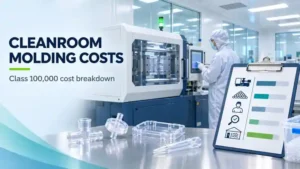
What Is the Real Cost Breakdown for Class 100,000 Cleanroom Molding?

Your supplier sends a "cleanroom" quote that is 25% higher than the standard molding quote, and you can’t tell what the extra money buys. It could be the room, the gowns, the paperwork, or just margin. Without a clear breakdown, you either overpay for years or pick the cheapest molder and risk a failed audit. Below, I’ll break down the cost line by line so you can budget with confidence and question each quote. A Class 100,000 (ISO 8) cleanroom molding program has three cost layers. Construction usually runs about $75–$300 per square foot, and HVAC plus HEPA filtration takes
Read More »
Cost and Procurement Category

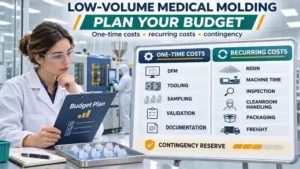
Budgeting for Low Volume Medical Device Molding: How Much Should You Really Plan For?

You have a promising medical device, a clinical build on the calendar, and a budget that has to last. Then the quotes arrive. One molder hides tooling in the piece price. Another leaves out validation. A third looks cheap until a late design change forces tool rework and retesting. Suddenly your "small" run costs twice what you planned. The fix is a budget that breaks out every cost bucket before you send a single RFQ. To budget for low volume medical device molding, split costs into one-time and recurring buckets. One-time costs cover DFM, tooling, sampling, validation (IQ/OQ/PQ), and documentation.

Read More »
Cost and Procurement Category

Cost Factors in Medical Grade Resin Selection: What Really Drives the Price?

You get two resin quotes, and one is 40% cheaper. Procurement loves it. Then that grade needs longer cycles, scraps more parts, and comes with no change-notification commitment. Two years later it gets reformulated, and your team loses months requalifying the device. I have watched this happen more than once. The good news is that once you know where resin costs really come from, you can pick a material that stays affordable for the whole life of your device. The main cost factors in medical grade resin selection are biocompatibility documentation (USP Class VI and ISO 10993 data), sterilization compatibility,

Read More »
Cost and Procurement Category

Mold Lifespan Expectations for Medical Device Production

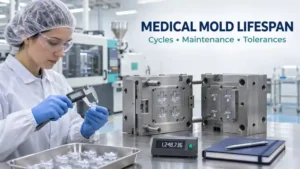
You approved the tooling quote, validated the process, and launched the product. Eighteen months later, a critical dimension starts to drift. Flash shows up on the parting line. Quality opens a deviation, and you find out the mold needs major repair and then revalidation. That costs months of supply and a lot of money. You can predict most of this if you set mold lifespan expectations before anyone cuts steel. Most high-volume medical device molds are built to SPI Class 101 standards. They use fully hardened, corrosion-resistant tool steel such as S136 or 420 stainless and are rated for more

Read More »
Cost and Procurement Category

How to Estimate Injection Molding Costs for Startups?

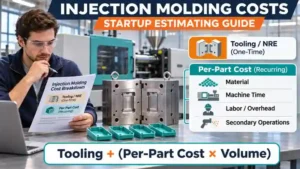
You have a working prototype, a pitch deck, and a launch date. Then the first mold quote arrives, and it is three times what you planned. I see this often with medical startups. A bad estimate does more than hurt your budget. It can delay validation, burn runway, and force a redesign at the worst possible time. The good news is that molding costs follow a predictable logic. Once you know the drivers, you can estimate with confidence. To estimate injection molding costs, split your budget into two parts: one-time costs and recurring costs. Total cost = tooling/NRE + (per-part

Read More »
Cost and Procurement Category

Cost Comparison: Prototype Molding vs 3D Printing for Medical Parts: Which Costs Less?

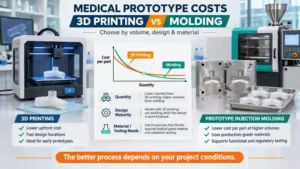
You need medical prototypes fast, and the budget is tight. So you 3D print them. Then a verification test fails because the printed resin cracked after sterilization, and you rebuild parts and repeat the test. Or you buy an aluminum mold too early and pay for four tool changes. Both mistakes are expensive. The fix is to match the process to your volume, design maturity, and validation needs. 3D printing is usually cheaper for medical prototypes from one part up to a few hundred parts, because it needs no tooling. Prototype injection molding needs an aluminum mold that costs about

Read More »
Cost and Procurement Category

What Are the MOQ Requirements for Medical Device Injection Molding?

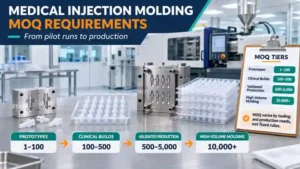
You found a molder you like. The quote looks fair. Then you see the minimum order: 10,000 parts. Your clinical build only needs 300. Now you have two bad options. You can overbuy inventory that may become scrap after a design change, or you can start your supplier search again. I’ve watched many teams lose months at this step. The good news is that medical MOQs are rarely fixed. Once you understand what drives them, you can negotiate them. Medical device injection molding MOQs usually range from 100–500 parts for pilot or clinical builds made with aluminum bridge tooling, 500–5,000

Read More »
Regional Procurement Guide Category

How Do You Build a Dual-Source and Long-Term Medical Supply Chain?

Your device has passed design verification and your launch date is set. Then your only molder calls with bad news. A resin shortage, a damaged mold, or a sterilizer shutdown has stopped production. Every week of delay means backorders, unhappy hospital customers, and hard questions from your quality team. COVID-19 showed how fast single-source supply chains break. Panic buying will not fix this. A dual-source, long-term supply strategy, built before you need it, will. To build a dual-source and long-term medical supply chain, first rank components by patient and business risk. Qualify at least two suppliers for critical parts, ideally

Read More »
Regional Procurement Guide Category

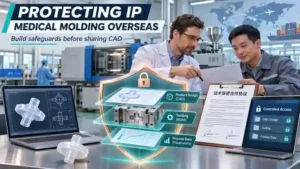
How Do You Protect IP When Sourcing Medical Molding Overseas?

You found an overseas molder with strong pricing and real cleanroom capacity. But once you send your CAD files, your design is no longer fully in your control. In medical devices, the risk goes beyond a copied part. Your mold, process window, and validation data can be reused, copied, or held hostage. The good news is that most IP losses are preventable if you build protection into sourcing from day one. To protect IP when sourcing medical molding overseas, treat protection as a system, not a single NDA. Register patents, utility models, and trademarks in the manufacturing country before you

Read More »
Regional Procurement Guide Category

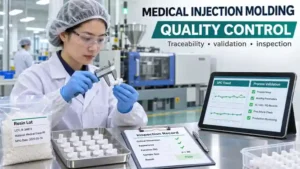
Quality Control for Overseas Medical Injection Molding: How Do You Get It Right?

Your molded parts looked perfect in the sample box. Then the first production lot arrived from overseas with flash on a sealing surface, a slightly different shade of white, and no resin lot numbers. Now your verification build is on hold, your launch date is slipping, and your auditor wants answers. Distance makes every quality gap more expensive. But overseas medical injection molding can be as reliable as domestic molding if you build quality control in from day one. Quality control for overseas medical injection molding means building quality into every stage instead of relying on final inspection. Start with

Read More »

Request a Quick Quote

Send your drawings and detailed requirements via:
Email: jerry@ckmold.com

Or fill out the contact form below:

We will contact you within one working day. Please pay attention to the email with the suffix “@ckmold.com”