
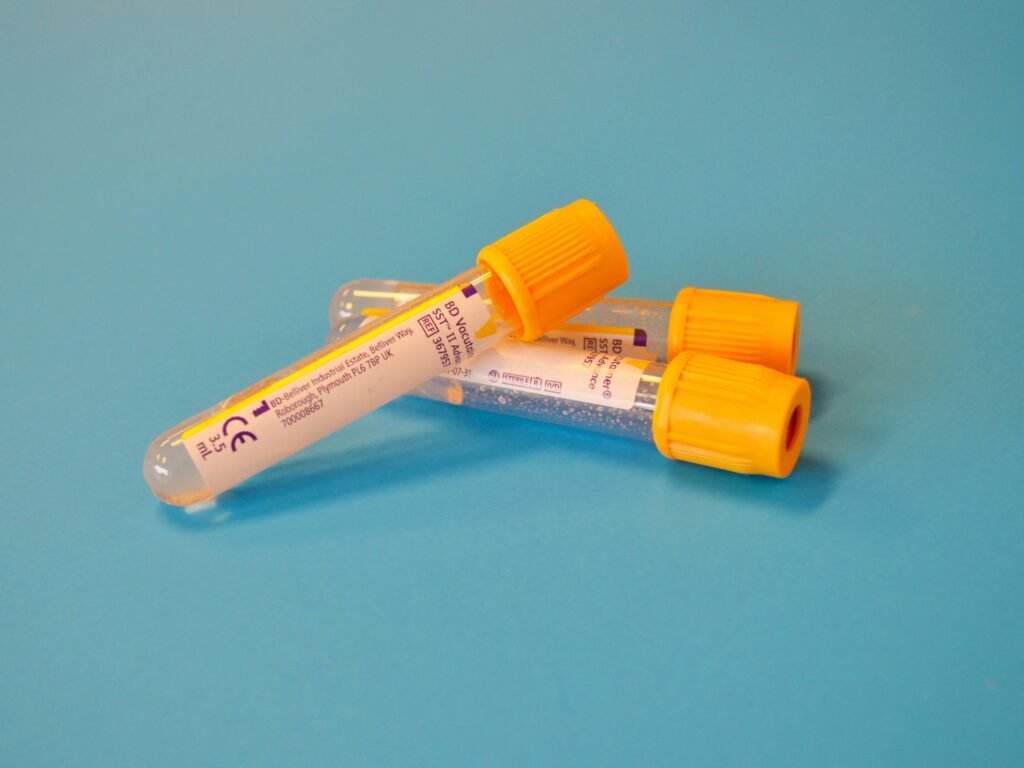
Where generic off-the-shelf caps suffer, custom-molded sample collection tube caps excel. These injection-molded custom caps pair well with different medical tubes or diagnostic assay kits.
To begin with, engineers rely on an effective design strategy and material selection. This lays a strong foundation. If done right, it results in products with exact dimensions, high seal integrity, and strict regulatory compliance.
So, in this article, we’ll walk you through the core strategic considerations specifically targeted for custom applications and requirements.
What are Custom Molded Sample Collection Tube Caps?
Custom molded sample collection tube caps are sealing closures you use for securing the chemical or sample specimens. This simple-looking product is engineered for use in various medical applications. These include laboratories, clinics, and industrial packaging. It prevents contamination and evaporation, providing a secure seal. With different-sized tubes and automated equipment, each system requires a custom cap. That’s why the need for customization goes beyond just a feature.
Medical Injection molding is an incredible manufacturing technique. With this method, you can produce detailed, precise custom caps in bulk quantities fast. Moreover, it is cost-effective and helps you scale fast.
Understanding the Standard Requirements for Custom Molded Tube Caps
When working with medical injection-molded components, you must adhere to some standard regulations. This will help you maintain quality and consistency across your products. This includes:
- Reliable and accurate design
- Biocompatible material choices
- Secure sealing mechanism
- Sterile cleanroom manufacturing
- Validated IQ/OQ/PQ processes
- Compliance with International standards such as ISO 9001 and ISO 13485
To make a thorough analysis, we will discuss all the points in detail. We, at MedMoldPro, understand the importance of these requirements. So, our engineering team utilizes core expertise to assist you from initial design to final production.Key DFM (Design for Manufacturing) Considerations
Before diving into manufacturing and other aspects, engineers begin with DFM analysis. This is the key to laying a strong foundation for a quality product. Additionally, it prevents injection-molding defects such as sink marks and warping. Here, the custom-molded sample collection tube cap design is assessed for various features. Then adjustments are made accordingly.
Wall thickness:
Engineers must ensure uniform wall thickness. The safe range is from 40% to 60% of the adjacent thickness depending upon your chosen material. Products with thin walls tend to cool fast during the injection molding process. For inconsistent and thick-walled components, the cooling rate is slower. Additionally, this may result in molding defects such as sink marks, warping, and voids. Variation in wall thickness also leads to failed seal integrity and automation failure.
Draft angles:
Minimum draft angles help the part eject easily. So, if your custom tube cap is plain, try keeping the draft angle of 1° to 2° to the vertical surface. For textured caps, the draft angle should be increased by 1° to 1.5° per 0.1 mm texture depth. The cap will not stick to the mold surface, and you can eject it easily when the mold opens.
Thread geometry:
For custom molded sample collection tube caps, design engineers must opt for smooth radii (R > 0.5 mm). Design radii on roots or rounded at threads. This will help avoid stress concentration and cracking, and ensure easy ejection,Dimensional tolerance:
Only use tight tolerances where critical. As custom molded sample collection tube caps fall in the precision group, dimensional and geometric standards must be met. For critical features, injection molding tolerances range from 0.25mm to 0.5mm. The dimensional tolerance of the critical sealing diameter must be held at 0.5mm. This allows consistent compression against the sample collection tube rim.
Undercut:
Undercut gives a secure mechanical lock. It prevents cross-contamination or accidental opening. If your cap design requires a snap-fit feature, undercut will be necessary. It is always recommended to avoid them. But if required, for flexible plastics, design caps with sloped edges. This allows them to pop off the mold without tearing.
Gating and ejection system:
Your cap design should include gate placement away from sealing surfaces and threads. Gating and ejection components that align well prevent ‘flash’ (thin excess plastic). Otherwise, it may interfere with automated decapping machines.
Advanced Material Selection for Medical-Grade Caps
Material selection is another critical part of injection molding. It affects various other aspects, such as product integrity, processing, and final operational use. These caps must be made from biocompatible, medical-grade resin to meet regulatory standards (USP Class VI, ISO 10993 compliant). These caps may have to withstand heat and chemical exposure. So assessing these details ahead of selection is important. Inappropriate material choice can lead to defects and compromise regulatory compliance.
Different materials work well for different types of custom caps you choose. Common materials for manufacturing injection-molded medical-grade caps include:Polypropylene (PP)
It is one of the most commonly used materials and industry standards for medical use. It stands out for its non-reactive nature and moisture- and heat resistance. This makes it the best choice for handling chemicals and specimen collection. If your custom cap design offers interference seals, its great flexibility can engage well with lab capping machines. Being sterilization-compatible, polypropylene caps withstand autoclaving without degrading.
Polyethylene
Well, another option you have is polyethylene. They are best for precision molding and can be molded down to micrometres. There are two major varieties of polyethylene–high density (HDPE) and low density (LDPE).
If you require plug-style or push-fit caps with a snug fit, engineers recommend LDPE. It gives the required flexibility for such designs.
You can choose HDPE for threaded designs like screw-on caps. This material is rigid, cost-effective, and offers good moisture resistance. Additionally, due to excellent flow properties, it benefits during the high-cavitation molding process.
Custom molded polyethylene caps withstand EtO and gamma radiation without color fading. The material is cost-effective and best for high-production injection-molded caps.Thermoplastic Elastomers
TPE, or thermoplastic elastomer, is a flexible polymer. It includes a broad range of polymers that excel in chemical resistance. It forms a strong, flexible material for seals and pierceable injection ports in custom caps for automated needle sampling. TPU custom-molded sample collection tube caps lock tightly with the tube. This reduces the risk of contamination and evaporation.
Comparison Table For Material Selection
Material Key Characteristics Best For Polypropylene (PP) High chemical resistance, rigid, cost-effective, autoclavable. Standard laboratory test tube caps, PCR caps. High- and Low-Density Polyethylene Excellent moisture barrier, rigid, impact-resistant. Blood collection tube caps, transport tube caps, automation caps. Thermoplastic Elastomers (TPE) Rubber-like flexibility, excellent sealing, easily overmolded. Self-sealing/pierceable septum caps, multi-material caps.
Custom Cap Design Option
While general snap caps and screw caps can be produced. MedProMold uniquely offers extensive manufacturing capabilities for custom molded solutions. When creating custom molded tube caps, you can choose from many design options to meet your requirements.
Custom capping may include a wide range of medical sample collection tube caps. These include automated caps, flange plug caps, pierceable stoppers, and more. So, with these varieties, you can get customization on the basis of:
| Feature | Specification / Details |
|---|---|
| Sealing mechanism | Integrate Linear or O’gasket ring for leak-proof seals. |
| Cap Style | Hinged cap, pierceable caps, custom threaded caps, septum caps |
| Automation Compatibility | Designed with a flat top surface or specific gripping ribs. It ensures the cap works well with decapping machines. |
| Color coding | A variety of transparent or opaque colors include red, purple, grey and others. This helps in identifying the sample type. |
| Thread geometry | Use radiused roots and crests. It improves material flow and prevents stripping. |
Choose The Right Tooling
The mold tooling material also matters. Engineers use different types of material for different production volumes.
If you need low volume (< 10,000) custom molded caps, aluminum 7075 molds are used. It helps with multiple cycles while keeping tooling costs low.
Engineers utilize hardened H13 steel or 420 stainless steel molds for high-production molding. Exceeding 50,000 parts. These molds are made with CNC machining for precise dimensional tolerances. Optimizing them enhances cycle time and consistent quality over millions of cycles.
Manufacturing Environment
Manufacturing medical-grade custom-molded tube caps is not as simple as standard injection molding. It requires a specialized manufacturing environment meeting regulatory standards to prevent particulate or biological contamination.
Failing to adhere to strict requirements can result in catastrophic consequences. It can ultimately lead to product recall and immediate legal penalties. Here are some of the core manufacturing requirements:
Cleanroom Injection Molding
According to ISO standards, cleanroom injection molding is crucial for medical-grade components. For manufacturing sample collection tube caps, engineers work in ISO Class 7/8 cleanroom facilities. This complies with the sterile environment needed for a high level of biocompatibility.
For contamination control, the process includes continuous particle and microbial monitoring. The equipment used here is automated. This includes all-electric injection molding machines with pneumatic (air) ejection coupled with robotics. With less human interaction, the process guarantees secure, leakproof caps- free from defects and contaminants.
Process Validation — IQ, OQ, PQ
Medical injection molding processes must go through strict process validation. This includes IQ, OQ, and PQ to meet strict FDA standards and international audits.
Our engineering team understands the importance of process validation. As an industry expert, MedProMold assists you through this stage without headaches. Our entire process lifecycle aligns well, including the following, to meet the requirements.
Critical Process Parameters (CPPs),
Critical Quality Attributes (CQAs),
Comprehensive documentation
As a result, you can get quick, hassle-free market approval.
Quality Control and Traceability
So, talking about quality systems in precision injection molding. Here, not only end-of-the-line quality checks matter, but also in-process monitoring.
Audits verify the system using coordinate measuring machines (CMM).
Cosmetic defects, short shots, flash or contaminants are checked through automated vision systems.
Following the ISO quality management system is necessary. It ensures a high level of traceability, weight verification, and tolerance checks.
At MedProMold, traceability records are available for each project. We can acquire this with your shipment. It can be formatted to match your internal quality documentation requirements.
How to Partner for Your Custom-Molded Sample Collection Tube Cap Project?
For a successful project, partnering with a reliable manufacturer is all you need. But you need a strategic approach. Before beginning, the first thing is to plan and define your specifications for custom molded sample collection tube caps. When you have all the details ready, you can engage with the manufacturer and begin the work. With clear requirements, it's easy to stay on the right track and prevent costly modifications later.
1- Request a Design for Manufacturing (DFM) Review
Contact the manufacturer and send your CAD file for review. Your injection molding partner will review it. Their engineers help you optimize the custom molded sample collection tube cap designs. For this, they run a simulation of how the molten plastic flows into the mold. This allows them to detect and identify weak design areas or other defects. It also ensures dimensional accuracy and tolerances that may cause automation errors.
2- Prototyping and Tooling Fabrication
Now that your designs are approved, it's time to work on production before diving directly into manufacturing. Your partner creates a prototype using a 3D printing technique. Some manufacturers may offer a single-cavity mold to create a prototype.
But why is prototyping important? It saves you from financial risk. Lower volume up to a few hundred caps works best for testing it in real time. It ensures the final custom caps are fully operational.
3- Validation and Scale-Up
Your sample is tested and validated. Now, the manufacturer moves toward actual production. In this step, for high production, multi-cavity injection mold tooling is created. The molds are durable and can withstand millions of cycles without wearing out fast.
Modern manufacturing facilities use hot runner systems for your custom molded caps. This ensures uniform melt flow and pressure. As a result, cycle time and waste material are minimized to a large extent. This benefits large-volume production.
Partner With MedProMold Today For Successful Medical Injection Molding!
If you are ready to convert your prototypes to successful medical products– MedProMold can handle it all. With our experienced engineering team coupled with advanced equipment, we can assist you with custom medical injection molding. Our facility operates under a Class 7/8 cleanroom and has acquired ISO 13485 certifications. Additionally, our goal is to provide medical products that perfectly align with international standards. So, your business can stand out in this competitive market.
Contact MedProMold with your CAD file and get responses within 24 hours!