
Home / Applications / Medical Device Housings & Enclosures
APPLICATION
Medical Device Housings & Enclosures
Medical device housings must protect internal components while locating displays, boards, connectors, fasteners, seals, and user interfaces. Injection-molding success depends on wall balance, ribs, bosses, snap fits, draft, gate placement, cosmetic surfaces, warpage control, and the tolerance stack across mating parts. MedMoldPro reviews the enclosure as an assembly rather than treating each half as an isolated plastic part.
Suitable Projects
- Diagnostic and monitoring equipment housings
- Handheld non-implant medical equipment enclosures
- Reader, controller, and laboratory instrument covers
- Multi-part housings using snaps, screws, or welded joints
Engineering Risks to Resolve
- Warpage that shifts seams and internal alignment
- Sink around bosses and structural ribs
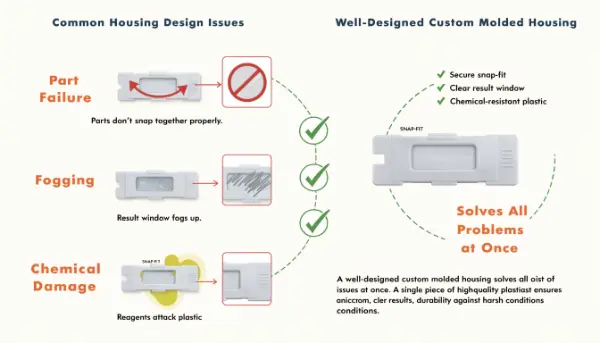
- Snap-fit stress and assembly damage
- Cosmetic variation near gates, weld lines, and texture transitions
How MedMoldPro Approaches the Work
Mating parts, internal components, seal paths, fasteners, cosmetic zones, and assembly sequence are reviewed together.
Critical datums and inspection methods are agreed before tooling so the drawing measures function rather than isolated dimensions that do not control fit.
Expected Project Deliverables
- Assembly-focused DFM
- Gate, parting-line, and ejection recommendations
- Cosmetic and dimensional acceptance plan
- Sample review against mating components when supplied
Scope and Responsibility Boundary
Ingress protection, electrical safety, cleaning resistance, drop performance, and device-level certifications require final assembly testing by the customer.
Related Engineering Resources
Medical Device Housings & Enclosures: Frequently Asked Questions
Balance walls and ribs, review gate and cooling strategy, select the resin carefully, and control the process and measurement condition.
Yes when the texture specification, draft, appearance zones, and repair implications are reviewed before surface finishing.
That depends on resin, strain, geometry, use cycles, and environment. The customer must define the functional requirement.
Often it helps coordinate interfaces and timing, but commercial and technical risks should be reviewed for the specific program.
Technical review: Jerry Zou | Last updated: August 28, 2026
Manufacturing statements are limited to available capability information. Regulatory references are informational and do not replace the legal manufacturer’s qualified review.
Discuss the Drawing, Material, Volume, and Documentation Scope
Send the controlled files and project requirements needed for an engineering review and quotation.