
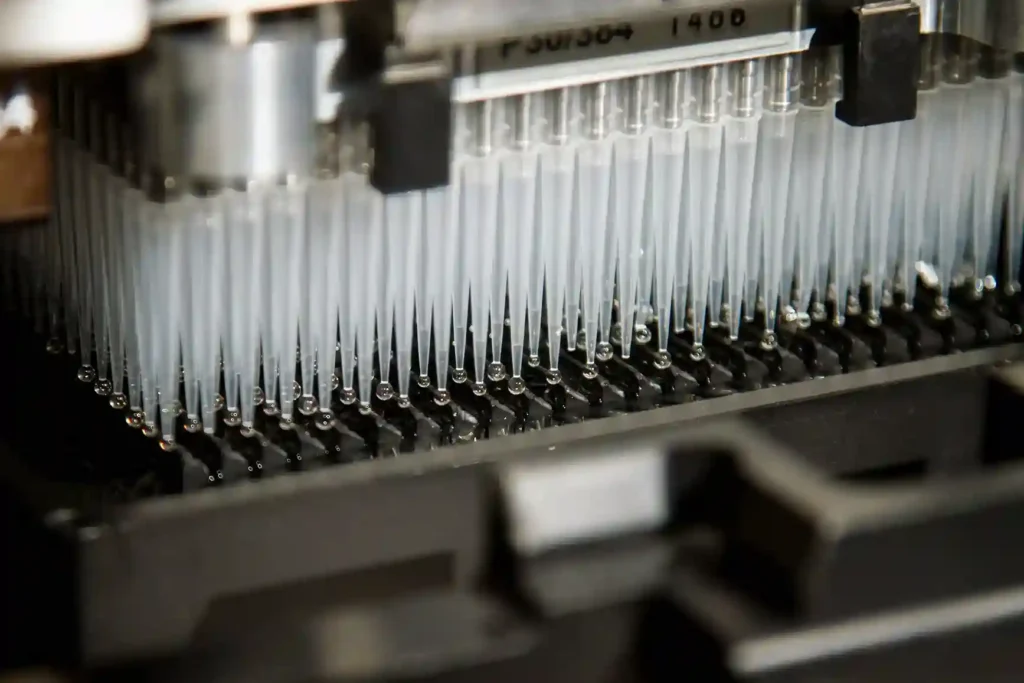
Pipette tips are manufactured through the injection molding process1. However, maintaining precision throughout the process is non-negotiable. Otherwise, it may lead to injection-molding defects such as warping, burrs, and voids. This may compromise sample integrity, affect liquid-handling accuracy2, and more.
Here is a detailed guide to the injection molding process to manufacture accurate Injection-Molded Pipette Tips For Lab Diagnostics. Additionally, we provide key technical insights into how to adjust process parameters, select materials, and meet tooling requirements.
Why Does Precision Matter in Manufacturing Injection-Molded Pipette Tips?
In laboratory diagnostics, accuracy is the baseline for both manual testing and automated systems. Although small components, pipette tips play an important role in aspirating and dispensing liquid and sample testing. Here, you have to measure the exact volumes of liquid samples ranging from milliliters to microliters.
Manufacturing injection-molded medical-grade pipette tips requires a strict regulatory framework to meet standard requirements. If you do not implement strategic precision injection molding techniques, your final product may face various challenges. These challenges are not limited to process defects and dimensional inaccuracies. They may also cause your product to fail to acquire ISO certification.
Selecting the Right Raw Materials
Before you dive into the manufacturing process, let’s talk about material choices. Selecting the right raw material is important. These injection-molded pipette tips for lab diagnostics have to go through testing procedures in demanding conditions. Therefore, they must ensure accuracy in both the injection molding process and in various laboratory settings.
Let’s see what the key material requirements are for injection-molded pipette tips:
How do the right materials enhance consistency and precision in injection-molded products?
When you use compatible materials, maintaining consistency and repeatability, and ensuring dimensional tolerances, becomes much easier. This is because different medical-grade components use materials with specific molecular properties based on application. For injection-molded pipette tips, the material must offer:
- Predictable volumetric shrinkage rates
- Stable molecular structure to hold exact dimensional tolerances
- Stabilized viscosity for consistent melt flow
- Do not change properties upon temperature shift
- Uniform thermal conductivity and mechanical strength
Regulatory Standards For Material Selection
These injection molded pipette tips will be used in lab diagnostics, where they will directly come in contact with chemicals and biomedical samples. In such settings, sample accuracy, protection, and equipment sterility cannot be compromised at any cost. That’s why material selection must meet strict regulatory standards. The following are some of the key requirements:
- Non-reactive: In lab diagnostics, pipette tips are used for dispensing chemicals, bioactive materials, and samples. Here, material reactivity may affect the validity of test results. Thus, any material used for injection-molded pipette tips for lab diagnostics must be non-reactive in nature.
- Biocompatible: Ensure that your selected material is free from DNA, RNase, DNase, or PCR inhibitors. Some sensitive chemical reactions, for example, PCR chain reactions, may not yield effective results when contaminated.
- Structural integrity: Weak material means your injection-molded pipette tips will not perform well in extreme lab testing conditions. So, material strength counts so these tips do not deform during high-temperature testing or other conditions.
- ISO 13485 Compliance pipette tips: This certification is crucial for companies and especially medical device businesses. It guarantees that the manufacturing is done under a compliance framework and controlled environments. Additionally, it validates that all processes undergo rigorous quality checks and are documented thoroughly.
- FDA-approved and USP certified: Food and Drug Administration (FDA) approval is essential for all injection-molded medical devices, including pipette tips. It ensures these tips are safe for lab diagnostics and pharmaceutical manufacturing. USP Class VI verifies that your selected resin is tested to be safe for system toxicity and biological reactivity. It also prevents heavy metals from leaching into the samples.
Resin Choice For Injection-Molded Pipette Tips
100% virgin Polypropylene (PP): The best resin choice for injection-molded pipette tips is 100% virgin polypropylene. It meets all requirements and ensures precise, thin-walled pipette tips. The material offers flexibility, strength, and biocompatibility necessary for manufacturing pipette tips. Medical grade polypropylene pipette tips are chemically resistant and allows for low water retention. This is why chemicals or bioactive materials do not stick their walls and you can carry out dispensing accurately.
Polyethylene (PE): The second option you can opt for is polyethylene. It is a suitable material for injection molding due to its microporous structure. It’s lightweight and chemically non-reactive. It is a cost-effective choice if you want to produce pipettes in bulk.Mold Design and Tooling
Multi-cavity toolingMulti-cavity tooling
If you are dealing with large order production, multi-cavity injection mold tooling can work perfectly. However, they may cost you a bit more initially. But per-unit costs may be lower.
Hot runner systems
Unlike cold runner systems that produce waste material and temperature variance, hot runner systems follow the right thermal balance. This means molten plastic fills the cavity at the same speed, pressure, and time. This is essential to ensure that the viscosity of molten plastic and filling accuracy are not altered. As a result, this system gives you clean, flash-free pipette tips.
Conformal cooling channels
Uneven cooling can create uneven thermal zones and cause defects. That’s where the standard cooling system is not enough for highly precise medical device mold tooling. Therefore, it’s wise to use conformal cooling channels. They utilize 3D mold inserts that follow the exact contour of the mold cavity. This effectively extracts heat, enabling uniform cooling throughout at a faster rate.
Highly polished mold tooling surface
Polished steel mold tooling makes a solid choice for precise pipette tips. In fact, polishing eliminates the surface imperfections and gives clean, burr-free, consistent surfaces. Additionally, it improves the strength of the molds for repeated cycles.
Considerations for Pipette Tips Manufacturing Process
Injection Speed Control
During the injection molding process, injection speed matters. The faster the injection speed, the lower the risk of defects. This is because faster injection fills micro-thin-walled gaps before solidification starts.
Raw Material Handling– Melt Flow And Temperature
Melt flow and maintaining the temperature of the molten plastic and mold are equally critical considerations. You must choose the material wisely. For example, materials like polypropylene have a high melt flow index (MFI). They melt easily and fill long, thin cavities efficiently, enabling precise mold inserts. Consequently, if temperatures are not maintained, molten plastic crystallizes, producing hazy parts.
Additionally, feed zone temperatures should be maintained at 20℃. While mold temperature should be set between 20℃ and 40℃.V/P (Velocity to Pressure) Switch-over
The transition point where the injection mold switches from velocity-controlled filling to pressure control package must be fine-tuned. A good filling capacity is between 95 and 98%. This helps prevent overfilling or underfilling that will lead to dimensionally inaccurate pipette tips.
Cleanroom Standards
Medical Injection molding calls for cleanroom manufacturing. It ensures the pipette tips are produced in a contamination-free environment. According to standard requirements, injection-molded pipette tips for lab diagnostics should pass Class 7 or Class 8 cleanroom certification to maintain low particulate and microbial counts. Personnel must wear certified cleanroom garments, masks, gloves, and caps.
Injection Molding Process
Pipette tips for diagnostics are manufactured through a precise injection molding process. Here is a detailed breakdown of the step-by-step process:
Step 1: Clamping phase
The manufacturing process starts with clamping the mold tooling. A high clamping force, ranging between 100-300 tons, seals both parts of the mold together. This prevents any leakage during the process.
Step 2: High-Speed Injection of molten plastic
After clamping, molten plastic is forced at high speed into the mold cavity. This is a controlled process, and various aspects must be considered for consistent results:
As injection-molded pipette tips use thin-walled mold cavities, a dynamic high-speed injection rate is crucial. This will help fill gaps without premature freezing.
Another notable point is the filling capacity. On average, you can set the cavity filling capacity to 95%- 98%. It is recommended to configure the V/P switchover, which helps avoid overfilling or incomplete filling.
Fine-tuning filling velocity and pressure, and ensuring cavity balance and concentricity, is essential. Balancing all these factors will result in dimensionally stable pipettes free from burrs and flash.Step 3: Packing and holding phase
Now that the cavity is filled up to 95%-98%, the cooling phase starts. The machine will transition from velocity-controlled filling to pressure-controlled packing. This transition is known as a V/P switchover, which is due to the screw position.
As the material begins to solidify, the controlled packing pressure tries to push molten plastic into the cavity. This counteracts the volumetric shrinkage that occurs during cooling.
Throughout this phase, you must maintain the pressure at a constant rate until the small gate freezes. Once the gate freezes, the molten plastic can not backflow into the cavity and into the runner system.Step 4: Solidification
Cooling time accounts for 80% of the entire injection molding cycle. So, in this phase, an effective cooling system is the most critical aspect. If the temperature of the mold cavity and core are balanced and the molten plastic cools uniformly, it allows geometrically precise pipette tips. It keeps the tips straight without bowing or sticky ejection.
The efficient cooling system involves key components such as internal cooling channels, baffles, and a mold temperature controller. When coupled with the right coolant in a conformal cooling system, these components allow rapid heat exchange.Step 5: Mold opening and part Ejection
After complete solidification of pipette tips, it’s time to open the mold and eject the part smoothly. This is a delicate process and must be done carefully; otherwise, it may scratch the pipette tips.
For clean ejection of pipette tips, stripper plate ejection or air-assisted ejection methods are used. Here, the ejector design should be considered to ensure it does not crack, bend, or leave stress marks on the tips.
These medical-grade tips are then collected by the robotic arms in a room environment. They are then transferred to racks or downstream high-speed optical inspection stations for verification and quality checks.Step 6: Quality assurance and inspections
Finally, the injection-molded pipette tips undergo final quality checks. These are thoroughly checked using high-speed vision systems, CMM, and optical measurement systems. This ensures they all meet strict regulatory standards and are ready to be shipped to their final destination.
Common Defects In Pipette Tips In Injection Molding – And How Do We Deal With Them?
All-electric machines are used in medical-grade injection molding, and with advancements, automation systems are also introduced. However, minor inaccuracies may lead to common defects. The table below helps you with precision solutions to each defect you may encounter:
Injection Molding Defect Solution Matrix
| Injection Molding Defect | Possible Root Cause | Recommended Solution |
|---|---|---|
| Bending / Warping | Uneven cooling around core pins causes inconsistent shrinkage and part deformation | Optimize cooling channel layout, adjust cooling flow, and balance filling speed between cavities |
| Flashing (Excess Plastic) | Excessive injection pressure, insufficient mold clamping force, or worn mold parting surfaces | Reduce peak injection pressure, verify clamping force, and repair worn mold steel surfaces |
| Short Shot / Incomplete Filling | Plastic melt cools too quickly or trapped air prevents complete filling | Increase melt temperature, optimize injection speed, and add proper venting (approximately 0.005mm vent depth) |
| Vacuum Leakage at Top Ring | Core pin shifts during injection, causing dimensional deviation and sealing failure | Check core pin alignment, improve insert support, and strengthen mold structure |
Conclusion
So, now you see how precision is achieved in the injection molding process for manufacturing pipette tips for lab diagnostics. However, it’s not hard if your engineering team is highly skilled and you have a strategic framework ready to implement.
As an experienced industry expert, the core purpose of MedProMold is to provide quality medical injection molding services. Our skilled engineering team is ready to handle your project; just send us your DFM file now and get a reply in just 24 hours.
-
"A perfect pipette tip, please!", https://www.netstal.com/en/a-perfect-pipette-tip-please/. Injection molding is widely used in the production of laboratory consumables including pipette tips, where thermoplastic polymers are injected into precision molds to create uniform, disposable components. Evidence role: general_support; source type: research. Supports: that injection molding is a standard manufacturing method for laboratory pipette tips. Scope note: This describes the general manufacturing category rather than providing specific industry adoption statistics. ↩
-
"Surreptitious pipetting errors on a vendor-programmed liquid …", https://pmc.ncbi.nlm.nih.gov/articles/PMC11141273/. Dimensional tolerances in pipette tips directly influence liquid retention and aspiration performance, with surface irregularities and geometric deviations potentially causing measurement errors in precision liquid handling. Evidence role: mechanism; source type: research. Supports: that dimensional variations and surface defects in pipette tips can compromise volumetric accuracy. Scope note: This establishes the general principle of dimensional precision affecting performance, though specific defect thresholds would require controlled testing data. ↩