
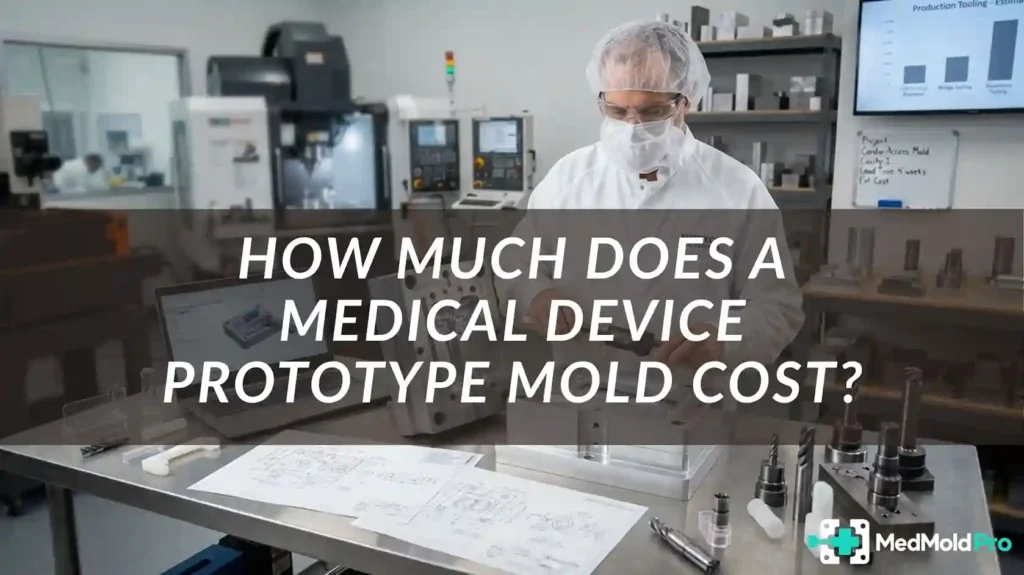
A medical device prototype mold typically costs from around $2,500 for a simple aluminum tool to roughly \$20,000 or more for complex, steel, multi-cavity, or production-intent tooling. The final price may vary depending on several factors. These include part geometry, medical-grade resin selection, documentation scope, and device risk. Understanding these factors before you send an RFQ or accept a quote helps you set a realistic budget.
This guide explains medical device prototype molding costs for device OEMs, startups, R&D teams, and sourcing departments. It outlines the main factors, timelines, and quotation checks that support a realistic budget.
The figures below are MedMoldPro planning ranges for prototype tooling sourced from China, not universal market prices. Final cost depends on the CAD geometry, mold construction, resin, tolerances, sample quantity, inspection requirements, and documentation scope.
Key Takeaways
- Aluminum tooling usually has a lower upfront cost and shorter lead time than hardened steel, but the difference varies substantially with part geometry, mold construction, resin, expected tool life, and supplier.
- Tight tolerances, side actions, cosmetic finishes, inspection fixtures, traceability, and validation can materially increase cost and should be identified separately in the quotation.
- Some aluminum prototype tools can produce thousands to tens of thousands of shots, but actual tool life depends on the aluminum grade, resin abrasiveness, part geometry, tolerances, molding conditions, and maintenance.
- An early DFM review can identify cost-saving changes before metal is cut and reduce the risk of expensive rework.
Important: Figures in this article are indicative planning ranges. Actual pricing depends on the drawings, resin, and quotation scope.
What Does Injection Molding a Medical Device Prototype Involve?
Prototype injection molding uses a low-volume tool, often made from aluminum or pre-hardened steel, to produce parts in the intended thermoplastic material. It is useful for evaluating fit, function, assembly, and process behavior before production tooling is approved. When the selected material and manufacturing process are appropriate, the parts may also support certain verification tests. The device manufacturer must determine whether the parts are suitable for a particular regulatory or validation test.
Which Costs Are Included in a Prototype Mold Quotation, and Why Do Quotes Differ?
Quotes differ mainly because suppliers assume different scopes of work.
| Cost Item | What It Covers | Typically Included? |
|---|---|---|
| Design for manufacturability (DFM) review | Part analysis, draft angles, wall thickness, gate and parting line, undercuts, and feedback before steel is cut | Yes |
| Mold base | Standard or custom steel frame, plates, guide pins, and ejector system | Yes |
| Cavity and core machining | CNC milling and finishing of the cavity and core that form the part shape | Yes |
| EDM | Electrical discharge machining for ribs, sharp corners, deep slots, and fine details CNC cannot reach | Yes (if the geometry needs it) |
| Trial shots (T1) | First molding run to check fit, fill, and function, plus basic process setup | Yes |
| Basic sample inspection | Visual check and key dimension measurement of the first samples | Yes |
| Texture or polish | Surface finishing such as SPI polish grades or etched texture, mainly for cosmetic or patient-facing parts | Often extra |
| Inspection fixtures | Dedicated gauges or fixtures for repeatable measurement of critical features | Often extra |
| Packaging and freight | Protective packing for molds and samples, such as crating or export-grade wooden cases. Also includes shipping, customs, and insurance | Varies by supplier |
| IQ/OQ/PQ validation | Installation Qualification, Operational Qualification, and Performance Qualification protocols, process capability studies, and reports | Separate scope |
Some suppliers also include texture, fixtures, packaging, and freight, while others exclude them. Validation is often separate, since a quote may cover trial samples but not Installation Qualification, Operational Qualification, and Performance Qualification (IQ, OQ, PQ) protocols. An itemized quote is needed before any two prices can be compared.
What Are the Primary Factors That Drive Prototype Mold Cost?
Part Complexity, Size, and Cavity Count
Complexity is the largest single driver of tooling price. Based on MedMoldPro planning ranges, a simple single-cavity part generally falls between \$2,500 and \$5,000, a medium-complexity part between \$5,000 and \$12,000, and a part with side actions or several cavities between \$12,000 and \$20,000 or more. Undercuts and side actions increase machining, fitting, and maintenance requirements. Larger parts also require bigger mold bases and more machining hours.
Mold Material Choice
Aluminum is generally the lower-cost option for prototype work, while steel is chosen when volume, expected tool life, tight tolerances, or abrasive resins require greater durability. The price difference varies with part geometry, mold construction, resin, cavity count, and supplier, so the material choice should be confirmed through an itemized quotation.
Tolerances and Surface Finish
Tighter tolerances increase machining and inspection time. The achievable tolerance depends on nominal size, geometry, resin, shrinkage, tool construction, and measurement method. Critical dimensions should therefore be identified on the 2D drawing and quoted individually. Polished or textured surfaces also add finishing time, particularly for cosmetic or patient-facing parts.
Tool Life and Expected Quantity
Some aluminum prototype tools can produce thousands to tens of thousands of shots, but actual tool life depends on the aluminum grade, resin abrasiveness, part geometry, tolerances, molding conditions, and maintenance. Pre-hardened or hardened steel can support substantially longer production life. A shot-life guarantee should only be stated when the mold specification, resin, and operating conditions have been defined. For a few hundred parts, aluminum is often suitable, subject to the resin, geometry, tolerances, and testing requirements.
Which Medical-Specific Cost Drivers Apply to Prototype Molds?
Medical programs can add cost through resin controls, documentation, handling requirements, inspection fixtures, and validation. The amount depends on the device, target market, test plan, and customer quality agreement, so these items should be quoted separately.
Design Control and Risks
Design-control and risk-management activities may create additional requests for tolerance justification, material qualification, and change documentation. The device manufacturer remains responsible for its design-and-development records, while the supplier documentation scope should be defined in the RFQ or quality agreement.
Production-Intent Resin and Biocompatibility
Production-intent resin is generally required when test results must represent the final device. Medical-grade resins often carry minimum purchase quantities and lot certificates, which raise material cost for small runs.
For patient-contacting devices, biological evaluation should follow a risk-based approach under the applicable ISO 10993-1 requirements. The evaluation may depend on the final material, additives, colorants, processing conditions, cleaning, sterilization, and the nature and duration of body contact. A medical-grade resin certificate alone does not establish biocompatibility of the finished device.
Traceability, Documentation, and Lot Control
Traceability adds administrative effort because resin lots, tool revisions, samples, and measurements are linked in controlled records. Change control and record retention responsibilities are often defined in a customer quality agreement.
Cleanliness and Handling
Clean handling and contamination control are agreed with the device owner on a project basis. Requirements range from basic packaging controls to controlled environments, and each level increases cost.
Validation and Inspection Fixtures
Validation activities such as IQ, OQ, and PQ, together with dedicated inspection fixtures, are typically budgeted separately. Prototype programs may need only part of this scope. Still, the plan should be defined before the quotation is issued.
Market and Supplier Role
Requirements vary by target market and by the supplier’s role in the device owner’s supply chain. A supplier of prototype tooling generally carries lighter documentation than a supplier of validated production parts. Define the supplier’s role in writing before quotation.
Why Is Certification Not the Same as Device Approval?
A supplier certificate supports controlled work but does not approve a device, a mold, or a process. In the United States, the FDA clears or approves devices, and manufacturers are responsible for quality system requirements under 21 CFR Part 820.
FDA’s Quality Management System Regulation (QMSR) became effective on February 2, 2026, and incorporates ISO 13485:2016 by reference. It applies directly to finished-device manufacturers. Independent component and tooling suppliers are commonly managed through the device manufacturer’s supplier controls and quality agreement, although regulatory responsibilities depend on the activities actually performed.
Some medical-device customers require suppliers to hold ISO 13485 certification, while others accept ISO 9001:2015 together with project-specific traceability, material, inspection, and change-control requirements. ISO certification does not constitute FDA clearance or approval.
How Do Device Classification and Prototype Stage Affect Material and Tooling?
Device class affects the regulatory evidence required, but the intended test and regulatory strategy determine how closely prototype materials and tooling must match production. Material and process fidelity should therefore be defined for each test rather than inferred from device class alone.
Prototype Stages and Material Fidelity
An alpha prototype confirms form, fit, and early function, and representative material may be acceptable. A beta or verification prototype should use production-intent material when test results depend on material or process. A validation or pre-production prototype should use the final material and intended process where required by the test and regulatory plan.
Device Classes in the United States
The FDA assigns devices to Class I, II, or III according to risk. Device class affects the regulatory evidence required, but it does not by itself determine mold material or a fixed number of prototype iterations. Design maturity, intended testing, material requirements, risk analysis, and regulatory strategy determine the appropriate prototype and tooling route.
- Class I devices are subject to general controls, and many are exempt from 510(k) premarket notification.
- Class II devices are subject to general and special controls. Most require a 510(k) submission demonstrating substantial equivalence to a predicate device, although some are exempt. The required prototype material and process depend on the specific test and regulatory plan.
- Class III devices generally require Premarket Approval (PMA). Clinical investigations in the United States are subject to 21 CFR Part 812. A significant-risk device study generally requires an FDA-approved IDE and IRB approval. A non-significant-risk study normally follows the abbreviated IDE requirements and requires IRB approval without a separate FDA IDE application, while certain studies may be exempt. Production-intent material and process should be used when required by the applicable preclinical or clinical test plan.
Total device development budgets are far larger than mold costs. Tooling typically represents only a small fraction of them.
Device Classes in the European Union
Under MDR 2017/745, devices are classified as Class I, IIa, IIb, or III, and CE marking follows a conformity assessment that becomes more demanding as risk rises. Higher-risk classes generally require more extensive evidence, but the required prototype material and process depend on the intended test and conformity-assessment strategy.
Decision Matrix: Prototype Stage and Tooling Option
| Stage | Main Purpose | Material Fidelity | Common Process or Tooling Option |
|---|---|---|---|
| Alpha | Form, fit, handling, and early functional evaluation | Representative material may be acceptable | 3D printing, CNC machining, urethane casting or a simple prototype tool |
| Beta or verification | Functional and design-verification testing | Production-intent material when test results depend on material or process | Aluminum or pre-hardened steel prototype or bridge tooling |
| Validation or pre-production | Validation or submission-supporting evidence | Final material and intended process where required by the test and regulatory plan | Controlled bridge tooling or production-intent steel tooling |
Note: This matrix is an illustrative planning guide, not a regulatory requirement. The device manufacturer’s quality and regulatory teams should define the required material and process for each test.
How Long Does Prototype Mold Tooling Take to Develop?
Aluminum prototype tools generally take 2 to 6 weeks, while steel production tools often require 8 to 12 weeks. Lead time depends on part complexity, design readiness, material availability, and the number of revisions. Urethane casting is faster but supports only small quantities. In addition, validation activities and documentation extend the overall schedule beyond the mold build.
How Is a Prototype Molding Budget Calculated?
A prototype molding budget combines tooling, engineering, material, molding, inspection, secondary operations, and freight, with a buffer for unknowns. Tooling cost divided by the number of parts gives the amortized cost per part. Per-part cost then adds material, machine time, labor, and scrap. A project-specific contingency may be included for design changes and requirements that are not yet final.
As an illustration, an \$8,000 aluminum tool used for 500 parts adds \$16 per part in amortized cost. If material, machine time, and labor total \$3 per part, the project cost is about \$19 per part, or \$9,500 in total. The same tool spread across 5,000 parts adds only \$1.60 per part, which shows why quantity matters.
For a preliminary tooling range, use the MedMoldPro medical injection mold cost estimator.
It can provide a range from inputs such as part size, resin, cavity count, and finish. The result serves as a planning range, and a formal quotation remains necessary after drawings are reviewed.
What Should an RFQ Include for an Accurate Quote?
A complete request for quotation reduces assumptions and narrows the gap between quoted and final cost. The following items are generally included:
- 3D models and 2D drawings with critical dimensions and tolerances
- Specified resin grade and any acceptable substitutes
- Expected quantity and prototype stage
- Surface finish, texture, and cosmetic requirements
- Inspection and dimensional report expectations
- Validation, traceability, and cleanliness requirements
- Packaging, destination, and freight terms
In addition, a design for manufacturability review is often requested, and mold material should be matched to resin and expected shot count. Abrasive, glass-filled resins can wear aluminum faster.
Where Do Prototype Budgets Overrun, and How Can This Be Avoided?
Budgets usually overrun because of late design changes, unclear scope, and requirements discovered after quotation. Mold modifications after T1, tighter tolerances, and additional inspection requirements can materially increase cost. These risks are reduced by freezing critical requirements early, completing the DFM review before machining, and agreeing in advance on how changes will be quoted.
7 Ways to Reduce Medical Device Prototype Mold Cost Without Raising Risk
- Complete a design for manufacturability (DFM) review before cutting metal: An early DFM review can identify cost-saving changes before metal is cut and reduce the risk of expensive rework.
- Use aluminum tooling for early stages. It generally lowers upfront cost while the design is still changing.
- Apply tight tolerances only to critical dimensions. Limiting them reduces machining and inspection time.
- Simplify undercuts and side actions. Fewer moving components lower tool complexity.
- Match cavity count to real volume. A single cavity is often sufficient for prototype needs.
- Modify existing tooling during iteration. Adjusting a mold is generally less costly than building a new one.
- Align resin and documentation scope to the stage. Early builds rarely need the full validation package.
Conclusion
The cost of a medical device prototype mold is not fixed. It depends heavily on part geometry, tooling strategy, resin, tolerances, documentation, and validation scope. A defined scope, an itemized quotation, and an early DFM review are the most reliable ways to control cost. Providing the drawings, selected resin grade, and prototype stage before requesting a quote supports more accurate pricing and a more predictable schedule.
Get DFM Review and Accurate Prototype Mold Quote
Send your 3D CAD files, 2D drawings, resin grade, target quantity, and tolerance requirements to MedMoldPro. Supported by CKMOLD, an ISO 9001:2015-certified mold and injection molding manufacturer founded in 2002, our engineering team reviews the design for manufacturability, identifies practical cost-saving options, and prepares an itemized quotation after the complete files and project requirements have been reviewed. NDAs are available before file sharing.
FAQs
How much does a medical device prototype mold cost?
A medical device prototype mold generally costs from about \$2,500 to about \$20,000. Complexity, cavity count, tolerance, and documentation scope move the price within that range.
Is aluminum tooling acceptable for medical prototypes?
Aluminum tooling is generally acceptable for prototype and bridge needs. It supports limited shot counts and early testing, whereas steel is usually preferred for production volumes.
Does a prototype mold require medical-grade resin?
Medical-grade, production-intent resin is generally required when the data must represent the final device. Representative resin is often adequate for early alpha builds.
How many prototype iterations are typical?
There is no reliable fixed number of iterations based on device class. The number depends on design maturity, risk analysis, test results, material changes, usability findings, and regulatory strategy.
What should buyers ask before accepting a quote?
Buyers should confirm what is included, including validation, inspection, fixtures, resin, packaging, and freight. Questions on tool ownership, revision policy, and record retention are also relevant.
Does a mold quote include validation?
A mold quote often excludes validation unless it is stated. Protocols, process capability studies, and reports are generally itemized separately.
Disclaimer: This article is for general planning and is not regulatory or legal advice. Confirm requirements with your regulatory team and quality agreement.
Last updated: October 2026