Category: Cost and Procurement Category

Cost and Procurement Category

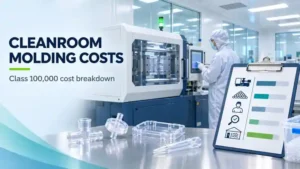
What Is the Real Cost Breakdown for Class 100,000 Cleanroom Molding?

Your supplier sends a "cleanroom" quote that is 25% higher than the standard molding quote, and you can’t tell what the extra money buys. It could be the room, the gowns, the paperwork, or just margin. Without a clear breakdown, you either overpay for years or pick the cheapest molder and risk a failed audit. Below, I’ll break down the cost line by line so you can budget with confidence and question each quote. A Class 100,000 (ISO 8) cleanroom molding program has three cost layers. Construction usually runs about $75–$300 per square foot, and HVAC plus HEPA filtration takes

Read More »
Cost and Procurement Category

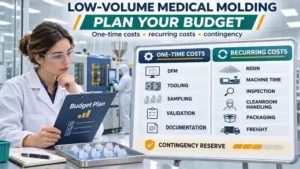
Budgeting for Low Volume Medical Device Molding: How Much Should You Really Plan For?

You have a promising medical device, a clinical build on the calendar, and a budget that has to last. Then the quotes arrive. One molder hides tooling in the piece price. Another leaves out validation. A third looks cheap until a late design change forces tool rework and retesting. Suddenly your "small" run costs twice what you planned. The fix is a budget that breaks out every cost bucket before you send a single RFQ. To budget for low volume medical device molding, split costs into one-time and recurring buckets. One-time costs cover DFM, tooling, sampling, validation (IQ/OQ/PQ), and documentation.

Read More »
Cost and Procurement Category

Cost Factors in Medical Grade Resin Selection: What Really Drives the Price?

You get two resin quotes, and one is 40% cheaper. Procurement loves it. Then that grade needs longer cycles, scraps more parts, and comes with no change-notification commitment. Two years later it gets reformulated, and your team loses months requalifying the device. I have watched this happen more than once. The good news is that once you know where resin costs really come from, you can pick a material that stays affordable for the whole life of your device. The main cost factors in medical grade resin selection are biocompatibility documentation (USP Class VI and ISO 10993 data), sterilization compatibility,

Read More »
Cost and Procurement Category

Mold Lifespan Expectations for Medical Device Production

You approved the tooling quote, validated the process, and launched the product. Eighteen months later, a critical dimension starts to drift. Flash shows up on the parting line. Quality opens a deviation, and you find out the mold needs major repair and then revalidation. That costs months of supply and a lot of money. You can predict most of this if you set mold lifespan expectations before anyone cuts steel. Most high-volume medical device molds are built to SPI Class 101 standards. They use fully hardened, corrosion-resistant tool steel such as S136 or 420 stainless and are rated for more

Read More »
Cost and Procurement Category

How to Estimate Injection Molding Costs for Startups?

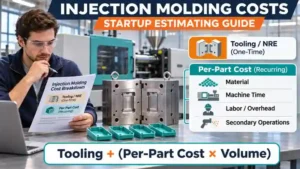
You have a working prototype, a pitch deck, and a launch date. Then the first mold quote arrives, and it is three times what you planned. I see this often with medical startups. A bad estimate does more than hurt your budget. It can delay validation, burn runway, and force a redesign at the worst possible time. The good news is that molding costs follow a predictable logic. Once you know the drivers, you can estimate with confidence. To estimate injection molding costs, split your budget into two parts: one-time costs and recurring costs. Total cost = tooling/NRE + (per-part

Read More »
Cost and Procurement Category

Cost Comparison: Prototype Molding vs 3D Printing for Medical Parts: Which Costs Less?

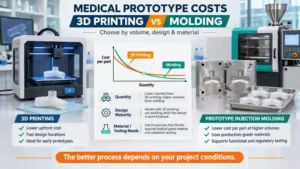
You need medical prototypes fast, and the budget is tight. So you 3D print them. Then a verification test fails because the printed resin cracked after sterilization, and you rebuild parts and repeat the test. Or you buy an aluminum mold too early and pay for four tool changes. Both mistakes are expensive. The fix is to match the process to your volume, design maturity, and validation needs. 3D printing is usually cheaper for medical prototypes from one part up to a few hundred parts, because it needs no tooling. Prototype injection molding needs an aluminum mold that costs about

Read More »
Cost and Procurement Category

What Are the MOQ Requirements for Medical Device Injection Molding?

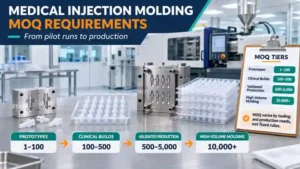
You found a molder you like. The quote looks fair. Then you see the minimum order: 10,000 parts. Your clinical build only needs 300. Now you have two bad options. You can overbuy inventory that may become scrap after a design change, or you can start your supplier search again. I’ve watched many teams lose months at this step. The good news is that medical MOQs are rarely fixed. Once you understand what drives them, you can negotiate them. Medical device injection molding MOQs usually range from 100–500 parts for pilot or clinical builds made with aluminum bridge tooling, 500–5,000

Read More »
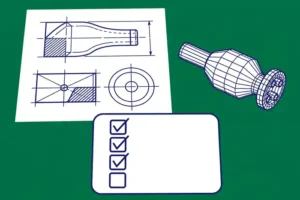
Flat illustration of an engineering RFQ pack with a technical drawing, a wireframe component model and a checklist
Cost and Procurement Category

What Should a Medical Injection Molding RFQ Include to Get an Accurate Quote?

What Should a Medical Injection Molding RFQ Include to Get an Accurate Quote? I have read requests for quotation, known as RFQs, that ask for a price but give a molder nothing to price against. The part is described in one line, the material is named only by a trade name, and the quantities are missing. The quote that comes back is a guess, and the buyer compares guesses as if they were prices. That is how projects start with the wrong tool, the wrong resin, or a schedule nobody can meet. A complete medical injection molding RFQ should include

Read More »
cavitation-medical-mold-tooling-cost
Cost and Procurement Category

How Does Cavitation Affect Medical Mold Tooling Cost?

How Does Cavitation Affect Medical Mold Tooling Cost? Cavitation affects medical mold tooling cost by changing the size, complexity, and documentation burden of the mold, while lowering the cost of each molded part. The right cavity count depends on volume, project stage, and quality requirements. This article explains the main relationships for sourcing and product teams. The discussion applies mainly to non-implant diagnostic, laboratory, and medical equipment components. Key Takeaways Adding cavities generally raises tooling cost, but the increase is usually less than proportional to the number of cavities. Medical programs may add validation, traceability, and inspection effort, which often

Read More »
Production injection mold for medical device components showing cavity and core steel
Cost and Procurement Category

Injection Mold Tooling Cost Breakdown for Medical Devices

A production mold price is the sum of many engineering decisions, not a single number. Each choice about cavities, medical injection mold material, runners, finishing, and documentation adds or removes cost in a different proportion. This guide shows which components and choices carry the most weight in a medical production mold budget. For medical device OEMs, an itemized cost breakdown makes planning more realistic and supplier quotations easier to compare. Key Takeaways Cavity count and steel grade set the base cost of the mold. Hot runners, slides, and surface finish are the main areas where cost moves up or down.

Read More »

Request a Quick Quote

Send your drawings and detailed requirements via:
Email: jerry@ckmold.com

Or fill out the contact form below:

We will contact you within one working day. Please pay attention to the email with the suffix “@ckmold.com”