
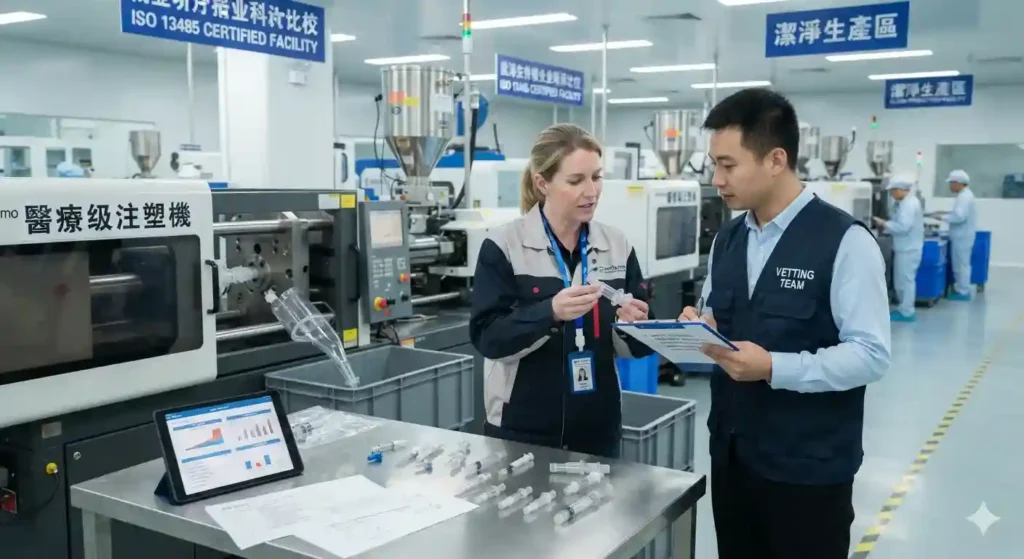
Some buyers may begin assessing Chinese medical injection molding suppliers based on pricing. But honestly, vetting a medical injection mold supplier extends far beyond that1.
To evaluate the legitimacy of your supplier, verify whether the company adheres to a strict regulatory framework, holds relevant certifications, and meets biocompatibility, safety, and consistency standards2.
This guide outlines a detailed process for vetting a Chinese Medical Injection Molding Supplier. So, whether you are a procurement officer, a medical company owner, or a project engineer, this guide has everything you need to get started.
How Does Medical Injection Molding Manufacturing Differ from Standard Injection Molding?
It is important to note that medical injection molding operates on a very different level of responsibility. It is much more demanding compared to general molding. In medical-grade injection molding, ISO 9001 certification isn’t sufficient.
As medical devices are directly associated with patient care and safety, negligence is non-negotiable. So, medical injection molding China companies operate within a strict regulatory framework. They face strict evaluation for ISO compliance and FDA regulations.
So, before you start your official contract, it’s crucial to vet a medical injection molding supplier. Evaluation must not be limited to moulding capabilities. Instead, extend it to include verification of the documentation, the Quality Management System (QMS), factory infrastructure, and more.
How to Vet a Chinese Medical Injection Molding Supplier?
Level 1– Initial business license verification of the Chinese Medical Injection Molding Supplier
First and foremost, verify your supplier’s Chinese business license. It is the foundational documentation issued by the State Administration of Market Regulation in China. It is proof that the company is legal. It contains the company’s identity, scope, and legal standing.
You must ask your supplier to provide details such as the Chinese legal entity name and the Unified Social Credit Code. The best way to verify this information is by using China’s Official National Enterprise Credit Information Publicity System (www.gsxt.gov.cn).
What to check thoroughly?
- Is the company name the same as the one provided?
- Does the unified social credit code match?
- Is the company registered against the same legal representative?
- Is the business scope the same as stated?
- Is the company’s establishment date the same?
- Is the registered capital the same?
- What is the current company status (active/operating)?
If you find the details mismatched on the GSXT record, the license most likely is forged. But to verify, you must ask your supplier rather than assume.
Other verification systems include checking with an electronic business licence App.
Foreign buyers may face some access barriers. This is due to the entire interface being in Chinese, limited accessibility, and others.
Red flags you must not ignore during verification:
- Inconsistency in registered capital
- Invalid unified business social credit code
- Difference in business name
- Different operational start date
Level 2– Validating the Quality Management System and Regulatory Certifications
Medical injection molding is among one of the most tightly regulated manufacturing processes. That’s why you must never ignore this verification step. Always validate that your supplier complies with the FDA’s Quality Management System Regulations (QMSR) and ISO standards. These control pre-market approval and quality management through facility inspection.
As noted above, ISO 9001 is insufficient for medical injection molding suppliers. Here, ISO 13485 compliance is crucial. This is an international standard for a quality management framework for medical device manufacturing.
According to the FDA’s new QMSR updates, effective February 2, 2026, the rule will require manufacturers to incorporate ISO 13485:2016 by reference. This means only the ISO 13485 certification is no longer enough. The manufacturer must also clearly outline and explain how their specific quality system satisfies both the ISO standard and FDA legal rules.
If you are sourcing medical injection molding from China to the USA, Europe, or any other country, you may know that international regulatory bodies like the EU MDR, Canada Health, and the Australian TGA all rely on ISO 13485 for quality management.
Other certifications to verify include:
- ISO 14971 (risk management)
- ISO 10993 (biocompatibility)
- ISO 14644 (Cleanroom compliance)
What to ask when evaluating your supplier’s QSM and regulatory compliance?
- Do you possess ISO 13485 certification?
- Does the certificate scope match your exact production type and operation?
- How do your current standards align with FDA Quality Management System Regulations (QSMR) and international medical standards?
- When was your last registrar and external audit? Can you share the audit summary?
- How has your QMS adapted to the new FDA regulatory updates?
Level 3– Assessing Technical Capability
Verify that the mold tooling will be manufactured in-house or outsourced. In-house is a preferable option. This is because the supplier itself will be accountable for the entire process– from start to end. Outsourcing the design introduces risks and technical gaps that may lead to various issues.
Clearly state your dimensional tolerance requirements. Ask about experience with similar medical-grade products and the company’s technical capabilities. Know about their engineering team and the CAD software they use.
What questions should you ask to assess technical capability?
- Do you have an in-house manufacturing facility?
- Who will design the mold?
- What CAD software do you use?
- Do you have any similar medical injection-molded parts with a similar tolerance level for evaluation?
Level 4– Technical Cleanroom And Infrastructure Assessment
Medical device injection molding needs a clean production facility. But each product requires a different classification system based on intended use. Mostly ISO Class 5 through Class 8 are used in medical injection molding facilities.
To ensure sterility and integrity of your medical injection molding, it is important to assess the supplier’s technical infrastructure and cleanroom facility. If your medical device or component requires a controlled environment, the facility must comply with ISO 14644 cleanroom standards (Class 7 or Class 8).
Additionally, ask your supplier to provide a list of injection molding machines and internal measurement equipment (CMM) used in their facility. Validate the company’s molding capacity to ensure they can handle the production volume.
What questions should I ask to validate the technical infrastructure?
- Does your facility comply with ISO classification for medical devices (ISO Class 7 or 8)?
- How do you monitor environmental sterility, including particulate count, humidity, temperature, and pressure changes?
- How do you maintain the injection moulding machines within the controlled environment?
- What do you verify dimensional tolerance?
Level 5– Evaluation of Validation Protocols (IQ, OQ, PQ)
In the injection molding process, validation is mandatory. This is because the results of the process cannot be fully verified by subsequent inspection and testing. So medical moulding programs usually involve a three-step process validation– installation qualification (IQ), operational qualification (OQ), and performance qualification (PQ).
| Phase | Core Objective | Key Audit Focus Items |
|---|---|---|
| Installation Qualification (IQ) | Verify equipment, wiring, and utilities meet specified design criteria. | • Calibration Records • Utility Verification • Equipment Documentation |
| Operational Qualification (OQ) | Determine the upper and lower process limits and establish the stability window. | • Process Boundary Identification • Verification of window stability under worst-case parameters. • Parameter Window for melt temperature, injection speed, and pack/hold pressures. |
| Performance Qualification (PQ) | Prove long-term process capability and consistency under normal production conditions. | • Multi-Batch Audits • First Article Inspection (FAI) reports via CMM or optical vision systems. |
What questions to ask for evaluating validation protocols?
- Do you follow a structured IQ/OQ/PQ protocol for new molds and machines?
- Can you share process validation documentation for recent past projects?
- What are your procedures for monitoring critical process parameters during routine production runs?
- Who keeps the final validation record?
Level 6– Material Qualification, Traceability and Biocompatibility
Resins like PEEK, Polycarbonate, TPU, and Medical PP are suitable for medical device injection molding. They are specialized, high-quality biocompatible materials that are different from standard commercial materials. So, first, you must verify that your supplier is experienced with the material your part requires.
Secondly, traceability is non-negotiable. Your supplier must be able to provide proof that the material meets regulatory standards. They must provide Lot traceability data and biocompatibility test reports. Additional documentation, such as a Certificate of Conformance (CoC) or a Certificate of Analysis (CoA), can be obtained upon request. These may sometimes be costly and require extra testing and administrative work. So if you want to obtain such documentation, ask your manufacturer beforehand.
You must ensure material compatibility. Also, verify whether the handling protocols align with your program’s regulatory strategy.
What questions to ask for material control?
- Have you previously worked with a specific resin type?
- How do you maintain full material traceability?
- How do you inform your customers about material formulation changes?
- What documentation will you provide to prove that resin meets ISO 10993 and USP Class VI requirements?
Level 7– Engineering Communication, RFQ / DFM Evaluation and sampling
Clear, fast communication and response time matter. Your supplier must understand technical drawing interpretation and communicate clearly.
To evaluate the supplier’s project management, the first indicator is RFQ response time and speed. Reliable suppliers respond within 24 to 48 hours of the initial inquiry.
Additionally, DFM feedback quality can also tell you a lot about the technical depth and project management attitude. Reliable suppliers proactively flag risks in DFM feedback. Some suppliers may not do the same. They may return instant quotes without engineering variations and DFM feedback. This can be one of the initial red flags one may look for.
- Sign an NDA before transferring your CAD files.
Require your supplier to sign an NDA or an NNN agreement before you transfer your CAD files. This will prevent IP theft in China. Prefer China NNN agreement injection molding rather than Western standards.
Ask what the sample rounds– T1, T2, and T3 –are intended to achieve. Understand how the sample validation process will work and how the supplier will deal with defects and manage corrections, in case.
What questions to ask?
- How are CAD files and proprietary medical designs protected on the shop floor?
- What is your process for mold approval?
- What is the standard lead time for sample T1?
- How do you manage corrections?
Level 8– On-site Inspection and Virtual Walkthroughs
Vetting a medical injection molding supplier is incomplete without a factory audit. If it is convenient, you must conduct an on-site audit yourself. If not, a third-party medical audit agency can do a great job.
Additionally, you can schedule a virtual walk-through (planned or impromptu) for inspection. Ultimately, the main purpose is to verify that the written quality management system or provided images match the factory environment.
Level 9– Contractual Protections, Tool Ownership, and Logistics
Intellectual property risks are common. But to manage them wisely is the key. Ask your supplier about contract protections, tool ownership, and logistics.
Clearly discuss that tool ownership rights belong to you. The design file must not be shared with third parties. Establish clear Delivered Duty Paid (DDP) or secure freight forwarding protocols if the tool or parts must be transferred out of China.
What questions to ask your supplier?
- Who owns the mold tooling?
- What are your terms for tooling transfer?
In addition to legal agreements, register your patent under Chinese law.
Executive Summary– Vetting a Medical Injection Molding Supplier Checklist
| Checking Criteria | How to Evaluate? |
|---|---|
| Level 1 – Business License | Verify the company’s identity, scope, unified social credit score, registered capital, establishment date, and company address. |
| Level 2 – QMS & Regs | Validate that your supplier complies with the FDA’s Quality Management System Regulations (QMSR) and ISO standards. Verify third-party audit reports. Also, evaluate whether their QMS is aligned with the new FDA regulatory updates. |
| Level 3 – Technical Capability | Verify in-house manufacturing. Evaluate the technical capability of the supplier by evaluating experience with similar products, dimensional tolerance, engineering team, and CAD software. |
| Level 4 – Cleanroom | Must possess a cleanroom certification based on your product. Daily logs for particulate counts, temperature, and differential pressure (≥10 Pa). |
| Level 5 – Validations | Follow structured IQ/OQ/PQ validation protocols and provide necessary documentation. |
| Level 6 – Materials | Verify their material selection process and whether it passes ISO 10993 and USP Class VI requirements. Provide lot traceability data, CoC, CoA, and biocompatibility test reports. |
| Level 7 – DFM / Eng | Clear communication and fast response with detailed DFM feedback. |
| Level 8 – Inspections | An on-site or visual walkthrough audit must verify that the written quality management system or the provided factory images match the environment. |
| Level 8 – Contracts | Verify buyer’s absolute ownership and exit rights. Establish clear contract terms including IP protection and logistics. |
Red Flags You Must Not Ignore When Vetting A Medical Injection Molding Supplier
- Inaccurate business identity or scope
- Does not comply with ISO 13485; only holds ISO 9001 Certification; overpromising irrelevant certifications.
- Refuses to sign a comprehensive NNN agreement before sharing design files
- No in-house manufacturing of DFM analysis
- Unable to provide raw material certification and traceability documentation
- Slow and unclear communication
- Vague medical injection molding quotation
Conclusion
China has a range of medical injection molding suppliers. But choosing the best one for your business requires careful evaluation. For that, you must have a bit of a technical view and ask logical questions to clear up confusion that can lead to bigger and costlier problems in the future.
Without a doubt, a reliable supplier with good experience will never hesitate to answer your questions clearly and maintain transparency at all levels, leaving you satisfied.
Medmoldpro, with years of experience, understand all your fears. So, our team is ready to serve you with the best medical injection molding service. Our qualified engineering team can get back to you with detailed DFM feedback upon request within 24-48 hours! So, contact us today with your CAD file.
-
"Purchasing Controls", https://www.fda.gov/media/94743/download. The FDA’s guidance on supplier controls recommends that manufacturers evaluate suppliers based on quality system capabilities, regulatory compliance history, and risk management processes, not solely on commercial terms. Evidence role: expert_consensus; source type: government. Supports: Supplier evaluation for medical devices must include quality system assessment beyond cost considerations. Scope note: This represents FDA guidance for U.S. manufacturers and may differ from requirements in other jurisdictions ↩
-
"Use of International Standard ISO 10993-1, "Biological …", https://www.fda.gov/media/142959/download. ISO 13485 specifies quality management system requirements for organizations involved in the design, production, and servicing of medical devices, including requirements for biocompatibility testing and regulatory compliance. Evidence role: general_support; source type: institution. Supports: Medical device manufacturers must comply with quality management system standards and biocompatibility requirements. Scope note: The standard itself does not specifically address injection molding processes, though it applies to manufacturers using such processes ↩