
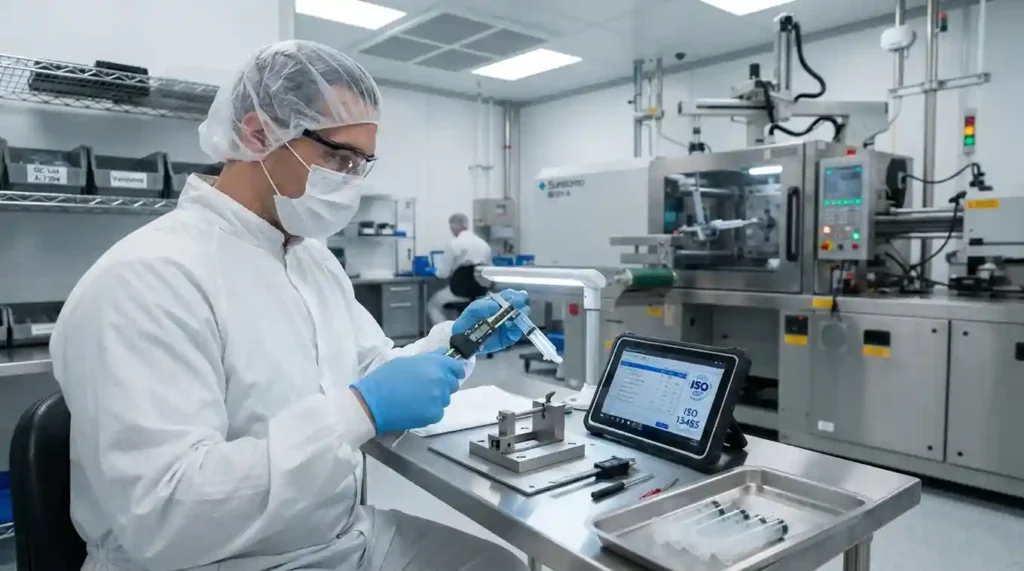
ISO 13485 is the quality management standard most frequently referenced in medical device sourcing, and the question of supplier certification appears early in many requests for quotation. However, the standard is written for medical device organizations, and its effect on injection molding suppliers is largely indirect. This article explains what the standard requires, how those requirements reach mold makers and molders, and how a supplier can be evaluated on a consistent basis.
Key Takeaways
- ISO 13485 sets quality system expectations for medical device organizations. Suppliers are affected mainly through purchasing controls and quality agreements.
- Neither FDA nor the EU MDR generally requires a component supplier to hold an ISO 13485 certificate. However, many device manufacturers require it by contract.
- Typical supplier expectations include process qualification support, material traceability, change notification, and corrective action.
- Certification is one form of evidence. Audits, records, and written agreements often serve a similar purpose for lower-risk components.
- A certificate is best verified by checking the legal entity, site, scope, and expiry date.
What Is ISO 13485, and Who Is It Written For?
ISO 13485 is an international quality management system standard written for organizations involved in the lifecycle of medical devices. The current edition, ISO 13485:2016, is framed around regulatory purposes and applies to organizations of different sizes and types. Suppliers may adopt it voluntarily, and some device manufacturers encourage this.
The standard is a system standard. It does not approve a product, a resin, or a finished device. Therefore, certification should not be confused with market authorization, such as CE marking or FDA clearance. It also differs from biocompatibility testing of materials. A certificate indicates that a certification body has assessed a quality system against the standard, and certificates generally follow a multi-year cycle with periodic surveillance audits.
How Do ISO 13485 Requirements Reach Injection Molding Suppliers?
ISO 13485 requirements reach injection molding suppliers through the outsourcing and purchasing controls that the device manufacturer must apply. The standard requires the manufacturer to monitor and control outsourced processes and to remain responsible for the conformity of the product (clause 4.1.5). When a manufacturer outsources a process that affects product conformity, its controls must include a written quality agreement. In addition, clause 7.4 calls for criteria to evaluate, select, monitor and re-evaluate suppliers, with the level of control proportionate to the risk associated with the device.
In practice, these controls are carried out through supplier questionnaires, audits and written quality agreements. Such agreements commonly address change notification, record retention, nonconformance handling and access for customer or regulatory audits. Thus, the obligations placed on a supplier are mostly contractual rather than imposed directly by the standard.
The depth of control depends on several factors. A component in a fluid path or in patient contact generally receives closer scrutiny than a housing for laboratory equipment. Similarly, the supplier’s role matters. A production molder is typically assessed on process and material controls, whereas a tooling supplier is often assessed on design review, build records, and sample approval.
What Makes Injection Molding a Distinct Case in Medical Supply Chains?
Injection molding is a distinct case because the consistency of a molded part depends on tight control of the material and the tool, together with the settings applied during production. A change in one of these elements can alter dimensions or performance, even when the part drawing remains the same. Therefore, device manufacturers tend to focus on change control and process qualification when assessing molding suppliers. In addition, for a multi-cavity mold, the customer’s inspection or validation plan may call for samples to be identified by cavity so that cavity-to-cavity variation can be investigated.
Which Controls Do Device Manufacturers Typically Expect From Molding Suppliers?
Device manufacturers typically expect documented control of materials, processes, changes, and nonconformities from molding suppliers. The scope varies by customer, yet several themes recur.
- Process qualification. ISO 13485 calls for validation where output cannot be fully verified by inspection. In molding, this generally means documenting a stable process window, which is the range of settings within which acceptable parts are produced, and confirming consistent results across material lots and cavities.
- Material control and traceability. Resin certificates and lot records are generally expected, together with a method for linking a material lot to a production batch. Medical-grade resins are normally sourced from approved suppliers with supporting documentation. However, confirming the suitability of a material for the device, including biocompatibility, generally remains the responsibility of the device manufacturer.
- Change control. Written notification before a change in material, tooling, process, or manufacturing site is widely treated as a core requirement.
- Nonconformance and corrective action. Documented procedures for containing, investigating, and correcting defects are generally requested.
- Measurement and calibration. Inspection equipment is expected to be calibrated, and sample reports are expected to refer to controlled drawings.
- Cleanliness and handling. The need for controlled-environment production depends on the intended use of the device and the sterilization route, both of which are defined by the device manufacturer.
- Record retention. Retention periods are normally defined in the quality agreement and in the applicable regulation.
What Additional Records Are Associated With Mold Manufacturing?
Mold suppliers are typically asked for design review records, certificates for key steel and components, trial sample reports and maintenance history. Tooling ownership, storage and transfer terms are generally agreed in writing, since a mold represents a significant investment and supports continuity of supply. Besides, the identification of cavities and the recording of tool modifications support traceability once production begins.
Tooling suppliers and production molders are often controlled differently. A mold maker may be approved on the basis of documented mold qualification, while a molder producing parts is more likely to face a request for formal certification. However, the approach varies by device manufacturer.
Preventive maintenance records and the count of molding cycles completed by a tool also support predictable performance over its service life. Similarly, repairs or modifications to a tool are typically recorded and communicated, since they may affect part dimensions.
What Do FDA and the EU MDR Say About Supplier Certification?
Neither FDA nor the EU MDR requires a component supplier to hold an ISO 13485 certificate, although both place responsibility for supplier control on the device manufacturer.
United States
The Quality Management System Regulation (QMSR) amends 21 CFR Part 820 and incorporates ISO 13485:2016 by reference. It took effect on 2 February 2026. FDA has stated that certification to ISO 13485 is not required and that a certificate does not exempt a manufacturer from inspection. Component manufacturers are generally outside the scope of the regulation. Nevertheless, FDA retains authority to inspect them, and finished device manufacturers remain responsible for the purchasing controls applied to them.
However, a molded part that is itself a finished device, or a molder performing operations for a finished device manufacturer, may fall within the scope of the regulation for those operations. Therefore, the classification of the product deserves confirmation at the start of each project.
European Union
Regulation (EU) 2017/745 (MDR) requires the manufacturer’s quality management system to address the selection and control of suppliers and subcontractors. In addition, Annex IX provides for notified body audits, including unannounced audits at manufacturers and, where appropriate, at their suppliers or subcontractors. Thus, quality agreements commonly include provisions for audit access.
Other Markets
Requirements in China, Japan, and other markets differ in detail. Therefore, regulatory advice specific to the target market remains advisable for each project.
How Does ISO 13485 Differ From ISO 9001 for a Molding Supplier?
ISO 13485 differs from ISO 9001 mainly through its emphasis on regulatory compliance, documented procedures and traceability, whereas ISO 9001 focuses on customer satisfaction and continual improvement across all industries. The comparison below summarizes the main points of difference.
| Topic | ISO 9001 | ISO 13485 |
|---|---|---|
| Primary focus | Customer satisfaction and continual improvement | Regulatory compliance and device safety |
| Documentation | Flexible, determined by the organization | More prescriptive, with defined procedures and records |
| Risk management | Risk-based thinking across the system | Risk management embedded in product realization and supplier control |
| Process validation | Requires validation and periodic revalidation when later checks cannot verify the process output. | Requires documented validation when later checks cannot or do not verify the output and a defect would only become apparent in use. |
| Traceability | Required where relevant | Defined requirements, with more detail for certain device types |
| Regulatory reporting | Not addressed | Complaint handling, advisory notices and reporting to authorities |
ISO 9001 provides a relevant foundation for process discipline. Nevertheless, it does not replace the additional controls described above, and acceptance of a supplier remains a decision of the device manufacturer.
Is ISO 13485 Certification Always Required for a Molding Supplier?
No, certification is not always required, but many device manufacturers make it a condition of supplier approval, and the position depends on several factors. These include the risk class of the device, the criticality of the component, the role of the supplier, the policy of the customer and the target market.
The table below indicates typical expectations. In many cases, the actual requirement is set by the individual customer and recorded in the quality agreement.
| Supplier role | Typical expectation |
|---|---|
| Production molder of patient-contact or fluid-path components | ISO 13485 certification is frequently required |
| Production molder of housings and other non-contact parts | Certification is often preferred, although audit results and a quality agreement may be accepted |
| Mold maker (tooling only) | Documented mold qualification and build records are more common than certification |
| Prototype and low-volume supplier | Project-based controls, generally agreed in writing |
| Molder producing a finished device or assembly | If the molder manufactures a finished device, it must meet the QMSR requirements applicable to its operations. FDA does not require an ISO 13485 certificate, although a customer may require one. |
How Can an ISO 13485 Certificate Be Verified?
An ISO 13485 certificate can be verified by checking the legal entity, site address, scope statement, issuing body, and expiry date, and by confirming the record with the certification body or through IAF CertSearch. The scope deserves particular attention. A certificate covering design activities at one site does not necessarily cover production at another. In addition, the certification body should hold accreditation from a recognized accreditation body, since certificates from unaccredited bodies are generally given less weight by buyers.
What Should a Supplier Qualification Checklist Include?
A supplier qualification checklist typically covers quality system evidence, process control records, change notification terms, and audit access. The depth of evidence is generally scaled to the risk of the component.
| Area | Evidence typically requested |
|---|---|
| Quality system status | Current certificates with scope, site, and expiry date |
| Quality agreement | Signed terms on responsibilities, change notification, and record access |
| Material control | Resin certificates and lot records linked to production batches |
| Process qualification | Qualification protocol and reports for the molding process |
| Inspection | Measurement plans, sample reports and gauge calibration records |
| Tooling records | Design review, key component certificates, trial reports and maintenance history |
| Traceability | Lot identification method and a sample trace exercise |
| Change control | Written procedure and an example change notice |
| Nonconformance and corrective action | Procedure and a sample record. |
| Audit access | Terms for customer and regulator audits, together with audit history |
Further information on documentation scope is available on the Inspection, Traceability and Change Control page and the Process and Production Documentation page.
Conclusion
Overall, ISO 13485 shapes supplier relationships mainly through the obligations of the device manufacturer, and certification is one of several forms of evidence. Buyers generally benefit from defining required documents, quality agreement terms, and audit access at the request-for-quotation stage.
Submit your Inquiries About Medical Injection Molding Today!
MedMoldPro, operated by C.K. MOLD & ENGINEERING LIMITED, supplies medical injection molds and molded parts. We are ISO 9001 certified and work to project-specific quality agreements, with traceability, process qualification support, and change notification agreed before tooling starts. Send your drawings, resin requirements, expected volumes, and any quality agreement terms for a quote.
Frequently Asked Questions
Is ISO 13485 a product certification?
No, ISO 13485 is a quality management system certification and does not approve a product or material. A certificate reflects an assessment of the organization’s system against the standard. Product-level approval is handled separately through market authorization processes and testing.
Does FDA require injection molding suppliers to hold ISO 13485 certification?
No, FDA does not generally require component suppliers to hold ISO 13485 certification. The QMSR incorporates the standard by reference for finished device manufacturers, and those manufacturers remain responsible for supplier controls. However, individual customers may impose certification as a contractual condition.
Can a supplier with ISO 9001 certification support medical device projects?
In many cases, yes, depending on the requirements of the customer and the risk of the component. Approval often relies on a supplier audit, a quality agreement, and project-specific documentation. On the other hand, some device manufacturers restrict approved suppliers to those holding ISO 13485, and such policies are more common for higher-risk components.
Do expectations differ between a mold maker and a molder?
Yes, expectations generally differ because a mold maker supplies tooling, while a molder supplies production parts. Tooling suppliers are commonly assessed on design review, build records, and sample approval. Molders are more often assessed on process control, material traceability, and certification status.
Does an ISO 13485 certificate replace a supplier audit?
No, a certificate does not generally replace a supplier audit. It provides useful evidence about the quality system, but it does not confirm how a specific process, material, or part is controlled. Device manufacturers therefore often combine certificate review with audits proportionate to risk.
Who is responsible for final medical device compliance?
The legal manufacturer of the medical device remains responsible for final validation, regulatory submissions and market approval. Suppliers contribute documented evidence and controlled processes. Outsourcing does not remove the device manufacturer’s responsibility. A contract manufacturer may also have direct obligations for the finished-device operations it performs.
Disclaimer: This article provides general information and does not constitute regulatory or legal advice.
Last updated: November 2026