
Medical Injection Molding in Mexico vs China vs Southeast Asia
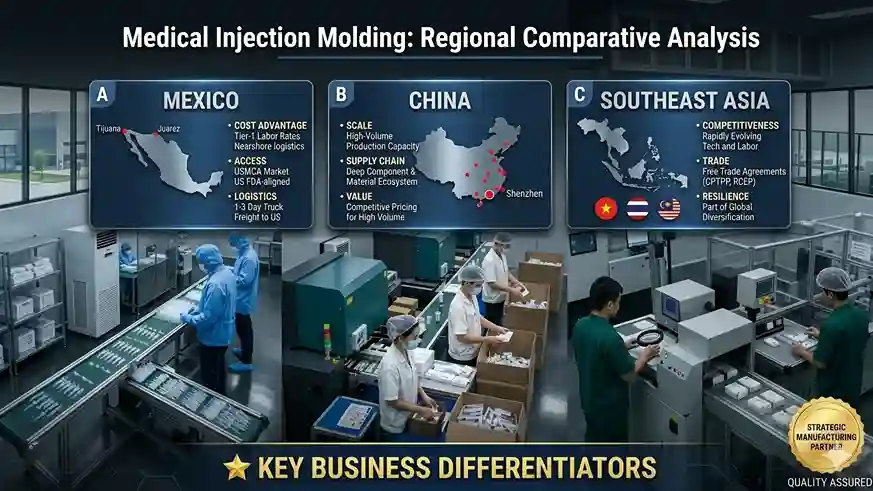
For business expansion, investing in a reliable manufacturer abroad can add value. Mexico, China and Southeast Asia serve as major manufacturing and supplier bases for medical injection molding.
But the harder decision when choosing a supplier is whether to nearshore or offshore. The location is one of the main factors to consider, as it can affect costs, quality, lead times and market responsiveness.
This guide compares Mexico, China, and Southeast Asia across costs, supply chain, infrastructure, engineering capabilities, and other factors, so you can decide which fits your project.
Comparative Analysis– Mexico vs China vs. Southeast Asia for Medical Injection Molding
Cost Analysis
One of the main factors when comparing medical injection molding suppliers is labor wages and expertise. These change with location and primarily contribute to production costs.
Mexico’s labor costs are higher than China’s or Vietnam’s, though still substantially below US levels. Border cities such as Tijuana and Ciudad Juárez are more expensive, while central and southern states are cheaper. But the labor is usually skilled and professional. This makes it a good choice for the technical aspects of medical injection molding production. Things ultimately change as the distance between the US and Mexico is less. It affects overall demand and its access to the Mexican market for parts supplied to the US.
China can offer competitive unit pricing, particularly for higher-volume programs, but the final landed cost depends on tooling, resin, quality requirements, freight, duties, scrap, and inventory. Labor costs also contribute. In major coastal cities like Shenzhen and Guangzhou, wages have risen sharply. But inland provinces and smaller industrial cities remain cheaper than Mexico and much of Southeast Asia. With a vast pool of labor, China also excels in skilled and specialized labor, which improves production quality for complex medical moldings and shortens lead times. High-volume production still benefits from economies of scale.
Southeast Asia is not a single manufacturing market. Malaysia, Thailand, Vietnam, and other countries have different tooling ecosystems, infrastructure, regulations, and supplier capabilities. Therefore, the final evaluation should be performed at the country and supplier level. Vietnam can offer low labor costs, but many factories there import molds and resin, often from China. That adds cost and time, so a low quote can grow once those items are included.
It is always wise to compare the total landed cost, not just the price per part, before manufacturing. For complex, high-volume programs, and for customers selling in Europe, Asia, and other non-US markets, China may be the most cost-effective option, depending on the supplier and project.
Supply Chain And Infrastructure
Mexico has built a solid medical device industry, centered on Baja California, Chihuahua and Juárez, and newer hubs in Guanajuato, Querétaro, and Jalisco. Mexico has become a major supplier of medical devices to the US, with major companies operating there. Speciality medical-grade resins, however, may still come from the US or Asia. Distance is Mexico’s clearest advantage: goods can reach the US by truck or rail in days, while sea freight from China typically takes weeks.
China has the biggest supplier network of the three. Resin producers, colorant suppliers, mold steel suppliers, printing, welding, and assembly shops often sit close to one another.
Sea freight from China to North America takes weeks rather than days. However, China’s large, well-connected port network (Guangzhou, Shenzhen, Shanghai) keeps schedules generally reliable. As a result, design changes and sample rounds can move quickly.
Buyers in neighboring Asian markets may benefit from shorter, cheaper shipping routes. Port congestion can occasionally add delays of up to a week, so plan some buffers.
In Southeast Asia, results vary by country. Malaysia, especially Penang, has a mature manufacturing base. Vietnam is growing quickly but may have fewer local suppliers of medical-grade materials. Thailand offers good plastics experience, though medical-specific experience varies by supplier.
Tooling And Engineering Capabilities
Mexico has moved well beyond basic assembly, too. Many plants now handle micro-molding for surgical tools, laser welding of implants, and precision machining of titanium and cobalt-chrome parts, and many of them run high-quality systems. Even so, molds are often built in the US or Asia and shipped in, and a shortage of specialized engineers limits how fast the industry can grow.
Mold quality drives part quality, and this is where China is strongest. Chinese medical injection molding suppliers have years of experience with multi-cavity and family molds, hot runner systems, micro-molds, and liquid silicone rubber (LSR) tooling, all built to tight medical tolerances. China’s depth of tooling experience makes it a strong choice for complex medical molds.
Suppliers in both Mexico and China are investing in advanced automation, which supports precise tooling and tight tolerances.
Some Malaysian suppliers work to European standards for medical injection-molded components, although advanced mold machining may be limited, and complex multi-cavity designs are sometimes outsourced. Molds for complex medical parts in Vietnam and Thailand may be sourced from China, Japan, or Korea, depending on the supplier and project.
Tooling Lead Time
Tooling lead time varies by mold complexity, supplier capacity, steel availability, validation requirements, and the number of design revisions.
In Mexico, fewer local mold makers means many companies build the mold in the US or China and ship it over. Proximity pays off later, since samples and design changes can travel back and forth in a day or two.
China’s medical injection molding market is highly populated. Many medical mold makers compete on speed, which can shorten lead times for suppliers with strong tooling capacity. On average, a moderately complex medical mold typically takes 6 to 10 weeks.
In Southeast Asia, lead times can be longer where molds are built elsewhere first, as in some Vietnam-based programs, because that adds both build time and shipping time.
Tariffs, Trade Agreements And Regulations
Tariffs are the most volatile part of any sourcing decision, so it helps to see the layers separately.
Tariff treatment cannot be determined from the supplier’s country alone. The importer must confirm the product’s HTS classification, country of origin, entry date, applicable duties, trade-remedy measures, exclusions, and documentation requirements.
Qualifying Mexico-origin goods may receive USMCA treatment only when they satisfy the applicable rules of origin and certification requirements. For products originating in China or Southeast Asia, duties vary by HTS classification and current trade measures. Buyers should verify the applicable rate through the USITC Harmonized Tariff Schedule, current CBP and USTR notices, and a licensed customs broker before calculating landed cost.
Regulation and quality. FDA requirements (and EU MDR for European sales) ultimately rest with the device manufacturer. A good molding partner in any of the three regions supports your documentation, traceability, and validation needs.
ISO 9001 and ISO 14001 certificates are held by many qualified suppliers in China, Mexico, and parts of Southeast Asia, so a certificate alone doesn’t separate one supplier from another. What matters is the certification’s scope and how consistently it is applied on the shop floor.
For medical molding programs, buyers should verify the supplier’s current QMS certificate and scope, material and lot traceability, inspection capability, change-control procedure, validation support, mold ownership terms, and control of subcontractors. ISO 13485 may be an important supplier-qualification criterion, but it should never be assumed without checking that the certificate covers the named manufacturing site and relevant processes.
What does this mean for your landed-cost model? Don’t build one number. Build three: today’s duties, a higher-tariff case, and a lower-tariff case. A supplier location that only works under one scenario is a risk.
Taxes, Incentives And Business Climate
China’s standard corporate tax rate is about 25%, with lower rates in some high-tech zones and regional incentives for medical manufacturers. Buyers should also weigh IP protection and political conditions alongside tax rates.
Mexico’s IMMEX (maquiladora) program lets exporters import raw materials and equipment without paying duties up front. Foreign investment in Mexico has been growing, and the national Plan México lists medical technology as a growth sector.
Malaysia and Vietnam offer tax incentives that often look better than Mexico’s on paper, but the rules may be more complex, change more often, and differ from country to country.
Environmental Standards
Mexico’s SEMARNAT oversees air, water, and waste rules, and US-facing plants generally follow North American regulations.
Environmental standards matter more each year, especially for buyers selling in the US and Europe. China has tightened its rules considerably under programs such as Green Manufacturing, and penalties for violations have grown.
Many reliable manufacturers are incorporating these practices to meet ISO and other international standards for certification and compliance. Additionally, the government supports manufacturers in fulfilling these compliance requirements to obtain certifications.
In Southeast Asia, rules and enforcement vary widely, and typhoons and floods can interrupt production.
Workforce And Productivity
Workforce quality varies by region and by supplier, so treat the following as general tendencies rather than guarantees.
Many Mexican suppliers draw on a young, improving workforce with growing precision skills and a work style close to North American habits. In China, productivity at many suppliers comes from strong technical training, investment in automation and robotics, and a focus on speed and meeting deadlines. In Southeast Asia, Malaysia’s electronics workforce is well-established, while suppliers in Vietnam and Thailand may have fewer workers trained specifically for medical-grade work.
Risks To Plan For
Mexico. Cargo security varies by state, though border cities such as Tijuana and Juárez have long experience and strong protection. Specialized engineers can be hard to find, and the peso can swing.
China. IP protection is the concern buyers raise most, and it can be managed. Sign confidentiality and mold-ownership agreements, keep tooling under your control, and choose a supplier with clear project separation and a track record with Western clients. Tariff exposure for US-bound goods depends on the product and should be built into your landed-cost model.
Southeast Asia. Political and legal stability differ by country. Malaysia is fairly stable, while Vietnam and Thailand have seen unpredictable periods. Dependence on Chinese materials can be a hidden weakness for anyone treating the region as a "China alternative."
The Quick Comparison Table
| Factor | China | Mexico | Southeast Asia |
|---|---|---|---|
| Labor cost | Lowest overall, especially inland. Coastal cities (Shenzhen, Guangzhou) have risen. | Often lower than US levels, but can be higher than China or Vietnam. Border cities cost more; central and southern states may cost less. | Vietnam is low, but imported molds and resin (often from China) add cost and time. |
| Per-part price | Lowest, especially at high volume | May be higher than Asia, partly offset by freight and duty considerations | Quotes can grow once imported items are included |
| Supply chain | Largest network: resin, colorants, mold steel, printing, welding and assembly close together | Solid medical device base (Baja California, Chihuahua, Juárez, Guanajuato, Querétaro, Jalisco). Specialty resins are often imported. | Varies: Malaysia (Penang) is mature, Vietnam has few medical-grade suppliers, Thailand has plastics experience but less medical |
| Shipping to the US | Sea freight, typically weeks | Truck or rail, typically days | Sea freight, typically weeks |
| Tooling capability | Strongest: multi-cavity and family molds, hot runner, micro-molds, LSR | Micro-molding, laser welding, precision machining. Molds often built in the US or Asia. | Malaysia is decent but limited in advanced machining. Vietnam and Thailand molds usually come from China, Japan or Korea. |
| Mold lead time | Fastest: 6-10 weeks for a moderately complex mold | Longer if the mold is built abroad, but samples and changes travel in 1-2 days | Slowest, especially Vietnam |
| Workforce | Strong technical training, heavy automation, speed-focused | Young and improving, North American work style, shortage of specialized engineers | Malaysia is experienced; Vietnam and Thailand have fewer medical-trained workers |
| US tariff exposure | Varies by HTS classification, origin, entry date, and current trade measures. Verify with USITC, CBP, USTR, and a licensed customs broker | USMCA treatment may apply only to qualifying goods that meet rules of origin and certification requirements | Varies by HTS classification and country of origin, plus scrutiny of goods rerouted to hide Chinese origin |
| Tax and incentives | About 25% corporate tax, lower in high-tech zones | IMMEX program, Plan México lists medtech as a growth sector | Malaysia and Vietnam incentives look good on paper but can be complex and change often |
| Environmental rules | Tightened (Green Manufacturing), stronger penalties | SEMARNAT, US-facing plants often follow North American practices | Enforcement varies by country; typhoons and floods can disrupt production |
| Main risks | IP protection (manageable with NDAs and mold-ownership terms), US tariff exposure | Cargo security varies by state, engineer shortage, peso swings | Political and legal stability differ by country; possible hidden dependence on Chinese materials |
TL;DR: Which Region Should You Choose?
Each location has its own strengths and limitations. So, the best option depends mainly on your medical injection molding project requirements– where you sell, how complex your mold is, and how fast you need to move. Compare total landed cost, not just price per part.
Mexico benefits from the USMCA. China’s strength lies in its tooling and engineering expertise, giving the best combination of tooling quality and price for high-volume manufacturing. Southeast Asia can work as a middle option, but it should be evaluated country-by-country and supplier-by-supplier.
Independent of which region you choose, you must:
- Confirm which certifications your project requires (such as ISO 9001 or, where your quality system demands it, ISO 13485), and check each supplier’s certificate scope.
- Ask for a full landed-cost quote covering tooling, freight, duties, and lead time.
- Confirm current US tariff rates for your specific HTS codes before you commit, because they change often.
Not Sure Where Your Project Fits? – Contact MedMoldPro
MedMoldPro, backed by CKMOLD in China, supports non-implant medical, diagnostic, and laboratory plastic components under an ISO 9001:2015-certified quality management system. Services can include DFM, mold design and manufacturing, injection molding, inspection, and project-specific documentation agreed before production. Share your drawings, resin requirements, annual volume, tolerances, and documentation needs for a manufacturability review. Contact us today!
Disclaimer: This article is for general information only and is not legal, customs, or tax advice. Tariff rates and trade rules change frequently. Verify current requirements with a customs professional.
Last Updated: September 2026