
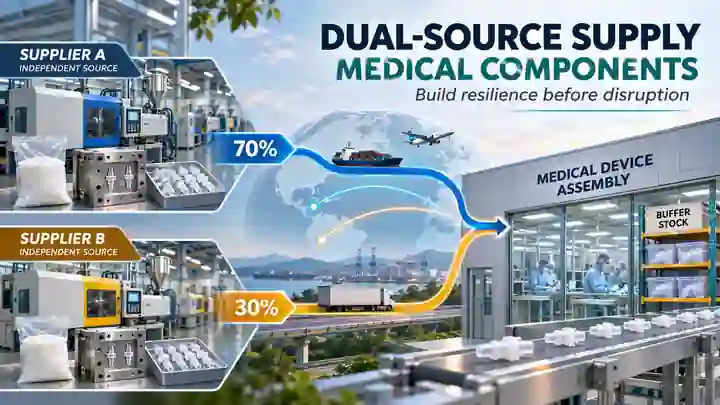
Your device has passed design verification and your launch date is set. Then your only molder calls with bad news. A resin shortage, a damaged mold, or a sterilizer shutdown has stopped production. Every week of delay means backorders, unhappy hospital customers, and hard questions from your quality team. COVID-19 showed how fast single-source supply chains break. Panic buying will not fix this. A dual-source, long-term supply strategy, built before you need it, will.
To build a dual-source and long-term medical supply chain, first rank components by patient and business risk. Qualify at least two suppliers for critical parts, ideally in different regions. Check that they do not share the same resin, sterilizer, or sub-tier vendor. Duplicate and validate tooling under ISO 13485. Give the second source a steady share of volume, such as 70/30. Sign multi-year agreements with change-notification and capacity terms, hold risk-based buffer stock, and judge suppliers on total cost of ownership instead of unit price.
In this guide, I will walk you through the full process. It covers how to decide which parts need a second source, how to duplicate injection molds, how long qualification really takes, and which contract terms protect you. The examples come from real projects I have supported. They involve drug delivery devices, IVD consumables, and medical electronics housings.
Why Is Single Sourcing So Risky for Medical Device Manufacturers?
Single sourcing feels efficient. You manage one supplier, one tool, one quality agreement, and one price. It also gives you one point of failure. If that supplier has a fire, a failed audit, a resin allocation, or a capacity crunch, your production stops. In medical devices, you cannot simply move the job to the next vendor down the street.
Single sourcing is risky because qualifying a replacement medical supplier takes months, not days. You must evaluate, validate, and document every change in supplier, material, or process under ISO 13485 and FDA requirements. If your only source fails, you could face 6 to 18 months of limited supply. COVID-19 made this clear. Shortages of PPE, test consumables, and device components were worst where one supplier or one region served most of the market.
Concentration Risk Is Everywhere
The problem is bigger than one factory. Much of the active pharmaceutical ingredient (API) supply for Western markets comes from a few countries, mainly China and India. Medical plastics follow a similar pattern. A handful of resin producers make most medical-grade polycarbonate, COC/COP, and PEEK. Sterilization capacity is also concentrated. When the EPA and state regulators forced some ethylene oxide (EtO) sterilization sites to close or cut capacity in 2019, the FDA warned about possible device shortages.
What Disruptions Actually Look Like
| Disruption Type | Real-World Example | Typical Recovery Time Without a Second Source |
|---|---|---|
| Resin force majeure | 2021 Texas winter storm hit petrochemical plants | 2–6 months |
| Sterilization capacity loss | EtO facility closures (2019) | 3–12 months |
| Mold damage | Cracked cavity insert or hot runner failure | 4–12 weeks |
| Supplier quality failure | FDA warning letter or failed audit | 6–18 months |
| Demand spike | COVID-19 test kit consumables | 6–24 months |
| Geopolitical / tariffs | Section 301 tariffs, export controls | Ongoing |
I worked with one IVD company that molded its reaction cuvettes at a single site. A hot runner controller failed during a demand peak. Repair took only three weeks. However, the company had no backup tool and only two weeks of stock. It spent the following month on allocation calls with its distributors.
A study on healthcare supply chain resilience published in PMC reached the same conclusion I have seen in practice. Resilience comes from combining supplier relationships, redundancy, and smart inventory. No single tactic is enough on its own. The FDA’s medical device supply chain resources are also worth bookmarking.
Which Medical Device Components Actually Need a Second Source?
Many teams overreact after a shortage and try to dual-source everything. That is expensive. Splitting volume raises unit costs, doubles tooling, and adds audits, validations, and paperwork. Small teams can get buried in supplier management. On the other hand, if you dual-source nothing, one bad week can shut down your line. You need a way to choose.
Dual-source the components where a shortage would harm patients, stop production, or break customer contracts. These are usually patient-contact parts, fluid path components, high-volume disposables, and parts with long lead times. Rank each part by three factors: impact if supply stops, probability of disruption, and time to recover. Parts that score high on all three need a qualified second source. Lower-risk parts can rely on buffer stock or a documented backup plan.
A Simple Segmentation Model
| Segment | Medical Device Examples | Recommended Sourcing Approach |
|---|---|---|
| Critical / patient-contact | Drug delivery fluid path, syringe barrels, IVD reaction wells, catheter hubs | Active dual source, safety stock, contracted capacity |
| High-volume disposables | Pipette tips, specimen cups, luer caps | Dual or regional sourcing, demand forecasting |
| Non-contact structural | Diagnostic equipment housings, battery doors, brackets | Single molder plus backup tool or transfer plan |
| Single-source constrained | Proprietary resins, licensed technology, specialty silicone | Strategic partnership, larger buffer, pre-qualified alternate material |
Score "Time to Recover," Not Just Likelihood
Most risk matrices focus on probability. I prefer to ask one question first: "If this supplier disappeared tomorrow, how many weeks until we have validated parts again?" For a cosmetic housing in ABS, the answer might be 10 weeks. For a drug-contact component in a specialty COC, the answer might be 12 months. Biocompatibility testing and regulatory review drive most of that time.
Use ISO 14971 thinking here. Your supply risk assessment should link to your device risk file. A shortage of a component that controls dose accuracy is a patient safety issue, not just a procurement problem.
Practical Rule of Thumb
Start with the top 10 to 20 parts by risk score. In my experience, that list usually covers more than 80% of your real exposure. Treat the rest with buffer stock and documented contingency plans. Review the list each year, and review it again after every design change.
How Do You Verify True Redundancy Beyond Your Tier 1 Suppliers?
Here is a trap I see often. A company qualifies two molders and believes it is protected. Then the one resin grade both molders use goes on allocation, and both lines stop on the same day. On paper the company had two suppliers. In practice it still depended on a single source.
Verify true redundancy by mapping your supply chain to the second and third tier. For each critical part, list the resin producer and grade, colorant or masterbatch, metal inserts, sterilization site, packaging materials, and key sub-suppliers. If both of your Tier 1 suppliers depend on the same upstream source, you have hidden single-point failures. Fix them with pre-qualified alternate materials, a second sterilizer, or contracts that require sub-tier disclosure.
Where Hidden Single Points of Failure Hide
| Tier 2/3 Dependency | Why It Is Often Shared | How to Reduce Risk |
|---|---|---|
| Medical-grade resin | Your design specifies one exact grade | Pre-qualify an equivalent grade under ISO 10993 |
| Color masterbatch | Molders buy from the same compounder | Require approved alternates in the quality agreement |
| Metal inserts (insert molding) | One machining shop holds the drawing | Qualify a second machining source |
| Sterilization (EtO, gamma, e-beam) | Regional capacity is limited | Validate a second site or a second modality |
| Sterile barrier packaging | Few sources of medical-grade Tyvek and pouches | Qualify an alternate pouch or lid supplier |
| Mold components / hot runners | Proprietary spare parts | Stock critical spares at both molders |
Resin Is the Most Common Blind Spot
Medical-grade resins usually come with change-control commitments. However, producers can still discontinue grades or put them on allocation. If your design history file names a single grade, you will need biocompatibility and performance evidence before you can switch. Plan for this early. Review ISO 10993-1 with your biocompatibility lab and decide which tests an alternate grade would need.
I once supported a wearable device company with two qualified enclosure molders in two countries. During a supply audit, we learned that both molders bought the same custom-matched gray masterbatch from one compounder. We qualified a second color source and added it to the approved supplier list. The whole effort took six weeks. Doing the same work during a shortage would have taken months.
Make Sub-Tier Visibility a Contract Term
Ask your molders to disclose their critical sub-suppliers. They should also notify you before they change any of them. Keep this information in a living supplier map, and review it every quarter.
How Do You Duplicate Injection Molds Without Creating Two Different Parts?
Two molds built from the same CAD file can still produce different parts. Steel shrinks differently. Cooling layouts vary. Machines and dryers behave differently. The second site may struggle to hold the same critical dimensions. Then you discover that "identical" tools have created two slightly different products, each needing its own validation and investigation.
Duplicate injection molds by fixing everything you can control before the steel is cut. Use the same mold design standards, steel grade, gating, cooling layout, venting, and hot runner system at both suppliers. Transfer a scientific molding process sheet, not just machine settings. Use the same CMM programs and gauges, and run measurement correlation between sites. Then validate each mold separately with IQ/OQ/PQ and compare capability on critical-to-quality dimensions.
Choose the Right Tooling Strategy
| Strategy | Cost | Speed to Activate | Best For |
|---|---|---|---|
| Duplicate tools at two molders (active) | High | Immediate | Critical, high-volume disposables |
| Backup tool stored at second molder | Medium-high | 2–6 weeks (requal run) | Critical parts with moderate volume |
| Single tool with documented transfer plan | Low | 2–4 months | Non-critical housings and brackets |
| Prototype/bridge tool as backup | Low-medium | 4–8 weeks | Low-volume or early-launch products |
Engineering Practices That Make Duplication Work
- Own your tools. Your contract should state that you own the molds and can move them.
- Standardize the mold build. Specify the same steel (for example, stainless S136 or Stavax for corrosion resistance) and the same hot runner brand at both sites.
- Design with a wide process window. Good DFM, with uniform walls, balanced filling, and sensible tolerances, makes a part far easier to reproduce at a second site.
- Transfer the process scientifically. Share data from viscosity curves, gate freeze studies, and DOE results. Machine settings alone will not transfer well.
- Correlate measurement systems. Run a gauge R&R and cross-site correlation study. Without it, dimensional differences may come from the metrology, not the parts.
On a drug delivery project, we built two 16-cavity molds for a plunger component. We delayed the second tool by six weeks so lessons from the first T1 trial could go into the second build. That decision saved us a full round of steel changes.
How Long Does It Take to Qualify a Second Medical Molding Supplier?
Most teams underestimate this badly. They assume a second supplier can start within a few weeks. In reality, audits, tool builds, validation, and regulatory assessment can stretch over a year. If you start after a disruption begins, you will spend that year short on parts.
Qualifying a second medical molding supplier usually takes 6 to 18 months. A simple non-contact housing with the same material can be ready in about 6 months. A patient-contact or drug-contact component, especially one that needs new biocompatibility data or a regulatory submission, can take more than 12 months. The main time drivers are the supplier audit, tool build, IQ/OQ/PQ validation, and your regulatory change assessment.
Typical Qualification Timeline
| Step | Typical Duration | Key Output |
|---|---|---|
| Define requirements (specs, volume, surge capacity) | 2–4 weeks | Supplier requirement document |
| Supplier evaluation and QMS audit | 4–8 weeks | Audit report, approved supplier status |
| Quality agreement negotiation | 2–6 weeks | Signed quality agreement |
| Mold build (medical multi-cavity) | 10–20 weeks | T1 samples |
| IQ/OQ/PQ process validation | 6–12 weeks | Validation reports |
| Equivalence testing / biocompatibility (if needed) | 4–24 weeks | Test reports, risk file update |
| Regulatory assessment and filings | 2 weeks to 6+ months | Letter-to-file, 510(k), or notified body notice |
Know Your Regulatory Path
Adding a supplier falls under purchasing controls. That means ISO 13485 clause 7.4 and, in the U.S., 21 CFR Part 820. Under the FDA’s Quality Management System Regulation (QMSR), effective February 2, 2026, ISO 13485:2016 is incorporated by reference. If you already follow ISO 13485, your supplier controls are now more closely aligned with U.S. expectations.
The questions that matter most:
- Does the change affect form, fit, function, or material? If you keep the same material and specifications, a documented assessment is often enough. Use the FDA guidance on deciding when to submit a 510(k) for a change.
- Is the supplier a critical subcontractor under EU MDR? Your notified body may expect to be notified, and it may need to audit the supplier.
- Is a new process validation needed? Yes, at every site. For the method, follow the GHTF/IMDRF process validation guidance.
My advice is simple: start your second-source qualification during design transfer, not after launch.
How Should You Split Volume Between Primary and Secondary Suppliers?
A backup supplier that never gets orders is not a real backup. Its operators forget the part. Its mold sits and corrodes. When you finally need it, it is busy with other customers’ work. Many companies learn this lesson during an emergency, when they discover that their "qualified" second source cannot ship.
Give the secondary supplier a steady, predictable share of volume, usually 70/30 or 80/20. This keeps its process validated, its people trained, and its capacity reserved for you. A 50/50 split maximizes resilience but reduces your volume leverage with each supplier. A standby-only model is cheapest but carries the highest activation risk. Whatever split you choose, require minimum annual production runs and define clear triggers for shifting volume.
Compare the Split Models
| Split Model | Resilience | Unit Cost Impact | Management Effort | Best Fit |
|---|---|---|---|---|
| 50/50 | Highest | Highest | High | Life-critical disposables |
| 70/30 | High | Moderate | Medium | Most critical molded parts |
| 80/20 | Good | Low-moderate | Medium | High-volume, stable demand |
| Qualified standby (0–5%) | Low-moderate | Lowest | Low (until activated) | Non-critical parts with buffer stock |
A Lesson From a "Sleeping" Backup Mold
One client stored a backup mold at a second molder for 18 months without a single run. When their primary supplier hit a capacity crisis, they activated the backup. The cavities showed light corrosion. The process technician who had validated the tool had left the company. The resin dryer settings were undocumented. The "two-week activation" took nine weeks.
How to Keep the Second Source Warm
- Run production at least every quarter, even if the batches are small.
- Track both suppliers on the same scorecard covering yield, on-time delivery, and complaints.
- Define requalification triggers, such as 12 months without production or a machine change.
- Agree in writing on surge capacity, for example, "Supplier B can increase to 100% within 8 weeks."
- Keep lot traceability separate by supplier, so investigations remain clean if a complaint occurs.
The 20% to 30% you place with the second source is not waste. It is the price of a working insurance policy.
What Should a Long-Term Medical Supply Agreement Include?
Many purchase orders are transactional. You negotiate a price, the supplier ships, and the arrangement repeats. However, a supplier with no long-term commitment has little reason to invest in capacity, cleanroom upgrades, or spare tools for your project. During a shortage, it will serve the customers who committed to it first.
A long-term medical supply agreement should combine multi-year volume or capacity commitments with clear quality and resilience terms. The key elements are guaranteed capacity, defined service levels, change-notification rules, tooling ownership and transfer rights, forecast sharing, safety stock commitments, and escalation procedures. Pair it with a separate quality agreement that meets ISO 13485. Together, these give your supplier the financial certainty to invest, and they give you priority when supply gets tight.
Essential Clauses and Why They Matter
| Clause | What It Covers | Why It Protects You |
|---|---|---|
| Capacity reservation | Machine hours or annual volume reserved | Priority during demand spikes |
| Change notification | Advance notice of resin, site, process, or sub-tier changes | Avoids surprise validation failures |
| Tooling ownership and transfer | You own the molds; defined transfer process | Lets you move tools fast if needed |
| Process documentation access | Validated parameters, DOE data, inspection plans | Speeds second-source setup |
| Safety stock commitment | Supplier holds X weeks of finished goods or resin | Buys time during disruptions |
| Last-time-buy / end-of-life notice | 6–12 months notice before discontinuation | Time to qualify alternatives |
| Price mechanism | Resin index-linked pricing, annual review | Reduces disputes and margin squeeze |
| KPIs and escalation | OTD, PPM, CAPA response time, escalation path | Faster problem solving |
Build a Governance Rhythm
Contracts only work if both sides review them regularly. I recommend this cadence:
- Monthly: Supplier scorecards, inventory levels, and open risks.
- Quarterly: Business review, forecast update, dual-source progress, and sub-tier changes.
- Annually: Full critical-part review, stress tests, and contract updates.
- During disruption: Predefined allocation rules and escalation contacts.
According to Deloitte’s medtech supply chain research, shared data and stronger collaboration help companies recover from disruptions faster. In my experience, the best suppliers welcome these structures, because predictability helps them as much as it helps you.
How Much Buffer Inventory Do You Need Alongside Dual Sourcing?
Lean, just-in-time manufacturing looks great on a balance sheet until something breaks. With only a few days of stock, any delay turns into a stockout. Holding too much inventory creates its own problems, including tied-up cash, expired sterile products, and obsolete parts after design changes. You need a deliberate balance.
Set buffer inventory by component criticality, supplier lead time, demand variability, and shelf life. Critical single-source parts often need 8 to 16 weeks of stock. Dual-sourced critical parts may need 4 to 8 weeks. Non-critical parts can run leaner. For long-lead materials, holding a resin buffer is often cheaper and more flexible than holding finished goods. Inventory is a bridge that buys time while you recover. It cannot replace supplier diversification.
Suggested Buffer Levels by Segment
| Component Segment | Dual-Sourced? | Suggested Buffer | Notes |
|---|---|---|---|
| Critical, single-source | No | 8–16 weeks | Highest priority to dual-source |
| Critical, dual-sourced | Yes | 4–8 weeks | Covers activation time for volume shift |
| High-volume disposable | Yes | 3–6 weeks | Watch sterile shelf life |
| Non-critical housing | No | 2–4 weeks + tool transfer plan | Low patient risk |
| Specialty resin (raw material) | Often no | 3–6 months of resin | Resin stores well if handled correctly |
Smart Ways to Hold Buffer Stock
- Stock resin, not just parts. Medical-grade resin in sealed packaging usually stores well. Holding it protects you from allocation and avoids sterile shelf-life limits.
- Use vendor-managed inventory (VMI) or consignment. Your molder holds the stock, and you pay when you use it.
- Split buffer by location. Keep some stock near your assembly site and some at the supplier.
- Track days-on-hand weekly. Set alarm thresholds that trigger a review before stock gets critical.
- Stress-test scenarios. Ask what happens with a port delay, a supplier bankruptcy, a recall, a new tariff, or a 3x demand spike. RSM’s healthcare supply chain insights offer useful scenario-planning ideas.
One point people often miss is that sterile finished goods have expiration dates. Before you build a large sterile buffer, check your validated shelf life and your FIFO discipline.
How Do You Calculate Total Cost of Ownership Instead of Unit Price?
Procurement teams are often measured on unit price savings. So the lowest quote wins, even when that supplier is single-site, far away, and thin on capacity. Then a stockout hits. The cost shows up in other budgets, such as expedited freight, line downtime, backorders, and lost hospital contracts. Nobody connects those costs back to the "cheap" part.
Calculate total cost of ownership (TCO) by adding every cost tied to a supplier decision. Include unit price, tooling amortization, qualification and validation, freight and tariffs, inventory carrying cost, quality costs, and the expected cost of supply disruptions. A dual-source strategy may raise unit cost by 3% to 10%. Avoiding just one stockout can easily save more than that. Make supply reliability a formal scoring factor in every sourcing decision.
TCO Elements to Include
| Cost Element | Often Ignored? | Example |
|---|---|---|
| Unit price | No | $0.36 vs. $0.42 per part |
| Tooling amortization | Sometimes | Second 16-cavity mold: $85,000 |
| Qualification and validation | Often | Audits, IQ/OQ/PQ, testing: $30,000–$80,000 |
| Freight, duties, tariffs | Sometimes | Air freight during shortages, Section 301 tariffs |
| Inventory carrying cost | Often | 15–25% of inventory value per year |
| Quality costs | Often | Inspection, NCRs, CAPAs, complaints |
| Disruption cost | Almost always | Line stoppage, backorders, lost contracts |
A Simple Worked Example
A client buys 2 million IVD consumable parts per year. Supplier A quotes $0.36 per part. A dual-source setup with Supplier B averages $0.42 per part. The difference is $120,000 per year, plus about $110,000 in one-time tooling and qualification costs.
Now consider the downside. A single 6-week stockout would have cost this client roughly $900,000 in lost sales. It would also have put a key distributor contract at risk. Even if that happens only once every five years, the expected annual cost is about $180,000. On that basis alone, dual sourcing pays for itself, before you count contract and reputation risk.
My recommendation is to present this calculation to finance and leadership before any sourcing decision. Use numbers, not fear. Most executives will approve resilience spending once they see a clear disruption cost.
What Does a 90-Day Plan to Start Dual Sourcing Look Like?
All of this can feel like a huge project. Your team is already busy with launches, CAPAs, and audits, so the supply chain work keeps sliding to "next quarter." Then a disruption hits, and you are forced to do it all at once, under pressure, with no leverage. A structured 90-day plan breaks that cycle.
A practical 90-day dual-sourcing plan has three phases. In days 1–30, build your critical-part list and map suppliers down to Tier 2 and Tier 3. In days 31–60, rank the risks, pick 10 to 20 dual-source candidates, and start supplier evaluations. In days 61–90, negotiate long-term agreements, set buffer stock policies, and document activation triggers. Tool builds and validation then run in parallel over the following months.
The 90-Day Roadmap
| Phase | Key Actions | Deliverables |
|---|---|---|
| Days 1–30: Map | List critical parts; map resin, inserts, sterilization, packaging; find shared dependencies | Critical-part register, multi-tier supplier map |
| Days 31–60: Prioritize | Score impact, probability, and time-to-recover; shortlist suppliers; start audits | Ranked risk list, supplier shortlist, audit plan |
| Days 61–90: Commit | Negotiate supply and quality agreements; set buffer levels; define triggers and escalation | Signed agreements, inventory policy, contingency playbook |
| Months 4–12: Execute | Build duplicate tools, run IQ/OQ/PQ, complete regulatory assessments, start volume split | Validated second source in production |
Who Should Own It?
Assign a single owner. This is usually the supply chain manager or program manager. Build a small cross-functional team of quality, regulatory, R&D, and procurement. Supply risk is not only procurement’s job. Regulatory decides whether a filing is needed. Quality owns validation. R&D decides whether an alternate material is acceptable.
Common Mistakes to Avoid
- Starting qualification after the disruption instead of before it.
- Qualifying two molders that share one resin source or one sterilizer.
- Giving the backup supplier zero volume.
- Choosing suppliers on unit price alone.
- Skipping measurement correlation between sites.
The MedDeviceGuide supply chain risk management guide is a helpful companion checklist. If you want a second set of eyes on your plan, the team at MedMoldPro can review your critical parts, DFM, and tooling strategy for dual-source readiness.
Conclusion
A resilient medical supply chain takes planning, not luck. Rank parts by risk, verify redundancy down to Tier 3, duplicate and validate tooling carefully, keep your second source active, and lock in long-term agreements. Use buffer stock wisely and judge suppliers on total cost of ownership. Start your 90-day plan this month. Need help with dual-source molding or DFM? Contact MedMoldPro to send your drawings for a free review.