
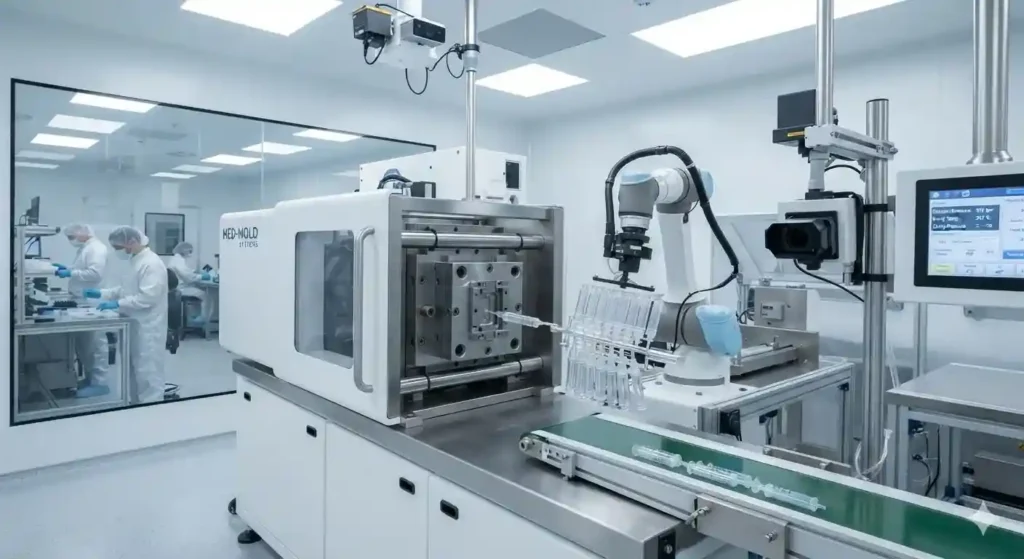
China can offer EU medical device companies competitive tooling costs, experienced mold engineering and scalable injection molding capacity. However, successful sourcing depends on more than price, factory size or quoted lead time.
Buyers must verify that the supplier’s quality-system scope matches the project, define regulatory and quality responsibilities, control materials and manufacturing changes, and document tooling and intellectual property ownership.
This guide explains seven areas that EU medical device companies should evaluate when sourcing injection molds or molded medical components from China, along with practical controls to reduce associated risks.
Why Supplier Quality Controls Matter
A McKinsey study estimated that the medical device industry’s direct cost of quality represented approximately 6.8% to 9.4% of industry sales. Based on annual industry sales of about US$380 billion at the time of the study, this equated to approximately US$26 billion to US$36 billion per year. However, this figure included prevention and appraisal costs as well as costs arising from internal and external quality failures. It should therefore not be described entirely as losses caused by poor manufacturing.
Although industry-wide figures cannot predict the outcome of an individual sourcing project, they demonstrate why effective supplier qualification, process control and change management are commercially important.
Effects of Undetected Hidden Risks When Sourcing from China
During the initial phase, buyers focus only on superficial vetting, such as lower prices and large-scale factories. And that’s where they miss hidden vulnerabilities in suppliers’ quality management systems.
Consequently, the fallout of inadequate vetting extends far beyond simple balance-sheet losses. In the medical device field, an unidentified supplier risk quickly snowballs into delayed product launches, failed regulatory audits, costly recalls, and a permanent loss of trust among investors and healthcare providers.
To avoid these major issues, you must thoroughly vet Chinese medical injection molding suppliers. For that, understanding how to identify and mitigate the hidden risks is important.
What Changes When the Supply Chain Extends Outside the EU?
The technical and regulatory requirements applicable to a finished medical device do not automatically become stricter because a mold or component is sourced from China. However, an international supply chain can introduce additional practical considerations, including remote supplier oversight, communication across time zones, access to production records, material traceability, change control, tooling transfer and longer corrective-action lead times.
The legal manufacturer remains responsible for ensuring that the finished device complies with the applicable requirements of the EU Medical Device Regulation. Importers, authorised representatives and distributors have separate obligations according to their respective roles. These responsibilities should be supported by clearly defined contractual and quality arrangements with the injection molding supplier.
Hidden Risks When Sourcing Injection Molding From China To EU Market
Each of the hidden risks discussed below has a distinct impact. It can ultimately damage your budget and delivery time. Here are the seven potential risks associated with sourcing injection molding from China for the EU market.
1- Quality-System Certification and Scope Gaps
ISO 13485 is the internationally recognized quality management system standard for organizations involved in the medical device supply chain. Although the use of harmonized standards under EU medical device legislation is generally voluntary, many medical device OEMs contractually require critical suppliers to operate under an ISO 13485-certified quality system.
Certification requirements should be determined by the supplier’s role, the device classification, the criticality of the molded component, and the customer’s regulatory strategy. A tooling supplier or non-critical component manufacturer is not automatically non-compliant simply because it holds ISO 9001 rather than ISO 13485.
Buyers should verify the exact legal entity, manufacturing address, certificate validity, certification body, accreditation and scope of certification. The scope should cover the actual processes being purchased, such as injection molding, assembly or medical device component manufacturing. A valid certificate is an important starting point, but it does not replace a process audit or project-specific supplier qualification.
2- Misalignment with Applicable EU Requirements
A supplier’s internal specifications or local manufacturing standards may not address every requirement applicable to the finished device in the EU market. The buyer should identify the applicable requirements and communicate them through approved drawings, material specifications, Quality Agreements, inspection standards and validation plans.
Applicable EU requirements should be determined according to the finished product and its intended use.
-
CE marking generally applies to a product placed on the EU market as a medical device; an ordinary custom-molded component is not automatically required to carry separate CE marking simply because it will be incorporated into a medical device.
-
RoHS primarily restricts hazardous substances in electrical and electronic equipment.
-
REACH addresses chemicals and certain obligations relating to substances, mixtures and articles.
Their applicability should be evaluated separately rather than presented as interchangeable medical-device standards.
3- Unclear Regulatory and Quality Responsibilities
Responsibilities under the EU Medical Device Regulation depend on each party’s role. The legal manufacturer—the company that places the device on the market under its name or trademark—must ensure that the device is designed and manufactured in accordance with the MDR.
An EU importer has separate obligations, including verifying CE marking, the EU Declaration of Conformity, manufacturer identification, authorised representative information, labelling and UDI requirements where applicable.
A Chinese injection molder is normally a contract supplier rather than the legal manufacturer of the finished medical device. Its responsibilities should be controlled through supplier qualification, technical specifications, a Quality Agreement, approved process documentation and written change-control requirements. Clearly allocating these responsibilities helps prevent gaps in supplier oversight, technical documentation, change approval and post-production traceability.
4- Material, Biocompatibility and Cleanroom Requirements
Material control, biological safety and contamination control are related but separate subjects.
Medical-grade resin documentation can provide useful supporting information, but resin data alone does not demonstrate the biological safety of the finished device.
Biological evaluation should be performed using a risk-based approach that considers the finished device, intended use, type and duration of body contact, additives, colorants, molding conditions, cleaning, packaging and sterilization where applicable.
-
ISO 10993-5 addresses in vitro cytotoxicity testing.
-
ISO 10993-10:2021 addresses skin sensitization.
-
ISO 10993-23 addresses irritation testing.
Cleanroom requirements should be determined according to the component’s intended use and contamination risk. ISO 14644 classifies cleanrooms primarily by airborne particle concentration; it does not mean that the room or molded product is sterile. Not every medical plastic component requires cleanroom molding.
Buyers should specify the approved resin manufacturer and grade, permitted colorants or additives, regrind policy, material certification requirements, lot traceability requirements, and whether a specific cleanroom class is required.
5- Unapproved Material or Process Changes
Another sourcing risk is an undocumented change to the approved resin grade, colorant, additive, regrind percentage, molding machine, mold configuration, cavity, manufacturing location or validated process window.
These risks should be controlled through an approved material list, material CoA or CoC requirements, resin lot traceability, a no-substitution clause, and a formal Engineering Change Order process.
The supplier should obtain written customer approval before making any change that could affect product fit, function, appearance, biocompatibility, traceability or regulatory documentation.
6- EU IPI Public Procurement Restrictions
Commission Implementing Regulation (EU) 2025/1197 applies to specified EU public procurement procedures for medical devices with an estimated value of €5 million or more, net of VAT. It does not apply to ordinary private sourcing arrangements between an EU medical device OEM and a Chinese injection molding supplier.
For covered public procurement procedures, tenders submitted by economic operators originating in China are excluded. Successful tenderers are also required to ensure that covered goods or services originating in China do not represent more than 50% of the total contract value during contract execution.
This should not be interpreted as an automatic ban based on the value of individual Chinese molded components. Product origin is determined under the applicable rules of origin and cannot be established simply by adding together the purchase prices of individual components.
EU companies participating in covered public tenders should assess the regulation’s applicability with qualified procurement or legal advisers and retain appropriate origin and supply-chain documentation.
7- Intellectual Property and Tooling Custody
Tool ownership must be clearly defined before the tooling order is placed. The contract should specify whether the customer owns the complete dedicated mold, including the mold base, core and cavity inserts, slides, lifters, ejector system, cooling components, and hot-runner system, or only the specified customer-funded inserts.
The agreement should also cover tool identification, permitted use, storage, preventive maintenance, maintenance records, access for inspection, restrictions on producing parts for third parties, transfer conditions, CAD data, mold drawings, spare components, hot-runner documentation, export packaging and transfer costs.
An NDA, NNN agreement or other IP agreement should not be presented as a universal solution. The appropriate confidentiality, non-use, intellectual property, and tooling ownership provisions should be prepared in accordance with applicable law and reviewed by qualified legal counsel.
Mitigating Risk at Each Sourcing Stage
With the core risks identified, the following section outlines key controls categorized by project phase.
| Stage | Key controls |
|---|---|
| 1. Before supplier nomination | Verify the legal entity and actual manufacturing site; confirm certificate validity and scope; audit relevant processes; identify subcontracted operations; and agree on confidentiality and data-security requirements. |
| 2. Before tool cutting | Complete DFM; define critical-to-quality dimensions and cosmetic requirements; approve the resin, grade, colorant and shrinkage assumptions; agree on mold ownership and transfer terms; and establish validation, inspection and engineering-change procedures. |
| 3. Before production approval | Define responsibility for IQ/OQ/PQ where required; approve the molding process window; confirm gauges, measurement methods and acceptance criteria; complete first-article or sample approval; and approve packaging, cleanliness and traceability requirements. |
| 4. During routine production | Maintain material CoA/CoC and lot traceability; prevent unauthorized material substitution or regrind; follow the approved control and sampling plans; document deviations and corrective actions; and obtain written approval before material, tooling or process changes. |
| 5. Before shipment | Complete final inspection and release; verify batch and material traceability; confirm packaging and labelling; and provide the agreed inspection reports and quality records. |
Takeaway
Sourcing injection molds and medical device components from China can offer meaningful cost, capacity and lead-time advantages, but these benefits depend on disciplined supplier management.
Buyers can reduce sourcing risk by verifying the supplier’s actual quality-system scope, defining regulatory and contractual responsibilities, approving materials and process requirements, maintaining batch traceability, controlling engineering changes and documenting complete tooling ownership.
A capable supplier should be able to support these controls with objective evidence rather than general marketing claims.
Discuss Your Medical Molding Project
MedMoldPro supports medical device teams with DFM, injection mold development, controlled material selection, process documentation, inspection and formal engineering change control.
To receive a project-specific manufacturing review, share your CAD files, expected annual volume, specified resin, intended application and any regulatory, validation, documentation or cleanroom requirements.