
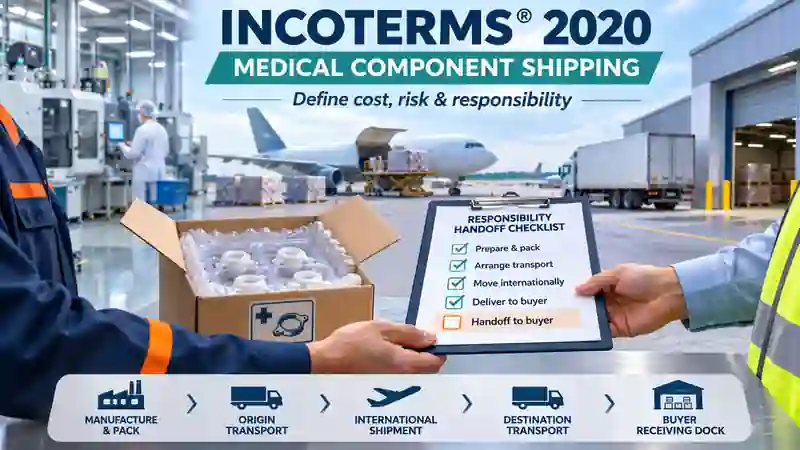
Your molded parts pass inspection and your forwarder picks them up. Then a carton of IVD cartridges arrives crushed, and nobody agrees on who pays. Or customs holds the shipment because the seller tried to act as importer without the right registrations. I have seen both. Most of these disputes trace back to one line in the purchase order: the Incoterm. Choose it carefully and you control cost, risk, and compliance from the molding floor to your dock.
For most international medical component shipments, FCA (Free Carrier) is the safest default. DAP (Delivered at Place) and CIP (Carriage and Insurance Paid To) are strong alternatives. These Incoterms® 2020 rules work for air, sea, and courier freight. They also keep import clearance, duties, and destination regulatory obligations with the buyer, who usually holds the FDA or EU MDR importer role. Avoid DDP unless the seller can legally act as importer of record. Avoid EXW, FOB, and CIF for containerized or air-freighted parts. Always state the rule, a precise named place, and the version.
Choosing an Incoterm is not just a purchasing decision. It affects your landed cost, your customs value, your insurance coverage, and even who carries regulatory liability at the border. Below, I break down each rule in plain language. I also share the mistakes I see most often with medical device and IVD buyers, plus contract wording you can copy into your next PO.
What Are Incoterms and What Do They Actually Control?
Many engineering teams treat Incoterms as a logistics detail. Purchasing picks "FOB" because the last supplier used it. Then a claim comes in. Only then does the team learn that Incoterms say nothing about who owns the goods, when payment is due, or who is liable for a bad lot. That gap can cost weeks of argument and real money.
Incoterms® are standard trade rules published by the International Chamber of Commerce (ICC). The current version, Incoterms® 2020, has 11 rules. Each rule defines three things: where the seller delivers, when risk passes to the buyer, and who pays which costs. Incoterms do not govern ownership transfer, payment terms, product quality, or remedies for breach. Those belong in your supply agreement and quality agreement.
I explain Incoterms to engineers this way: they are the interface specification for logistics. A drawing tells the molder what to make. An Incoterm tells both sides where the handoff happens and who pays for each step.
The 11 Incoterms® 2020 Rules at a Glance
| Rule | Full Name | Transport Mode | Where Risk Transfers to Buyer | Import Clearance |
|---|---|---|---|---|
| EXW | Ex Works | Any | Goods made available at seller’s premises (not loaded) | Buyer |
| FCA | Free Carrier | Any | Goods handed to buyer’s carrier at the named place | Buyer |
| CPT | Carriage Paid To | Any | Goods handed to the first carrier (seller pays freight) | Buyer |
| CIP | Carriage and Insurance Paid To | Any | Goods handed to the first carrier (seller pays freight and all-risk insurance) | Buyer |
| DAP | Delivered at Place | Any | Goods arrive at named destination, ready for unloading | Buyer |
| DPU | Delivered at Place Unloaded | Any | Goods unloaded at named destination | Buyer |
| DDP | Delivered Duty Paid | Any | Goods arrive import-cleared, ready for unloading | Seller |
| FAS | Free Alongside Ship | Sea/inland waterway only | Goods placed alongside the vessel | Buyer |
| FOB | Free on Board | Sea/inland waterway only | Goods loaded on board the vessel | Buyer |
| CFR | Cost and Freight | Sea/inland waterway only | Goods loaded on board (seller pays freight) | Buyer |
| CIF | Cost, Insurance and Freight | Sea/inland waterway only | Goods loaded on board (seller pays freight and minimum insurance) | Buyer |
The U.S. International Trade Administration also has a useful summary on its Know Your Incoterms page.
What Incoterms Do Not Cover
Incoterms leave several things out:
- Ownership (title). Title transfer is set by your contract and governing law.
- Payment terms. Net 30, T/T deposit, or letter of credit must be defined separately.
- Product conformity. Dimensional specs, lot acceptance, and nonconformance handling live in your quality agreement.
- Breach remedies. Late delivery penalties and rejection rights come from the contract.
A few years ago, a U.S. client assumed "FOB Shenzhen" meant they owned the parts once loaded. Their supplier’s contract said title passed only after full payment. When the supplier went into financial trouble, the goods sat in limbo. Incoterms were never designed to solve that problem.
Which Incoterms Work for Air Freight, Sea Freight, and Courier?
I still see "FOB Shenzhen" printed on air waybills for catheter hubs and diagnostic cartridges. It looks harmless. But FOB is a sea-only rule. If the shipment flies, there is no vessel and no "on board" moment. If something goes wrong, the contract points to a risk transfer point that never existed. That invites disputes nobody can win cleanly.
Seven Incoterms® 2020 rules work for any transport mode: EXW, FCA, CPT, CIP, DAP, DPU, and DDP. Four rules apply only to sea and inland waterway transport: FAS, FOB, CFR, and CIF. Most medical components ship by air, courier, or containerized sea freight. For those, use FCA instead of FOB, CPT instead of CFR, and CIP instead of CIF. The "any mode" rules match the real handover point at a warehouse or terminal.
Why FOB Fails for Containerized Medical Components
Here is the hidden problem with FOB in container shipping. Your molder usually delivers sealed cartons or a loaded container to the forwarder’s warehouse or the container yard. That often happens three to seven days before the container is lifted onto the ship.
Under FOB, risk stays with the seller until the goods are on board. During those days, the seller no longer controls the cargo but still carries the risk. If a pallet is damaged at the terminal, both sides will argue about where it happened.
| Factor | FOB (Sea Only) | FCA (Any Mode) |
|---|---|---|
| Risk transfer point | On board the vessel | When handed to the buyer’s carrier at the named place |
| Matches container handover? | No, the gap can be days | Yes |
| Works for air and courier? | No | Yes |
| Letter of credit support | Standard on-board bill of lading | Incoterms® 2020 allows parties to agree the buyer’s carrier issues an on-board bill of lading to the seller |
| Recommended for medical components? | Only for breakbulk or bulk cargo loaded directly to the ship | Yes, as a default |
Courier Shipments for Prototypes and Samples
For T1 samples, FAI parts, and small pilot lots, most buyers use express couriers like DHL, FedEx, or UPS. Couriers often offer "duties and taxes paid" billing. That is convenient, but it can quietly turn your shipment into a DDP-style arrangement. The shipper may then appear as the responsible party at import.
My recommendation: for samples, use DAP with the buyer’s courier account billed for duties. Or use FCA with the buyer’s own courier account. That keeps import responsibility with the buyer’s team, which is usually the correct party for medical products.
Why Is FCA the Best Default for Medical Components (and Why Not EXW)?
EXW looks attractive to buyers because the price is the lowest. The seller simply makes goods available at the factory door. But then the buyer must handle export clearance in the seller’s country. In China, that usually requires a locally registered exporter. Foreign buyers often cannot do it legally in their own name. Shipments stall, and the "cheap" term becomes expensive.
FCA is the best default for most medical component buyers. Under FCA, the seller clears export, packs the goods, and hands them to the buyer’s nominated carrier at a named place. If that place is the seller’s premises, the seller also loads the truck. The buyer controls main freight, insurance, import clearance, and destination regulatory steps. This split matches who actually holds the export and import licenses.
EXW vs FCA: A Practical Comparison
| Responsibility | EXW | FCA (Seller’s Premises) |
|---|---|---|
| Export customs declaration | Buyer | Seller |
| Loading onto pickup truck | Buyer (seller has no obligation) | Seller |
| Export documents (packing list, invoice, declaration) | Buyer arranges, seller only assists | Seller provides |
| Seller’s export VAT rebate (China) | Often lost if seller is not the declared exporter | Preserved |
| Risk transfer | When goods are made available | When goods are loaded on buyer’s vehicle |
| Typical problems | Forwarder cannot clear export, loading damage disputes | Few, if the named place is precise |
Why FCA Fits Medical Supply Chains
Most medical device companies already have a preferred forwarder and a customs broker. They also hold the registrations needed at import. FCA lets them keep those relationships while the molder handles everything it is best positioned to do.
At our facility, an FCA shipment usually works like this:
- The buyer nominates a forwarder and confirms the pickup window.
- We complete final inspection and release the lot with a Certificate of Conformance.
- Parts are packed to the agreed packaging specification, often double-bagged inside labeled cartons.
- We file the export declaration.
- The forwarder’s truck arrives, and we load and seal it.
- Risk transfers at that moment. We send the commercial invoice, packing list, and lot documentation.
Watch the Named Place
FCA only works if the named place is exact. "FCA Shenzhen" is too vague. Is it the factory, the forwarder’s warehouse, or the airport? Each location changes who pays local trucking and who carries risk during that leg. Write the full address. If you work with an medical injection molding partner, they should propose this wording in their quotation without being asked.
When Should You Choose CIP or DAP Instead of FCA?
Not every buyer has a strong forwarder. Startups and smaller IVD companies often want the supplier to handle international freight. So they ask for CIF or CPT. Then a high-value shipment of molded microfluidic chips is damaged in transit. The buyer learns that risk had already passed at origin. They also learn the seller’s insurance covered almost nothing.
Choose CIP when you want the seller to arrange freight and insurance across any transport mode. Incoterms® 2020 requires CIP sellers to buy all-risk cover (Institute Cargo Clauses A) for at least 110% of the contract value. CIF only requires minimum cover (Clauses C). Choose DAP when you want the seller to carry transit risk all the way to your named destination while you keep import clearance and regulatory responsibility.
CIP vs CIF: Why Insurance Coverage Matters
High-value medical components are easy to damage and hard to replace. One lot of precision drug delivery parts can represent weeks of molding time and a full validated production run. Minimum coverage is rarely enough.
| Rule | Transport Mode | Required Insurance | Practical Coverage |
|---|---|---|---|
| CIF | Sea only | Institute Cargo Clauses C | Major casualties only (fire, sinking, collision, and similar events) |
| CIP | Any mode | Institute Cargo Clauses A | All risks, subject to listed exclusions |
| CPT | Any mode | None required | Buyer must insure from the handover point |
| DAP / DPU | Any mode | Not required, but seller bears transit risk | Seller usually insures to protect itself |
Two cautions apply. First, under CIP, risk still transfers when the goods reach the first carrier. The seller pays freight, but you carry the risk. The insurance is there to protect you. Second, even Clauses A excludes some losses, such as those caused by delay or insufficient packing. If your parts are humidity-sensitive or temperature-sensitive, ask your insurer about specific extensions.
When DAP Makes Sense
DAP is my second most common recommendation. The seller arranges freight and carries the risk until the goods arrive at your named facility, ready for unloading. You handle import clearance, duties, and taxes. You also handle FDA or EU import requirements.
DAP works well when:
- You do not have a forwarder you trust.
- You want a single delivered price for budgeting.
- You want the supplier to own transit damage claims.
DPU is similar. The difference is that the seller must also unload at the destination. Use it only if the seller can truly arrange unloading at your site, which is uncommon for overseas molders.
Why Is DDP Risky for Medical Device and Component Shipments?
DDP sounds like the easiest option for buyers. One price, everything included, delivered to your door. But for medical products, DDP often asks the foreign seller to become the importer. That role can carry regulatory duties the seller cannot legally perform. When customs or the FDA flags the entry, the shipment stops, and both parties scramble.
DDP puts maximum responsibility on the seller. That includes import clearance, duties, taxes, and acting as or appointing the importer of record. For medical products, importers often carry regulatory obligations. Examples include FDA establishment registration for initial importers in the U.S. and importer duties under EU MDR (Regulation 2017/745) Article 13. Use DDP only when the seller has a legal import entity or a reliable importer-of-record service.
The Hidden Exposure Under DDP
| Exposure | What It Means for the Seller | Why It Matters for the Buyer |
|---|---|---|
| Importer of record | Seller must be registered with destination customs | Entries may be rejected or delayed |
| Medical regulatory duties | Finished devices may require importer registration, labeling checks, or MDR importer obligations | Product could be refused or held |
| Import VAT/GST | In the EU, a foreign seller often needs VAT registration and may not recover import VAT | Seller builds this cost into price |
| Tariff changes | Seller absorbs duty increases, such as U.S. Section 301 tariffs on some Chinese goods | Seller may renegotiate or add buffers |
| Classification errors | Seller is liable for penalties on wrong HS codes | Shipments may be audited later |
Components vs Finished Devices
The regulatory burden depends on what you ship. A molded component sold to a device manufacturer for further processing is usually treated differently from a finished, labeled device. But the line is not always clear. Accessories, kits, and sterile-packed parts can trigger device-level requirements. FDA may also review entries through its import program based on product codes declared by the importer.
That is why I prefer the buyer, the legal manufacturer or its designated importer, to stay in control of import clearance. They know the product’s regulatory status. The molder usually does not.
When DDP Can Work
DDP can be reasonable when:
- The seller has a subsidiary or registered entity in the destination country.
- A licensed importer-of-record service is contracted and understands medical products.
- The shipment is clearly non-device material, such as tooling spare parts or packaging samples.
In one project, a European startup insisted on DDP for production lots. We showed them the VAT registration cost, the tariff risk buffer, and the MDR questions. They switched to DAP within a week. Their landed cost dropped, and their regulatory team was relieved.
How Do Incoterms Affect Customs Value and Landed Cost?
Two buyers, one in Chicago and one in Hamburg, order the same molded parts at the same price. Their duty bills come out different. Neither did anything wrong. Countries calculate customs value from different starting points. If your Incoterm and your invoice do not line up with those rules, you may overpay duty or face penalties for under-declaring.
The U.S. assesses duty on transaction value, which generally excludes international freight and insurance. That is effectively a FOB-type value. The EU, the UK, Japan, and many other countries use a CIF-type value. That includes freight and insurance up to the border. Your Incoterm determines which costs appear on the invoice. Your customs broker must then add or deduct them correctly to reach the right dutiable value.
Customs Valuation Basis by Market
| Market | Valuation Basis | What This Means |
|---|---|---|
| United States | Transaction value, excluding international freight and insurance (FOB-type) | Under CIP or DAP, freight must be separately identified so it can be excluded |
| European Union | Value at the EU border, including freight and insurance (CIF-type) | Under FCA, freight and insurance must be added to the declared value |
| United Kingdom | CIF-type | Similar to the EU |
| Japan | CIF-type | Similar to the EU |
| Canada | Value at the place of direct shipment (FOB-type) | Freight to Canada is generally excluded |
| Australia | FOB-type | International freight is excluded |
For official detail, see U.S. CBP import basics and the European Commission’s customs valuation guidance.
A Simple Landed Cost Example
Assume a lot of molded components worth $20,000, with $1,800 air freight and $200 insurance. Assume an illustrative 5% duty rate.
| Item | U.S. Import | EU Import |
|---|---|---|
| Dutiable value | $20,000 | $22,000 |
| Duty at 5% | $1,000 | $1,100 |
| Import VAT | Not applicable | Charged on value plus duty |
Small differences add up quickly across a year of production.
Don’t Forget Tooling "Assists"
This one catches many medical device buyers. If you pay for an injection mold built overseas, customs may treat its value as an assist. In the U.S., the cost of buyer-paid tooling used to produce imported parts generally must be added to the declared value, either all at once or spread across shipments. Talk to your customs broker before the first production shipment. Missing this can lead to penalties during a later audit.
HS classification also matters. A plastic part may be classified as a general plastic article or as a part of a medical instrument. The duty rate can differ. Agree on the HS code with your broker early, and make sure your supplier’s invoice description matches.
What Do Incoterms Not Cover for Medical Components?
Medical components carry requirements most general cargo never sees. Cleanliness, humidity control, ESD protection, lot traceability, and sometimes temperature limits all apply. Many buyers assume the Incoterm covers these. It does not. When a shipment arrives with torn cleanroom bags or a temperature excursion, the Incoterm will not tell you who is responsible.
Incoterms only allocate delivery, transit risk, and logistics costs. They do not allocate responsibility for temperature control, data-logger monitoring, cleanroom packaging, sterile barrier integrity, lot traceability, or regulatory status. Define these in your supply agreement, quality agreement, and packaging specification. Under ISO 13485:2016, clause 7.4 covers purchasing controls and clause 7.5.11 covers preservation of product, including during delivery.
Where Each Obligation Should Live
| Obligation | Covered by Incoterms? | Where to Define It |
|---|---|---|
| Title transfer | No | Supply agreement |
| Payment terms | No | Supply agreement or PO terms |
| Packaging materials and method | Partly (seller must package suitably for transport) | Packaging specification, quality agreement |
| Cleanroom bagging and cleanliness | No | Quality agreement, drawing notes |
| Temperature and humidity limits | No | Quality agreement, shipping instructions |
| Data loggers and excursion handling | No | Quality agreement |
| Lot traceability and CoC | No | Quality agreement |
| Receiving inspection and rejection | No | Quality agreement, supply agreement |
| Sterile barrier performance | No | Packaging validation per ISO 11607 |
Practical Recommendations
Validate your shipping configuration. For high-value or sensitive parts, run transit simulation testing using ISTA procedures or ASTM D4169. I have seen thin-wall IVD cartridges pass every dimensional check and then crack after a 14-hour flight with poor cushioning.
Specify packaging levels. For example: parts double-bagged in cleanroom-grade PE bags, desiccant for hygroscopic resins, cartons labeled with part number, revision, lot number, and quantity.
Assign excursion responsibility. If a data logger shows a temperature spike, who decides whether the lot is usable? Who pays for replacement? Write it down before the first shipment.
Link documentation to every shipment. Require a CoC, inspection report, and resin lot traceability with each delivery. Your auditors will ask for it.
How Should You Write Incoterms Into a Medical Supply Contract?
"FOB China." "CIF Europe." "DDP." I see vague terms like these on purchase orders every month. They look complete, but they leave the most important questions open. Where exactly does risk transfer? Which version applies? When a dispute happens, vague wording forces both sides to argue over meaning instead of fixing the problem.
Write every Incoterm with three elements: the rule, a precise named place, and the version. For example: "FCA Supplier Warehouse, [full street address], Shenzhen, China, Incoterms® 2020." Use the same wording on the quotation, purchase order, commercial invoice, and supply agreement. Then add separate clauses for title, payment, packaging, and import responsibilities.
Sample Wording You Can Adapt
For a buyer-controlled pickup:
FCA Supplier Warehouse, [Street Address], Shenzhen, China, Incoterms® 2020.
Buyer’s designated forwarder collects. Seller clears export and loads. Buyer is importer of record and is responsible for import clearance, duties, taxes, and destination regulatory requirements.
For a seller-arranged delivery:
DAP Buyer Facility, [Street Address], Los Angeles, CA, USA, Incoterms® 2020.
Seller arranges carriage and bears transit risk to the named place. Buyer is responsible for import clearance, duties, taxes, unloading, and regulatory import requirements.
Common Contract Mistakes
| Mistake | Why It Causes Problems | Fix |
|---|---|---|
| Using a city only ("FCA Shenzhen") | Unclear pickup point and local cost split | Use full address or named terminal |
| No version stated | Incoterms 2010 and 2020 differ (for example, DAT became DPU, and CIP insurance changed) | Add "Incoterms® 2020" |
| Using U.S. domestic "FOB Origin" language | That is UCC-style shipping language, not an Incoterms rule | Use FCA for international trade |
| Sea-only rules for air freight | No vessel means no clear risk point | Use FCA, CPT, or CIP |
| Different terms on quote, PO, and invoice | Creates conflict about which term governs | Align all documents |
| Assuming Incoterms cover title or quality | They do not | Add separate clauses |
One quick note: this article shares practical experience, not legal or customs advice. For high-value contracts, have your trade counsel and customs broker review the final wording.
How Do You Choose the Right Incoterm for Your Medical Project?
You now know the rules. But your project still has real constraints: a pilot build due in six weeks, a regulatory team asking about import documents, and a CFO asking for landed cost. Picking the wrong term at this stage can delay validation builds or blow up your cost model. You need a simple way to decide.
Match the Incoterm to your logistics capability and regulatory role. If you have a forwarder and act as importer, use FCA. If you want the supplier to arrange freight and insurance across any mode, use CIP. If you want the supplier to carry transit risk to your door while you handle import, use DAP. Use DDP only when the seller can legally import. Avoid EXW for international medical shipments.
Decision Matrix by Project Stage
| Scenario | Recommended Rule | Why |
|---|---|---|
| T1 samples and FAI parts by courier | DAP or FCA (buyer’s courier account) | Fast, and buyer keeps import control |
| Pilot production, buyer has forwarder | FCA | Lowest friction, clear risk point |
| Pilot production, startup without forwarder | DAP | Seller manages freight and transit risk |
| High-value parts by air | CIP or DAP | All-risk insurance or seller-borne transit risk |
| Mass production by sea container | FCA (container yard or seller’s dock) | Matches actual handover |
| Seller has a local import entity | DDP (with care) | Only when importer obligations can be met |
| Any international medical shipment | Avoid EXW | Export clearance and loading problems |
Questions to Ask Before You Sign
- Who is the importer of record, and do they hold the required registrations?
- Is the part a component, an accessory, or a finished device at import?
- Does the destination use FOB-type or CIF-type customs valuation?
- Has the value of buyer-paid tooling been considered for customs?
- Is the shipping configuration validated for transit?
- Are temperature, humidity, and cleanliness requirements in the quality agreement?
How We Handle Shipping at MedMoldPro
When we quote medical injection molding projects, we usually offer FCA and DAP pricing side by side. That lets buyers compare total landed cost before they commit. We also prepare export documents and HS code suggestions for the broker’s review. Packaging specifications and lot documentation are agreed before the first shipment, not after.
If you are moving a medical product from prototype to production, send us your drawings, annual volume, destination country, and preferred Incoterm. Our engineering team will review DFM, packaging, and shipping options together through MedMoldPro.
Conclusion
Incoterms shape your cost, risk, and compliance exposure on every medical component shipment. FCA is the best default. CIP and DAP suit buyers who want seller-arranged freight. DDP and EXW usually create more problems than they solve. Always state the rule, the precise place, and "Incoterms® 2020." Then cover title, packaging, and quality in separate agreements. Need help planning your next shipment? Contact MedMoldPro today.