
Category: Regional Procurement Guide Category

Regional Procurement Guide Category

How Do You Build a Dual-Source and Long-Term Medical Supply Chain?

Your device has passed design verification and your launch date is set. Then your only molder calls with bad news. A resin shortage, a damaged mold, or a sterilizer shutdown has stopped production. Every week of delay means backorders, unhappy hospital customers, and hard questions from your quality team. COVID-19 showed how fast single-source supply chains break. Panic buying will not fix this. A dual-source, long-term supply strategy, built before you need it, will. To build a dual-source and long-term medical supply chain, first rank components by patient and business risk. Qualify at least two suppliers for critical parts, ideally

Read More »
Regional Procurement Guide Category

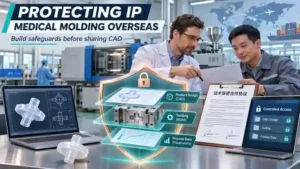
How Do You Protect IP When Sourcing Medical Molding Overseas?

You found an overseas molder with strong pricing and real cleanroom capacity. But once you send your CAD files, your design is no longer fully in your control. In medical devices, the risk goes beyond a copied part. Your mold, process window, and validation data can be reused, copied, or held hostage. The good news is that most IP losses are preventable if you build protection into sourcing from day one. To protect IP when sourcing medical molding overseas, treat protection as a system, not a single NDA. Register patents, utility models, and trademarks in the manufacturing country before you

Read More »
Regional Procurement Guide Category

Quality Control for Overseas Medical Injection Molding: How Do You Get It Right?

Your molded parts looked perfect in the sample box. Then the first production lot arrived from overseas with flash on a sealing surface, a slightly different shade of white, and no resin lot numbers. Now your verification build is on hold, your launch date is slipping, and your auditor wants answers. Distance makes every quality gap more expensive. But overseas medical injection molding can be as reliable as domestic molding if you build quality control in from day one. Quality control for overseas medical injection molding means building quality into every stage instead of relying on final inspection. Start with

Read More »
Regional Procurement Guide Category

Managing Communication, Time Zones, and Language Barriers: How Do You Keep a Global Medical Molding Project on Track?

Your mold is being built in China. Your quality team is in Boston. Your assembler is in Germany. A simple question about a gate location takes three days to answer. Then someone misses a drawing revision, the T1 samples arrive wrong, and your validation date slips by a month. In medical manufacturing, small communication gaps turn into costly delays and compliance risks. These problems are predictable, so you can design them out. To manage communication, time zones, and language barriers with a global medical molding partner, write down clear communication rules. Protect a short window of overlapping "core hours" for

Read More »
Regional Procurement Guide Category

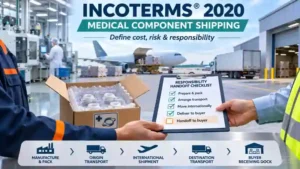
Incoterms for International Medical Component Shipping: Which Rule Should You Use?

Your molded parts pass inspection and your forwarder picks them up. Then a carton of IVD cartridges arrives crushed, and nobody agrees on who pays. Or customs holds the shipment because the seller tried to act as importer without the right registrations. I have seen both. Most of these disputes trace back to one line in the purchase order: the Incoterm. Choose it carefully and you control cost, risk, and compliance from the molding floor to your dock. For most international medical component shipments, FCA (Free Carrier) is the safest default. DAP (Delivered at Place) and CIP (Carriage and Insurance

Read More »
Regional Procurement Guide Category

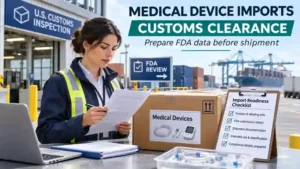
Customs Clearance for Medical Device Imports: How Do You Avoid FDA Holds and Delays?

A container of finished devices lands in Long Beach, and your launch date is already set. Then ACE shows an FDA hold. Your broker asks for a 510(k) number nobody entered. Every day at the port adds demurrage, storage fees, and pressure from sales. Medical device imports clear quickly when the regulatory data is ready before the goods ship. In my experience, most clearance delays are completely preventable. Customs clearance for medical device imports into the U.S. requires approval from both CBP and FDA. Your broker files the entry in CBP’s ACE system with the HTS code, FDA product code,

Read More »
Regional Procurement Guide Category

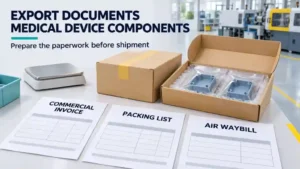
Export Documents for Medical Device Components: What Do You Actually Need?

Your parts are molded, inspected, and packed. Then the shipment sits in customs for nine days because one document is missing or one code is wrong. Your buyer’s assembly line waits, and your launch date slips. I have seen this happen to good companies with excellent parts. The fix is simple: know which export documents your medical device components need before the first carton leaves the dock. Medical device components usually need three core shipping documents: a commercial invoice, a packing list, and a bill of lading or air waybill. All three must show accurate descriptions, quantities, values, and HS

Read More »

Request a Quick Quote

Send your drawings and detailed requirements via:
Email: jerry@ckmold.com

Or fill out the contact form below:

We will contact you within one working day. Please pay attention to the email with the suffix “@ckmold.com”