
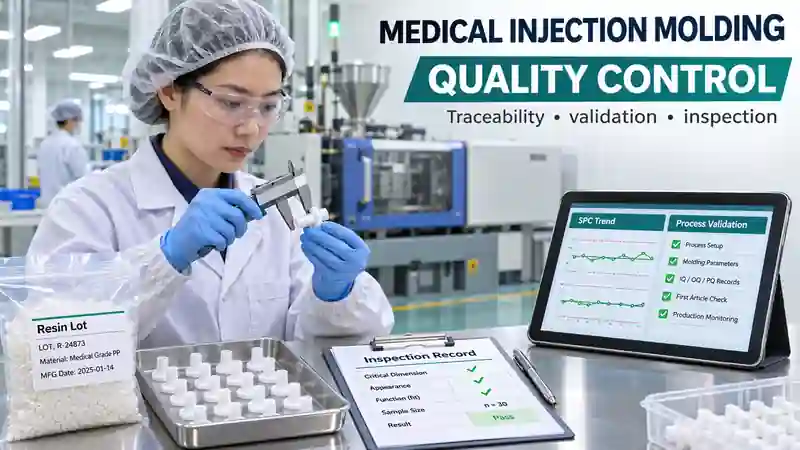
Your molded parts looked perfect in the sample box. Then the first production lot arrived from overseas with flash on a sealing surface, a slightly different shade of white, and no resin lot numbers. Now your verification build is on hold, your launch date is slipping, and your auditor wants answers. Distance makes every quality gap more expensive. But overseas medical injection molding can be as reliable as domestic molding if you build quality control in from day one.
Quality control for overseas medical injection molding means building quality into every stage instead of relying on final inspection. Start with an ISO 13485-certified molder whose scope covers your parts and who can support your FDA 21 CFR Part 820 (QMSR) obligations. Then require medical-grade resin with lot traceability and ISO 10993 or USP Class VI evidence, cleanroom molding (ISO Class 7 or 8) where needed, and IQ/OQ/PQ process validation. Add FAI, CMM, and SPC with Cpk ≥ 1.33 on critical dimensions, strict change control, a documented shipment release package, and packaging validated for transit.
I’ve worked with medical device companies that saved a lot of money by molding overseas. I’ve also seen companies lose a full year because they treated an overseas molder like a commodity parts vendor. The difference was rarely the factory’s equipment. It was the quality system the buyer put around the relationship. Below, I’ll walk you through each control point. It’s the same framework I use when I help clients qualify suppliers, validate processes, and release shipments with confidence.
Why Is Quality Control Harder When You Mold Medical Parts Overseas?
Many teams pick an overseas molder for cost and tooling speed. Then they manage quality the same way they would with a supplier down the road. That’s where trouble starts. You can’t walk the production floor on a Tuesday afternoon. Problems sit in a shipping container for weeks. By the time you find a defect, three more lots may already be on the water.
Overseas medical molding is harder to control because of distance, time zones, transit delays, and limited visibility into daily operations. Defects are often found weeks after production, when more lots have already been made. The fix is to move control upstream. Qualify the supplier deeply. Validate the process before production. Require data with every lot. Release shipments only after a documented review at the factory. Under FDA rules, you remain responsible for the quality of purchased components.
You Own the Supplier’s Quality
Here’s something many product managers miss. FDA’s quality system regulation generally does not apply directly to manufacturers of components. Section 820.1 of 21 CFR Part 820 explains this. That means FDA expects you, the finished device manufacturer, to control your suppliers through purchasing controls. Under ISO 13485:2016, clause 7.4, you must evaluate and select suppliers based on their ability to meet your requirements. You must also monitor their performance and define controls in proportion to risk.
So if an overseas molder ships bad parts, an auditor won’t ask the molder for answers. They will ask you.
What Changes When the Supplier Is Far Away
| Risk Factor | Domestic Supplier | Overseas Supplier |
|---|---|---|
| Time to detect a defect | Days | Often 3–8 weeks (transit + receiving) |
| Lots at risk when a problem appears | 1–2 | Often 3–5 already produced or shipped |
| Ability to do a quick site visit | Easy | Costly and slow |
| Language and documentation gaps | Low | Moderate to high |
| Transit stress on parts and packaging | Low | High (humidity, heat, vibration) |
| Risk of hidden material substitution | Lower | Higher without tight change control |
A Lesson I Learned Early
One of my first overseas projects involved an IVD cartridge housing. The samples were excellent. The first production lot was too. By the fourth lot, the snap-fit force had drifted. It turned out the supplier had adjusted hold pressure to fix a sink mark without telling anyone. No one was lying. They simply didn’t understand that a "small fix" in medical molding is a controlled change.
That project taught me a simple rule. With overseas suppliers, you don’t just buy parts. You buy a controlled process and the evidence that it stays controlled.
What Certifications Should an Overseas Medical Molder Have?
A certificate on a website looks reassuring. But I’ve seen ISO 13485 certificates that covered a different building, a different product category, or had expired months earlier. If you rely on the logo alone, you might qualify a factory that isn’t actually certified for the work you’re giving it. That gap often shows up during your own audit, not theirs.
At minimum, an overseas medical molder should hold a valid ISO 13485:2016 certificate. Its scope must cover injection molding of medical components, and it must name the exact site producing your parts. For the U.S. market, the supplier should understand FDA’s Quality Management System Regulation (QMSR), which incorporates ISO 13485 by reference. If they make finished devices, they also need FDA establishment registration. Cleanroom certification under ISO 14644 is required when your parts call for controlled-environment molding.
How to Verify an ISO 13485 Certificate
Don’t just download the PDF. Check these items:
| What to Check | Why It Matters | How to Verify |
|---|---|---|
| Certificate number | Confirms the certificate is real | Contact the certification body or search IAF CertSearch |
| Certification body accreditation | Unaccredited registrars carry little weight | Confirm the body is accredited by an IAF member |
| Scope wording | Must cover "design and/or manufacture of injection-molded medical components" or similar | Read the scope line carefully |
| Site address | Certificates often cover only one site | Match it to the factory that will run your mold |
| Validity dates | Lapsed certificates are common | Check issue, expiry, and surveillance audit dates |
Understanding QMSR
FDA published the QMSR final rule in the Federal Register in February 2024. It took effect on February 2, 2026. The rule incorporates ISO 13485:2016 by reference into 21 CFR Part 820. In practice, a supplier with a working ISO 13485 system is now much closer to what FDA expects. However, QMSR adds a few FDA-specific requirements, and FDA inspects against them.
Terms like "Device History Record" are no longer the formal language. But you still need equivalent batch-level records that show what was made, when, from what material, and with what results.
Other Certifications Worth Asking About
- FDA registration: Required only if the supplier makes finished devices for the U.S. market. You can check FDA’s Device Registration and Listing database.
- ISO 14644 cleanroom certification: Ask for the latest classification report, not just a brochure photo.
- ISO 14971 familiarity: A molder who understands risk management will help you build better PFMEAs.
- ISO 9001 or IATF 16949: Good signs of discipline, but not a substitute for ISO 13485.
How Do You Audit an Overseas Medical Injection Molding Supplier?
A sales tour shows you clean floors and new machines. It rarely shows you how the factory handles a bad lot at 2 a.m. on a night shift. Many audits I review were checklist exercises. Procedures existed on paper, but nobody checked whether people actually followed them. That’s how teams approve suppliers that look great and perform poorly.
Audit an overseas medical molder by testing how its quality system works day to day, not just whether procedures exist. Review control plans, incoming inspection, in-process checks, final inspection, nonconformance handling, CAPA records, calibration, mold maintenance, and training. Pick a recent production lot and trace it backward to resin lot, machine, mold, and inspection data. If you can’t travel, hire a qualified third-party auditor with medical device experience and give them your own checklist.
Audit Focus Areas and Red Flags
| Audit Area | What Good Looks Like | Red Flags |
|---|---|---|
| Incoming inspection | Resin COAs checked against specs, lot labels, quarantine area | COAs filed but never compared to specs |
| Process control | Locked parameters, process monitoring, setup sheets at the machine | Operators adjusting settings freely |
| In-process inspection | Defined frequency based on risk, SPC charts in use | "We check every hour" with no records |
| Final inspection | CMM or vision data, signed lot disposition | Visual checks only on critical features |
| Nonconformance | Segregated, labeled, documented reject area | Rejects mixed with good parts |
| CAPA | Root cause analysis with effectiveness checks | Same defect appearing in CAPA log repeatedly |
| Calibration | Current labels, traceable records | Expired gauges in use |
| Mold maintenance | Shot counters, PM schedule, repair logs | No history for the mold you’d use |
| Training | Records tied to specific job roles | Generic training sheets for everyone |
The Trace-Back Test
This is my favorite audit technique. Ask the supplier to pick any medical part shipped last month. Then ask them to show you:
- The resin lot number and its COA.
- The machine and mold used.
- The process parameters recorded during the run.
- In-process and final inspection results.
- Any deviations or nonconformances.
A strong supplier can do this in 15 minutes. A weak one will need two days and an apology.
Minimum Document Package to Request
Before you visit, ask for:
- ISO 13485 certificate and scope
- Quality manual, process flow, control plan, and inspection plan
- A blank FAI template and one completed FAI report (redacted is fine)
- Cpk/Ppk data for comparable medical parts
- IQC, in-process, and OQC procedures with recent records
- COA handling and traceability procedure
- CAPA log and nonconformance procedure
- Calibration records and mold maintenance history
- Cleanroom environmental monitoring records, if applicable
How fast and how completely they respond tells you a lot.
When Do Medical Molded Parts Need Cleanroom Production?
Some teams pay for cleanroom molding they don’t need. Others skip it on parts that really do need it. Both are costly mistakes. A fluid path component molded in an open shop can carry particles that cause failed bioburden tests or particulate complaints later. Once the product is validated, changing the molding environment means revalidation.
Cleanroom molding is typically needed for components that contact patients, drugs, body fluids, or sterile fluid paths. It’s also needed for parts that will be sterilized and where particulate or bioburden limits matter. Most medical molding runs in ISO Class 7 or ISO Class 8 cleanrooms per ISO 14644-1. External housings for diagnostic equipment or electronics often don’t need a cleanroom. Base the decision on your risk assessment, sterilization method, and particulate requirements.
ISO 14644 Cleanroom Classes for Medical Molding
| Class (ISO 14644-1) | Max Particles ≥0.5 µm per m³ | Typical Medical Molded Parts |
|---|---|---|
| ISO Class 7 | 352,000 | Drug delivery components, syringe parts, IV and fluid path parts, implant-adjacent parts |
| ISO Class 8 | 3,520,000 | IVD consumables, pipette tips, diagnostic cartridges, many disposables |
| Controlled non-classified | Not classified | Housings for medical electronics, instrument handles that get cleaned later |
You can review the classification method in ISO 14644-1:2015.
What to Check in an Overseas Cleanroom
A cleanroom is more than walls and filters. When I audit one, I look at:
- Classification report: Recent, from a qualified tester, at the "in operation" state if possible.
- Environmental monitoring: Ongoing particle counts, pressure differentials, temperature, and humidity logs.
- Gowning: Clear procedures, posted instructions, and people actually following them.
- Material flow: Resin enters through a pass-through or airlock, not through the main door.
- Mold maintenance: Done outside the cleanroom, with cleaning before the mold re-enters.
- Automation: Robots or conveyors that reduce hand contact with parts.
- Bagging and packaging: Done inside the cleanroom, right after molding.
Practical Advice
Define the cleanroom class on your drawing or in your quality agreement. Don’t leave it to the supplier’s judgment. Also, connect it to your sterilization and bioburden plan. If your sterilization validation assumes low bioburden, the molding environment is part of that assumption.
How Do You Control Medical-Grade Resin and Lot Traceability?
Material problems are the quietest failures in overseas molding. The parts look fine. They measure fine. But the resin came from a trader instead of an authorized distributor, or a "similar" grade replaced the one you validated. Your biocompatibility data now covers a material you’re not actually using. You may not find out until a complaint or an audit.
Control medical-grade resin by buying only from the resin maker or authorized distributors and specifying the exact grade on your drawing. Require a Certificate of Analysis for every resin lot and record lot numbers for each production lot. Verify identity yourself with FTIR or DSC instead of trusting paperwork alone. Define drying, storage, FIFO, and regrind rules. For patient-contact parts, confirm biocompatibility evidence under ISO 10993 or USP Class VI for that exact grade and colorant.
Independent Material Verification Methods
| Method | What It Confirms | When to Use |
|---|---|---|
| FTIR (infrared spectroscopy) | Polymer identity (PC vs. PC/ABS, etc.) | First lot, then periodically or after any supply issue |
| DSC (differential scanning calorimetry) | Melting point, glass transition, crystallinity | Semi-crystalline resins like PP, PEEK, POM |
| Melt flow index (MFI) | Viscosity and possible degradation | Checking resin lots or molded parts for overheating |
| Moisture analysis | Proper drying before molding | Hygroscopic resins like PC, PA, PBT |
| Color measurement (spectrophotometer) | Colorant consistency | Colored or tinted parts with appearance limits |
ISO 10993 vs. USP Class VI
| Factor | ISO 10993 | USP Class VI |
|---|---|---|
| Scope | Risk-based biological evaluation of the finished device | Material-level tests (systemic toxicity, intracutaneous, implantation) |
| FDA expectation | Primary framework | Helpful supporting data, not sufficient alone |
| Applies to | The device in its final form | The raw material |
| Best use | Regulatory submissions | Early material screening |
FDA explains its approach in its guidance on ISO 10993-1. Remember that colorants, mold release agents, and processing aids can affect biocompatibility too.
Regrind Policy
For most patient-contact medical parts, I recommend zero regrind. For non-contact housings, a controlled percentage may be acceptable if you validated it. Either way, write it into the quality agreement.
How Does IQ/OQ/PQ Validation Work for Medical Injection Molding?
Many teams approve production because the samples passed. But samples only prove the process worked once, on one day, with one set of conditions. They don’t prove it will work with a new resin lot, a warm afternoon, or a different operator. Without validation, every production lot is a gamble. And FDA expects validation for processes whose output can’t be fully verified.
IQ/OQ/PQ validation proves that a molding process consistently produces parts within specification. Installation Qualification (IQ) confirms the machine, mold, and auxiliary equipment are installed and calibrated correctly. Operational Qualification (OQ) tests the process at the edges of the operating window, usually using Design of Experiments. Performance Qualification (PQ) runs at nominal settings across multiple lots to show long-term consistency. Scientific molding helps define a robust window before OQ begins.
What Each Stage Includes
| Stage | Purpose | Typical Activities | Common Output |
|---|---|---|---|
| IQ | Equipment is installed correctly | Machine, mold, dryer, chiller, and temperature controller checks; calibration; utilities; software versions | IQ protocol and report |
| OQ | Process works across its window | Scientific molding studies; DOE on melt temp, injection speed, hold pressure, hold time, mold temp, cooling time; worst-case runs | Validated process window |
| PQ | Process is repeatable at nominal | Usually 3 production-scale runs, often with different resin lots; capability studies | Cpk/Ppk results; locked process |
The classic reference is the GHTF Process Validation Guidance, now hosted by IMDRF. Most auditors still use it.
Scientific Molding Comes First
Before OQ, a good molder will run studies such as:
- Viscosity curve: Finds an injection speed where small changes don’t affect fill.
- Gate seal study: Defines the right hold time.
- Pressure drop study: Confirms the machine isn’t pressure-limited.
- Cosmetic process window: Maps where parts are acceptable.
- Cooling time study: Balances cycle time and dimensional stability.
Then DOE tests the key factors together. The goal is a process window wide enough to handle normal variation.
My Practical Advice
Ask your overseas supplier to send the protocol for your approval before they run it. I’ve seen many validation reports written after the fact, with acceptance criteria that conveniently matched the results. Approve the protocol, then review the report. Also, require that validated parameters be locked or monitored at the machine. Cavity pressure sensors are worth the cost on high-risk parts.
How Do You Verify Dimensional Consistency in Production?
A part that measures well at First Article Inspection can drift out of tolerance months later. Molds wear. Vents clog. Cooling lines scale up. If your supplier only checks a few parts by hand, you won’t see the drift until assembly fails or a seal leaks. On a multi-cavity mold, one bad cavity can hide inside good average numbers.
Verify dimensional consistency with three layers. First, a complete First Article Inspection on every cavity before production approval. Second, capability studies on critical-to-quality dimensions, with targets such as Cpk ≥ 1.33, or 1.67 for high-risk features. Third, ongoing Statistical Process Control at a sampling frequency tied to risk. Use CMM or vision measurement for critical features, and confirm the measurement system works with a Gage R&R study.
Classify Your Characteristics First
Don’t ask the supplier to measure everything at the same frequency. That leads to shallow checking. Instead, classify each characteristic on your drawing:
| Classification | Example | Requirement |
|---|---|---|
| Critical (safety/function) | Luer taper, seal diameter, needle hub bore | Cpk ≥ 1.67, SPC every lot, 100% check if capability is weak |
| Major (fit/assembly) | Snap-fit height, boss location | Cpk ≥ 1.33, SPC at defined frequency |
| Minor (cosmetic/non-functional) | Logo depth, non-mating edges | AQL sampling |
Choosing Measurement Methods
| Method | Best For | Notes |
|---|---|---|
| CMM | Tight tolerances, GD&T, complex geometry | Slower, but most accurate for critical features |
| Vision measuring machine (VMM) | Small parts, 2D features, IVD consumables | Fast for high-volume sampling |
| CT scanning | Internal features, micro parts, wall thickness | Great for FAI and troubleshooting |
| Functional gauges | Go/no-go checks at the press | Useful for 100% inspection of one feature |
| Calipers/micrometers | Non-critical features | Fine for minor dimensions only |
Don’t Skip Gage R&R
If your measurement system can’t tell good from bad, your Cpk numbers mean nothing. A Gage R&R under 10% of tolerance is ideal. Between 10% and 30% may be acceptable depending on risk. Above 30%, fix the measurement method first.
A Note on Multi-Cavity Molds
On a 16-cavity IVD tip mold, I always ask for cavity-by-cavity data. Averages hide problems. Make sure each part, or at least each sample, can be traced to its cavity number. Engrave cavity IDs into the mold. It costs almost nothing and saves days of troubleshooting.
How Do You Stop Unapproved Changes at an Overseas Supplier?
Undisclosed changes are one of the leading causes of overseas quality failures. A supplier switches colorant suppliers to save money. They move your mold to a bigger press during a busy month. They swap a worn core insert with new steel. Each change seems small to them. To you, each change can invalidate testing you’ve already paid for.
Stop unapproved changes by writing a change-control clause into your quality agreement and supply contract. The clause should prohibit any change to resin grade, resin source, colorant, mold steel, mold design, machine, production site, secondary operations, packaging, or validated process parameters without your written approval. Require advance notice, usually 60 to 90 days for major changes. Define what revalidation is needed. Add consequences, such as rejection and chargebacks, for violations.
What Your Change-Control Clause Should Cover
| Change Type | Example | Typical Required Action |
|---|---|---|
| Resin grade or source | New grade, new distributor, new resin plant | Your approval, material verification, possible biocompatibility review |
| Colorant or masterbatch | New supplier or loading rate | Your approval, color check, biocompatibility review |
| Mold modification | Steel change, gate change, insert replacement | FAI, possible OQ/PQ |
| Machine change | Different press or tonnage | IQ, abbreviated OQ, PQ |
| Production site | Moving to another building or factory | Full revalidation |
| Process parameters | Changes outside validated window | Your approval and revalidation |
| Secondary operations | New ultrasonic welder, new pad printer | Validation of that process |
| Packaging | New bag material, box, or pallet pattern | Packaging review or revalidation |
| Sub-suppliers | New plating, printing, or assembly vendor | Your approval and qualification |
A Story About "Just a Colorant Change"
A client of mine made a wearable device enclosure in light gray. One lot arrived with a slightly warmer tone. The supplier had switched masterbatch suppliers because the original had a long lead time. The color difference was minor. The real problem was that the new masterbatch hadn’t been part of the biocompatibility evaluation for a skin-contact device. The client had to quarantine product and run additional testing.
The fix was simple, but it came too late. We rewrote the quality agreement to list every material, including colorant part numbers, as controlled items.
Make It Enforceable
- Attach a Bill of Materials and process specification to the quality agreement so "approved" is clearly defined.
- Ask the supplier to put your part on a "frozen process" list inside their system.
- Include change control in every audit, and ask to see their internal change log.
- Run periodic FTIR checks on molded parts as a quiet cross-check.
What Should Every Overseas Shipment Release Include?
When parts arrive and documentation is missing, you face a bad choice. You can hold the shipment and delay production. Or you can accept it and hope the paperwork shows up. Neither is good for compliance. With a 30-day ocean transit, finding a problem at your dock means the fix starts a month late.
Every overseas shipment should be released at the factory, before goods leave, based on a complete quality package. That package should include COAs and resin lot numbers, process records, in-process SPC data, final inspection reports with CMM or vision data, and nonconformance or deviation reports. It should also confirm that the lot matches approved FAI and validation records. Back it up with a third-party pre-shipment inspection using an AQL sampling plan and a "no shipment without approved package" contract clause.
The Shipment Release Package
| Document | What It Proves |
|---|---|
| Lot traceability record | Links lot to mold, cavity, machine, resin lot, date, and shift |
| Resin COA(s) | Material meets your approved specification |
| Process data summary | Run stayed within the validated window |
| In-process inspection and SPC charts | No trends or out-of-control signals |
| Final inspection report | Critical dimensions measured with CMM/VMM, with signed disposition |
| Nonconformance and deviation reports | Any issues were documented and dispositioned |
| Certificate of Conformance | Supplier states the lot meets all requirements |
| Packaging and labeling check | Correct labels, quantities, and lot IDs |
Pre-Shipment Inspection
Even with good documents, I recommend independent eyes for medical parts. You can send your own QA engineer or use a third-party inspector. Give them:
- A written inspection standard, not just a drawing
- An AQL sampling plan based on ISO 2859-1 or ANSI/ASQ Z1.4
- Golden samples and limit samples for appearance
- A short list of critical features to measure
Golden and Limit Samples
Keep signed golden samples at both your site and the supplier’s site. Add limit samples that show the worst acceptable flash, gate vestige, or color. This turns vague words like "minor flash" into a physical standard that anyone can compare against.
Put It in the Contract
Add a clause that says the supplier may not ship without your written approval of the quality package. Include the right to reject shipments with missing records and to charge back costs. In my experience, once suppliers know paperwork is a shipping requirement, completeness improves quickly.
How Do You Protect Molded Medical Parts During International Shipping?
Ocean freight is rough on medical parts. Containers can heat up in port and cool down at sea. Humidity condenses inside bags. Pallets vibrate for weeks. I’ve seen nylon parts swell out of tolerance and sterile barrier pouches lose seal strength after transit. If your packaging was designed for a domestic truck route, it may not survive a trip across the ocean.
Protect molded medical parts during international shipping by validating packaging against the real distribution environment. For sterile barrier systems, follow ISO 11607-1 for materials and design and ISO 11607-2 for process validation. Use ASTM D4169 to simulate shipping hazards like drops, vibration, compression, and climate cycling. Use ASTM F1980 for accelerated aging. Add humidity control, such as desiccant or moisture-barrier bags, for hygroscopic resins. Use data loggers on early shipments to confirm actual conditions.
Transit Hazards and How to Test for Them
| Hazard | What It Can Do | Test or Control |
|---|---|---|
| Temperature cycling | Warpage, seal weakening, stress cracking | ASTM D4169 climatic conditioning; data loggers |
| Humidity and condensation | Dimensional growth in PA, PBT; mold or moisture on cartons | Moisture-barrier bags, desiccant, humidity indicator cards |
| Vibration | Abrasion, particle generation, pouch wear | ASTM D4169 vibration testing |
| Drops and impacts | Cracked parts, broken sterile barriers | ASTM D4169 drop testing |
| Stacking compression | Crushed cartons, deformed thin-wall parts | Compression testing, pallet pattern design |
| Long storage | Aging of sterile barrier materials | ASTM F1980 accelerated aging plus real-time aging |
Useful references:
- ISO 11607-1 for packaging of terminally sterilized medical devices
- ASTM D4169 for shipping container performance testing
- ASTM F1980 for accelerated aging of sterile barrier systems
Practical Packaging Tips for Overseas Molding
- Bag parts in the cleanroom. Double-bag if they’ll be opened in your cleanroom later.
- Control moisture. For nylon parts, decide whether you want them dry or conditioned. Then package to keep them that way.
- Use real routes in testing. Pick a D4169 distribution cycle and assurance level that match your actual shipping method.
- Log the first shipments. Temperature and humidity loggers cost little and give you real data.
- Re-inspect critical dimensions after arrival on the first few lots. Compare results to factory data to detect transit-related changes.
What Happens When You Transfer a Mold Between Factories?
Mold transfers happen more than people expect. A supplier opens a new plant. You bring production back to the U.S. A factory closes. Teams often assume the mold will run the same way somewhere else because "it’s the same tool." It rarely does. Different machines, cooling capacity, and room conditions can shift dimensions enough to fail critical features.
Transferring a medical mold to a new facility requires full revalidation, even if the mold hasn’t changed. Differences in press design, screw size, cooling water temperature, dryer performance, and room conditions can affect part dimensions and properties. Plan for IQ at the new site, an OQ to confirm the process window, and PQ across multiple lots. Run FAI and capability studies again. Review whether the change affects your regulatory filings, biocompatibility, or sterilization validation before production restarts.
Why Parts Change After a Transfer
| Factor | How It Changes the Part |
|---|---|
| Machine brand and screw size | Different shear, melt residence time, and shot consistency |
| Cooling water temperature and flow | Different shrinkage and warpage |
| Dryer type and performance | Different residual moisture, causing splay or brittleness |
| Room temperature and humidity | Different mold and part conditioning |
| Hot runner controllers | Different temperature balance between cavities |
| Operators and setup practices | Different startup and purge habits |
A Transfer Plan That Works
When I help clients plan a transfer, we follow these steps:
- Capture the baseline. Gather process sheets, validation reports, Cpk data, and retained parts from the original site.
- Inspect and refurbish the mold. Clean cooling lines, check vents, measure wear, and document condition.
- Match equipment. Choose a press with similar shot-size usage, ideally 20–80% of barrel capacity.
- Run IQ on the new press and auxiliary equipment.
- Re-establish the process with scientific molding studies. Don’t just copy settings.
- Run OQ and PQ. Compare results against the original capability data.
- Run regulatory review. Check whether the transfer needs a notification or update to your technical file or 510(k) records.
A Real Example
One client moved a luer connector mold from an overseas plant to a U.S. contract molder. The settings were copied exactly. The new site’s chiller ran about 4°C colder. Shrinkage changed just enough to push the taper toward the edge of ISO 80369-7 limits. We caught it during OQ because we compared against baseline data. Without that baseline, the transfer would have looked like a mystery.
What Are the Most Common Overseas Medical Molding Quality Failures?
Most overseas quality problems aren’t unusual. They’re the same few failures, repeated across many projects. The frustrating part is that they’re usually preventable. Teams just don’t see them coming because they don’t know what early warning signs to look for. By the time the failure appears, it’s already cost time, money, and trust.
The most common overseas medical molding failures are certificate scope mismatches, unapproved resin substitution or regrind, mold wear causing dimensional drift or flash, process parameters that are recorded but not controlled, visual checks replacing dimensional inspection, and CAPAs that don’t fix root causes. Each one has early warning signs you can spot during audits or lot reviews. Prevention comes from a combined system of qualification, validation, traceability, inspection, and change control.
Failure Modes, Warning Signs, and Prevention
| Failure Mode | Early Warning Sign | Prevention |
|---|---|---|
| Certificate scope doesn’t match production | Certificate lists another site or product type | Verify scope and site before PO |
| Resin substitution | COA from an unknown distributor; small color or gloss shifts | Approved source list, FTIR checks, change-control clause |
| Unapproved regrind | Black specks, brittleness, MFI changes | Written regrind policy, audit grinder areas |
| Mold wear or poor venting | Gradual flash, burns, short shots, drifting Cpk | PM schedule by shot count, SPC trend review |
| Parameters recorded but not controlled | Setup sheets differ from machine screens | Locked parameters, process monitoring, audits |
| Visual-only final inspection | Final reports without measured data | Require CMM/VMM data on critical features |
| Ineffective CAPA | Same defect appears again | Require root cause and effectiveness checks |
| Packaging damage in transit | Crushed cartons, moisture in bags | ASTM D4169 and ISO 11607 validation |
| Silent mold or site move | Unexplained dimensional shift | Contract clause, unannounced audits |
The Setup That Works Best for U.S. Buyers
After many projects, this is the combination I trust most:
ISO 13485 supplier + validated process + lot traceability + FAI/SPC/CMM inspection + third-party pre-shipment inspection + controlled change management.
No single item is enough on its own. Together, they give you consistent parts and the documentation trail FDA, notified bodies, and your customers expect.
Where to Start This Week
If you already have an overseas supplier, pick one current part and run a trace-back test. Ask for the last three lots’ COAs, SPC data, and final inspection reports. Then review your quality agreement for change-control language. Those two steps alone will show you where your biggest gaps are.
If you’re still selecting a supplier, MedMoldPro can help. We support medical device teams with DFM reviews, supplier qualification, IQ/OQ/PQ planning, and production. You can send us your drawing or project details for a practical quality and manufacturability review.
Conclusion
Quality control for overseas medical injection molding isn’t about inspecting harder at the end. It’s about building control into supplier qualification, materials, validation, inspection, change management, and shipping. Start by auditing your current supplier’s traceability and change control. Then close gaps before your next lot ships. Need help qualifying a molder or validating a process? Visit MedMoldPro and send us your project details today.