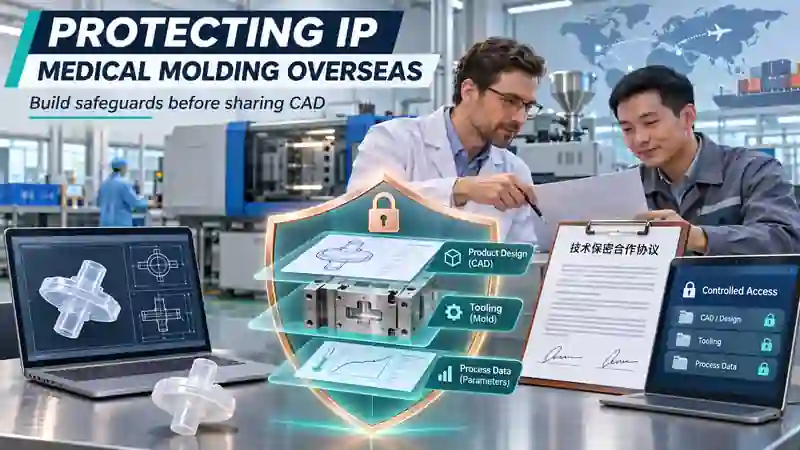
You found an overseas molder with strong pricing and real cleanroom capacity. But once you send your CAD files, your design is no longer fully in your control. In medical devices, the risk goes beyond a copied part. Your mold, process window, and validation data can be reused, copied, or held hostage. The good news is that most IP losses are preventable if you build protection into sourcing from day one.
To protect IP when sourcing medical molding overseas, treat protection as a system, not a single NDA. Register patents, utility models, and trademarks in the manufacturing country before you share designs. Sign a local-language NNN agreement governed by local law. Vet suppliers with on-site audits and ISO 13485 checks. Share only need-to-know data. Write ownership of molds, tooling, and IQ/OQ/PQ data into the contract. Split critical parts across suppliers. Record your rights with customs, and keep US Section 337 actions as a backstop.
Below, I’ll walk through each layer in the order you should build it. I’ve included tables, checklists, and lessons from projects I’ve supported over the years. Whether you’re developing IVD consumables, drug delivery components, or wearable device housings, you’ll know what to do before you send your next RFQ. One note: this is practical manufacturing guidance, not legal advice. Always confirm the final strategy with qualified IP counsel in each country.
Why Is IP Risk Higher When You Source Medical Molding Overseas?
Many teams think IP risk just means someone copying a plastic part. In medical molding, that’s only the surface. A molder that holds your tool, your process settings, and your validation records holds most of what makes your part approvable. If that relationship goes wrong, you can lose more than a design. You can lose months of regulatory work.
IP risk is higher in overseas medical molding because the molder touches every layer of value: part geometry, mold design, process parameters, resin specs, and validation data. Distance makes audits harder. Different legal systems make enforcement slower. In first-to-file countries, a supplier or one of its affiliates can register your design before you do. The fix is to list every IP asset first. Then decide which ones to protect by registration, which by contract, and which by keeping them in-house.
Start With an IP Inventory
Before any RFQ goes out, I ask clients to list what they’re actually protecting. Most teams list "the CAD" and stop. That leaves big gaps.
| IP Asset | Where It Lives | Main Risk Overseas | Best Protection |
|---|---|---|---|
| Part geometry and appearance | 3D CAD, 2D drawings | Copying, design squatting | Design patent, NNN, limited file sharing |
| Functional features (snap fits, valves, fluid paths) | CAD, mold design | Copying by molder or competitors | Invention patent, utility model |
| Mold design (gating, cooling, cavity layout) | Toolmaker files | Tool reuse or duplication | Tooling ownership clause, file deliverables |
| Process parameters | Molder’s process sheets | Lock-in, knowledge loss | Buyer-owned validation deliverables |
| IQ/OQ/PQ and mold-flow data | Molder’s QMS | Supplier transfer delays | Contract ownership, delivery schedule |
| Resin specs and colorant formulas | Material specs, CoAs | Substitution, copying | Specification control, trade secret |
| Brand and product names | Labels, packaging | Trademark squatting | Local trademark registration |
How Leaks Actually Happen
In my experience, IP rarely leaks through a dramatic theft. It leaks through ordinary paths: overrun parts sold to a third party, a mold running "extra" shots after hours, a subcontracted toolmaker that keeps your files, or a departing engineer who joins a competitor.
So treat your inventory as the foundation. Every section below maps back to it.
Should You Register Patents and Trademarks in the Manufacturing Country First?
Here’s a scenario I’ve seen more than once. A US company shares drawings with an overseas supplier. A year later, it discovers a local patent on its own design, filed by someone it has never heard of. In a first-to-file country, the original inventor now faces a costly invalidation fight just to keep making its own part.
Yes. Register before you share. China and most major manufacturing countries use a first-to-file system, so the first applicant generally wins, not the first inventor. US patents give you no protection in China. File invention patents for core technology, utility models for functional features, design patents for appearance, and trademarks for your brand and product names. International systems such as the PCT, Hague, and Madrid help you manage cost and timing across several countries.
Know the Main IP Types in China
IP rights are territorial. As WIPO explains, you generally need protection in each country where you manufacture or sell. For China, the main options are:
| IP Type | Term | Examination | Typical Grant Time | Best For |
|---|---|---|---|---|
| Invention patent | 20 years | Full substantive exam | Often 2–4 years | Core device technology |
| Utility model | 10 years | No substantive exam | Often under 1 year | Functional mold and device features |
| Design patent | 15 years | No substantive exam | Often under 1 year | Housings, appearance, ergonomics |
| Trademark | 10 years, renewable | Formal and substantive | Often around 1 year | Brand, product names, Chinese names |
You can file directly with CNIPA through a licensed Chinese patent agent. Or you can route filings through the PCT system for inventions, the Hague System for designs, and the Madrid System for trademarks.
Why Utility Models Are Underrated
Utility models are one of the most useful and least used tools for medical device companies. Because there’s no substantive examination, they’re fast and relatively low cost. They work well for functional features like snap-fit latches, luer interfaces, cartridge vents, or a clever ejection-friendly geometry.
A common strategy is to file an invention patent and a utility model on the same day for the same invention. You get fast protection now and stronger long-term protection later. You’ll need to give up the utility model when the invention patent is granted. Before you enforce a utility model, ask your agent about getting a patent evaluation report from CNIPA. Courts often expect one.
Don’t Forget Your Chinese Brand Name
Register your trademark in English and in a Chinese-character version. Trademark squatters often file the Chinese name because foreign companies forget it. If someone else owns your Chinese brand name, they can cause trouble at customs and on local marketplaces.
Why Is an NNN Agreement Better Than a Standard NDA for Overseas Molders?
Most US companies send a standard Western NDA, governed by New York or California law. It looks strong on paper. But if your overseas molder breaches it, a US court judgment can be hard to enforce where the factory and its assets actually sit. Some suppliers understand this very well, which is why they sign these NDAs so easily.
An NNN agreement covers three risks: Non-Disclosure (they won’t share your information), Non-Use (they won’t use it for their own products), and Non-Circumvention (they won’t go around you to sell to your customers or deal with your partners directly). When it’s written in the local language, governed by local law, and enforceable in local courts, it gives you a realistic path to injunctions and damages where the molder operates.
NDA vs. NNN: What Changes?
| Feature | Typical Western NDA | China-Style NNN Agreement |
|---|---|---|
| Language | English only | Chinese as the controlling version |
| Governing law | US state law | Local law (e.g., PRC law) |
| Venue | US court | Local court where the supplier is based |
| Scope | Confidentiality only | Disclosure, use, and circumvention |
| Damages | "Actual damages" | Pre-agreed liquidated damages |
| Execution | Signature | Signature plus official company seal (chop) |
Clauses I Always Recommend
The China IPR SME Helpdesk and many practitioners recommend NNN agreements for Chinese suppliers. From my own projects, these details make the biggest difference:
- Exact legal entity. Use the supplier’s registered Chinese name from its business license, not the trading name on its website.
- Company chop. Make sure it’s stamped with the official company seal, not just signed by a sales manager.
- Liquidated damages. Set a specific amount for breach. Proving actual damages is slow and hard.
- Affiliates and subcontractors. Cover sister companies, toolmakers, and anyone else the molder brings in.
- Survival. Confidentiality and non-use should continue well after the project ends.
- Defined product scope. Describe your products clearly so "non-use" is easy to prove.
Some teams prefer arbitration, such as CIETAC, because arbitration awards are generally enforceable across borders under the New York Convention. That can work too. The key is choosing a forum where you can actually win and collect.
One more tip: watch how a supplier reacts when you send the NNN. Serious medical molders sign it quickly. If a supplier pushes back hard, treat that as useful information.
How Do You Vet an Overseas Medical Molder for IP Safety?
A low quote and a polished factory tour don’t tell you who will see your files. Some molders quietly subcontract tooling to small workshops. Some share owners with companies that sell competing devices. If you release CAD before you know these facts, you’ve already given up control, and you can’t take it back.
Vet an overseas medical molder before releasing any confidential files. Verify its ISO 13485 certificate with the issuing registrar and confirm the scope covers injection molding. Audit the site in person or through a trusted third party. Check corporate ownership, subcontractors, IT security, and litigation history. Ask for references from medical customers. Until the supplier passes, release only non-confidential RFQ data.
An IP-Focused Supplier Checklist
Under ISO 13485 and FDA purchasing controls in 21 CFR Part 820, you already need to evaluate suppliers. I suggest adding IP checks to that same process so you don’t run two separate programs.
| Area | What to Check | Red Flags |
|---|---|---|
| Certification | ISO 13485 certificate, scope, registrar | Expired, scope excludes molding, unknown registrar |
| Ownership | Business license, shareholders | Links to device brands in your category |
| Subcontracting | Who builds the tools, who does secondary ops | "We handle everything" but no in-house toolroom |
| IT security | File servers, access control, logs | Shared drives, personal email, USB drives everywhere |
| Physical security | Cleanroom and toolroom access | Visitors walk freely into molding areas |
| Track record | Court records, references | Past IP disputes, no medical references |
You can confirm whether a registrar is accredited through IAF CertSearch. For Chinese suppliers, the National Enterprise Credit Information Publicity System shows registration and shareholder data. China Judgments Online can reveal past lawsuits.
Use Phased Disclosure
I like a three-stage approach. Stage one: a simplified envelope model for quoting. Stage two: part-level files after the NNN is signed. Stage three: full manufacturing data after a successful audit. It slows things down by a week or two. That’s a small price for control.
At MedMoldPro, we welcome audits before file release. A medical molder that refuses an audit is telling you something important.
Who Should Own the Injection Molds and Tooling?
You paid $60,000 for a multi-cavity mold. Then a pricing dispute starts, and the molder refuses to release it. Or you learn the same tool has been running parts for someone else on the night shift. Without clear tooling terms, "your" mold may only be yours on paper, and getting it back can take months you don’t have.
The buyer should own the injection molds, inserts, fixtures, gauges, and spare components, and the contract should say so in writing. Include permanent ownership marking, a tooling register, defined storage and maintenance duties, insurance, a ban on use for anyone else, and inspection rights. Most importantly, require return of the tools within a fixed period on request, even if unrelated commercial disputes are still open.
Tooling Clauses That Actually Work
| Clause | What It Should Say | Why It Matters |
|---|---|---|
| Ownership | Buyer owns tools upon payment | Prevents "the mold is ours" claims |
| Marking | Engraved owner name and asset number on the mold base | Stickers fall off; engraving doesn’t |
| Exclusive use | Tools used only for buyer’s orders | Stops unauthorized production |
| Shot counter | Mechanical or electronic counter installed | Lets you compare shots vs. shipped parts |
| Maintenance | Preventive maintenance schedule and logs | Protects tool life and validated state |
| Storage | Climate-controlled storage, rust prevention | Preserves tools between runs |
| Return | Ship within a set number of days on request | Avoids hostage situations |
| Documentation | Mold drawings, BOM, hot runner specs delivered | You can repair or rebuild elsewhere |
Practical Tips From the Shop Floor
Tie tooling payments to milestones like T1 samples and first article inspection approval. Ask for a separate tooling invoice so ownership is clearly documented. Take dated photos of each mold, the engraving, and the shot counter at every audit.
Also remember the regulatory side. Moving a validated mold to a new site usually triggers requalification. Your return clause should require the molder to send the last approved process sheet and maintenance records with the tool. Otherwise, you get the steel but lose the history.
Why Should IQ/OQ/PQ Data and Mold-Flow Reports Be Buyer-Owned?
Even if you get your mold back, can you run it? Without the validated process window, resin specs, and IQ/OQ/PQ reports, a new molder starts almost from zero. For a regulated part, that can mean months of rework and a stalled supply chain while your old supplier still holds the real knowledge.
Name process validation data as buyer-owned deliverables in your contract. This includes IQ/OQ/PQ protocols and reports, mold-flow analyses, DOE results, validated process parameter sheets, resin specifications and certificates, and inspection methods. These documents are the regulatory core of a medical part. Owning them protects your design history and device records and makes a supplier transfer faster and safer.
The Deliverables I Put in Every Contract
| Deliverable | Why It Matters | When to Deliver |
|---|---|---|
| Mold-flow analysis report | Shows gating, fill, and warpage logic | Before tool steel cut |
| Mold design drawings | Needed for repair or duplication | At tool approval |
| IQ report | Proves equipment and utilities are correct | After installation qualification |
| OQ report and DOE data | Defines the validated process window | After OQ |
| PQ report | Proves consistent output at nominal settings | After PQ |
| Validated process sheet | The "recipe" for the part | With PQ approval |
| Resin spec and CoA records | Locks material grade and lot traceability | Ongoing |
| Inspection plans and gauge R&R | Shows how parts are measured | Before production release |
Ownership vs. Retention
Here’s a detail many contracts miss. Your molder must keep copies of these records for its own QMS under ISO 13485. That’s fine. Write the clause so you own the data, and the molder may keep copies only for quality-record purposes, under the NNN’s confidentiality terms.
Also specify format and language. I ask for English versions, native analysis files where possible, and delivery within a set number of days after each approval. Don’t wait until the end of the project to request everything. Collect as you go.
This matters for compliance too. Under FDA requirements and ISO 13485 process validation expectations, you as the device manufacturer remain responsible for your supplier’s validated processes. If you don’t hold the data, you can’t fully demonstrate control. When we run medical injection molding projects at MedMoldPro, the validation package is defined and quoted for the specific project, because we believe the customer should never be locked in by paperwork.
How Much Technical Data Should You Share With a Medical Molder?
Engineers like to send the full native assembly because it’s fast. But that single file can reveal your entire device architecture, your mating parts, and your design intent. A molder making one housing doesn’t need to see your sensor module, your fluid path, or your drug reservoir, and it shouldn’t.
Share technical data on a need-to-know basis. Send neutral files like STEP for the single part being molded, not native assembly models. Remove feature history, hide unrelated components, and use watermarked, numbered 2D drawings. Deliver files through a controlled portal with named users, access logs, and expiring links. Keep design rationale, risk files, and clinical data inside your company.
What to Share at Each Stage
| Project Stage | Share | Hold Back |
|---|---|---|
| RFQ | Simplified envelope model, material, volume, key tolerances | Full CAD, assembly, design intent |
| DFM review | Part-level STEP, 2D drawing with critical dimensions | Mating parts, risk analysis, clinical data |
| Tooling | Final part STEP, approved drawing, cosmetic requirements | Other suppliers’ components |
| Validation | Critical-to-function features, acceptance criteria | Design rationale, user needs |
| Production | Released drawing revision, inspection plan | Next-generation designs |
Simple Controls That Make a Big Difference
- Watermark every drawing with the supplier’s name, date, and "Confidential." If it shows up somewhere else, you’ll know where it came from.
- Number every document and log who received which revision.
- Avoid email attachments. Use a secure portal with named users and expiring links.
- Explain what, not why. A molder needs to know a dimension is critical. It doesn’t need to know it controls dose accuracy.
Balance Protection With Good DFM
Be careful not to over-restrict. A molder can’t give you good DFM feedback on draft, wall thickness, or gate location without accurate part geometry. I’ve seen teams hide so much that the supplier missed a sink mark risk that cost a tooling change later. The goal is minimum necessary data, not minimum data. If you want a second opinion, a DFM review under NNN protection is a safe middle ground.
Should You Split Critical Components Across Multiple Suppliers?
If one supplier molds every part, assembles the device, and packs finished goods, it holds everything needed to copy your product. It also holds everything needed to sell it. Single-source convenience can slowly turn into single-source dependence, and that’s a risk to both your IP and your supply continuity.
Yes, for products with high copy value. Split critical components or process steps across suppliers so no single manufacturer holds the full design. For example, mold housings overseas, keep the critical fluid path or valve with a domestic or second-region molder, and do final assembly, calibration, or firmware loading in-house. Use separate toolmakers and molders where practical, but weigh the IP benefit against added validation and logistics cost.
Splitting Options Compared
| Strategy | IP Benefit | Added Cost/Complexity | Best For |
|---|---|---|---|
| Split parts across two molders | Medium | More supplier audits | Multi-part housings, consumables |
| Keep critical part domestic | High | Higher piece price on one part | Valves, microfluidic chips, drug-contact parts |
| Separate toolmaker and molder | Medium | Tool transfer and coordination | High-value molds |
| In-house final assembly | High | Labor and assembly validation | Drug delivery devices, POC devices |
| In-house firmware or calibration | Very high | Minimal if already in-house | Electronics-based devices |
Split Where the Secret Lives
Don’t split randomly. Find the one or two components that make your product hard to copy. For an autoinjector, it might be the plunger and spring mechanism. For a point-of-care cartridge, it’s usually the fluid channels and reagent zones. For a wearable, it’s often the sealed sensor window and firmware.
Keep those protected. Let overseas partners handle parts with lower copy value, like outer covers, battery doors, or packaging trays.
Watch the Tradeoffs
Every extra supplier means another qualification, another incoming inspection plan, and more tolerance stack-up risk across parts made in different places. You’ll also need assembly validation if parts come together at a new site. I usually recommend splitting only where the IP value clearly justifies the extra work. For many low-cost disposables, strong contracts plus tooling ownership are enough.
A secondary benefit: dual sourcing also protects you if a supplier has a fire, a shutdown, or a quality crisis. Many of my clients justify splitting on supply-risk grounds alone.
How Can Customs Recordation and Section 337 Actions Stop Copies?
Even with strong contracts, copies can still appear. A former supplier may start exporting near-identical cartridges or housings. By the time they reach US distributors or online marketplaces, the damage is already done. You need tools that stop infringing parts at the border, not just in a courtroom years later.
Record your registered IP with the customs authority in the manufacturing country. In China, recordal with the General Administration of Customs allows officers to detain suspected infringing goods at export. For the US market, record trademarks and copyrights with CBP. For patents, a Section 337 investigation at the US International Trade Commission can produce exclusion orders that block infringing products from entering the US, regardless of where they were made.
Comparing Border Enforcement Tools
| Tool | Where It Works | IP Covered | Speed | Cost |
|---|---|---|---|---|
| China customs recordal | Chinese exports and imports | Patents, trademarks, copyrights | Detentions can happen at shipment | Low |
| US CBP recordation | US imports | Trademarks and copyrights | Ongoing screening | Low to moderate |
| Section 337 investigation | US imports | Patents, trademarks, trade secrets, others | Often 16–18 months | High |
Make Customs Recordal Useful
Recordal alone isn’t enough. Customs officers see thousands of shipments. Give them a product identification guide with photos, part markings, and packaging details. List your authorized manufacturers and exporters so your legitimate shipments aren’t held up. Keep the recordal updated when you change suppliers. You can find official information through China Customs.
When Section 337 Makes Sense
Section 337 is powerful but expensive. It often costs far more than a typical district court case in early stages. You also need to show a US "domestic industry," such as significant US investment in the product. A general exclusion order can block infringing goods from any source, which is valuable when copies come from many small manufacturers. For most small device companies, it’s a backstop for high-value products, not a first step.
For resources on US enforcement abroad, StopFakes.gov is a good starting point.
How Do You Monitor IP After Production Starts?
Many companies treat IP protection as a one-time startup task. They sign agreements, file patents, and move on. But suppliers change staff, add subcontractors, and win new customers. Risks that were low at launch can grow quietly over three or four years of production, until a copy suddenly shows up.
Monitor IP continuously after production starts. Add IP checks to supplier audits, review scrap and overrun records, reconcile resin usage against shipped parts, and confirm molds run only for your orders. Watch online marketplaces, trade shows, and new patent filings for copies. Keep dated design records and signed agreements, and update your IP filings and contracts whenever products or markets change.
A Simple Monitoring Plan
| Activity | What to Look For | Suggested Frequency |
|---|---|---|
| Supplier audit with IP checklist | File access, subcontractors, mold location | Annually or with QMS audit |
| Resin reconciliation | Resin purchased vs. parts shipped plus scrap | Quarterly |
| Shot counter review | Shots vs. shipped quantities | Each production run |
| Scrap destruction records | Certificates or photos of destroyed rejects | Each batch |
| Marketplace search | Look-alike parts on B2B and retail sites | Quarterly |
| Patent and trademark watch | New filings similar to your designs | Quarterly |
| Trade show review | Copies at shows like MEDICA or CMEF | Yearly |
| Contract and IP review | New products, markets, or suppliers | At each major change |
My Favorite Low-Cost Check
Resin reconciliation is simple and powerful. You know your part weight, runner weight, and expected scrap rate. If a supplier bought far more of your specified medical-grade resin than your orders need, ask why. Combined with shot counter data, it often reveals unauthorized runs before any copy appears on the market.
Build It Into Your QMS
ISO 13485 already requires ongoing supplier monitoring and re-evaluation. Add IP indicators to your supplier scorecard instead of creating a separate process. That keeps it sustainable and audit-ready. Also keep dated evidence of your design history and signed agreements. If you ever need to enforce, clear records make your case much stronger.
If you’re planning an overseas molding program and want a partner that builds these protections in from the start, contact MedMoldPro. We’re happy to sign your NNN before your first file transfer.
Conclusion
Protecting IP in overseas medical molding is a system: file locally first, sign an enforceable NNN, vet suppliers, own your tooling and validation data, share only what’s needed, split critical parts, and monitor continuously. Your next step is simple. Build your IP inventory before your next RFQ. If you’d like a confidential DFM review or a molding quote under NNN protection, reach out to MedMoldPro.