You found a molder you like. The quote looks fair. Then you see the minimum order: 10,000 parts. Your clinical build only needs 300. Now you have two bad options. You can overbuy inventory that may become scrap after a design change, or you can start your supplier search again. I’ve watched many teams lose months at this step. The good news is that medical MOQs are rarely fixed. Once you understand what drives them, you can negotiate them.
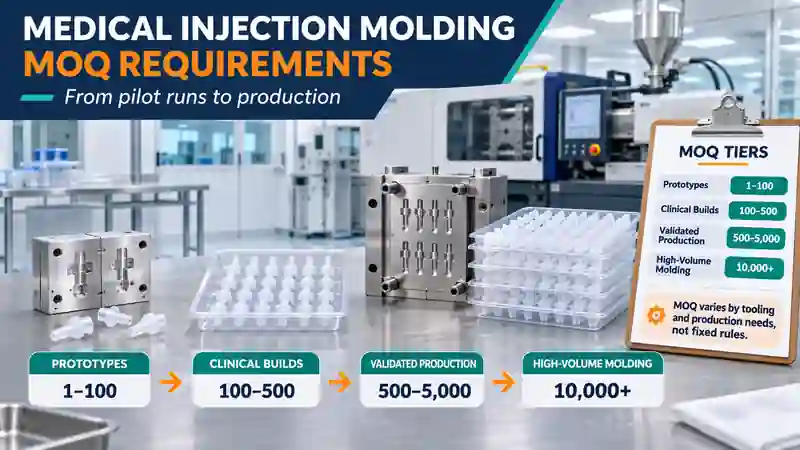
Medical device injection molding MOQs usually range from 100–500 parts for pilot or clinical builds made with aluminum bridge tooling, 500–5,000 parts for low-volume validated production, and 10,000+ parts for high-volume, multi-cavity steel tooling. Prototype runs can be as small as 1–100 parts. MOQ is not an industry rule. It depends on tooling amortization, machine setup, material lot minimums, cleanroom overhead, and IQ/OQ/PQ validation costs. A reasonable opening target for a custom medical component is 500–1,000 pieces for the first validated production release.
In this guide, I’ll explain where each MOQ number comes from. I’ll show typical ranges by stage and product type, and how tooling, materials, cleanrooms, and validation change the math. I’ll also cover why a large order before design freeze can create regulatory trouble. At the end, you’ll find a negotiation playbook and a list of questions you can bring to your next supplier quote review.
Why Do Medical Injection Molders Set Minimum Order Quantities?
Many buyers see an MOQ as a supplier being difficult. That view leads to bad negotiations. You push for 200 parts, the molder says no, and nobody explains why. Meanwhile, your clinical timeline keeps slipping. If you don’t understand the cost structure behind the number, you can’t find the parts of it that can actually be changed.
Molders set MOQs because every production run carries fixed costs that don’t depend on part count. These include hanging the mold, heating and purging the barrel, dialing in the process, first-article inspection, cleanroom line clearance, and batch documentation. These costs can reach $500–$2,000 or more per run. Spread over 100 parts, they dominate the unit price. Spread over 5,000 parts, they almost disappear. The MOQ is the point where the run is worth doing for both sides.
Fixed Costs vs. Variable Costs
Every medical molding job has two cost buckets. Variable costs grow with each part. They include resin, machine time, and packaging. Fixed costs occur once per run, whether you order 50 parts or 50,000.
Typical fixed costs per run include:
- Mold installation, water and heater connections, and hot runner checks
- Material drying, which often takes 2–4 hours for PC, PEEK, or nylon
- Barrel purging to remove the previous material and color
- Process startup until parts are stable and in spec
- First-article inspection (FAI) and in-process sampling
- Line clearance and cleanroom cleaning before and after the run
- Batch record review and quality release
How Run Size Changes Unit Price
Here is a simple example. Assume $1,200 in fixed run costs and $0.40 in variable cost per part.
| Run Size | Fixed Cost per Part | Variable Cost per Part | Total Unit Cost |
|---|---|---|---|
| 100 | $12.00 | $0.40 | $12.40 |
| 500 | $2.40 | $0.40 | $2.80 |
| 1,000 | $1.20 | $0.40 | $1.60 |
| 5,000 | $0.24 | $0.40 | $0.64 |
| 10,000 | $0.12 | $0.40 | $0.52 |
Illustrative numbers only. Real costs depend on part size, resin, and quality requirements.
You can see the curve. Between 100 and 1,000 parts, unit cost drops by almost 90%. After 5,000, the gains get small. This is why many suppliers set MOQs in the 500–5,000 range.
My advice is simple. Before you push back on an MOQ, ask the supplier to show you the fixed cost per run. Once you see that number, you can decide whether to pay a small-run premium, commit to more volume, or restructure the order. That conversation goes much better than "can you go lower?"
What Are Typical MOQ Ranges by Production Stage?
Product managers often get one MOQ number from a supplier and treat it as the rule for the whole program. That’s a mistake. A design verification build, a clinical lot, and a commercial launch have very different needs. If you use the wrong benchmark, you either overpay for early parts or lock into the wrong tooling for production.
MOQs change with each stage of development. Prototype and design verification builds usually need 1–100 parts made with soft or prototype tooling. Pilot, clinical, and bridge builds typically need 100–500 parts from aluminum molds. Low-volume commercial production usually starts at 500–5,000 parts. Routine cleanroom production often requires 1,000+ parts per run. High-volume programs with multi-cavity steel tools usually run 10,000+ parts per order.
MOQ Benchmarks by Stage
| Production Stage | Common MOQ | Typical Tooling | Main Purpose |
|---|---|---|---|
| Prototype / design verification | 1–100 | 3D-printed, soft, or prototype aluminum | Fit, form, function testing |
| Pilot / clinical / bridge | 100–500 | Aluminum or MUD-insert bridge tool | Clinical trials, usability, early verification |
| Low-volume commercial | 500–5,000 | Single-cavity P20 or hardened steel | Validated launch, niche devices |
| Routine cleanroom production | 1,000+ | Hardened steel, 1–4 cavities | Ongoing supply of patient-contact parts |
| High-volume production | 10,000+ | Multi-cavity hot runner steel | Disposables, IVD consumables, drug delivery |
MOQ Benchmarks by Product Type
Product type matters as much as stage. In my experience, these ranges are typical once a product is in commercial supply:
| Product Type | Typical Annual Volume | Typical Run MOQ |
|---|---|---|
| Surgical instrument handles | 1,000–20,000 | 500–2,000 |
| Diagnostic equipment housings | 500–10,000 | 250–1,000 |
| Wearable device enclosures | 5,000–100,000 | 1,000–5,000 |
| Point-of-care cartridges | 100,000–5M | 10,000–50,000 |
| IVD consumables (tips, tubes, plates) | 1M+ | 50,000+ |
| Drug delivery components | 500,000+ | 20,000+ |
The lesson is to quote by stage, not by project. Ask for a separate bridge-build quote and a separate production quote. Then compare each one against the right benchmark. If a production supplier quotes 10,000 pieces for a housing you’ll sell 2,000 of per year, they’re likely the wrong fit. They’re not being unreasonable. Your volume profile just doesn’t match their business model.
How Does Tooling Type Affect Your MOQ?
Tooling is often the biggest line item in a medical molding budget. It also has the biggest influence on MOQ. If you commit to a $60,000 hardened steel tool and then order 300 parts, the math falls apart. If you go cheap on tooling for a high-volume disposable, the mold may wear out right when demand takes off.
Tooling drives MOQ because suppliers and buyers both want to amortize the mold cost across enough parts to keep the unit price reasonable. Aluminum and bridge tools cost less and are often used for 100–5,000 parts, so they support very low MOQs. Hardened steel production molds cost more, often $10,000–$100,000+, and last hundreds of thousands to millions of cycles. Suppliers usually pair these tools with higher MOQs and annual volume commitments.
Tooling Options Compared
| Tooling Type | Typical Cost | Expected Life | Lead Time | Typical MOQ | Best For |
|---|---|---|---|---|---|
| Prototype aluminum | $3,000–$15,000 | 500–5,000 shots | 2–4 weeks | 1–100 | Design verification |
| Bridge aluminum / MUD insert | $5,000–$25,000 | 5,000–50,000 shots | 3–5 weeks | 100–500 | Clinical builds, early launch |
| P20 pre-hardened steel | $15,000–$50,000 | 100,000–500,000 shots | 5–8 weeks | 500–5,000 | Low-to-mid volume production |
| Hardened steel (H13, S136) | $30,000–$100,000+ | 500,000–1M+ shots | 6–12 weeks | 5,000+ | Validated high-volume production |
| Multi-cavity hot runner | $50,000–$250,000+ | 1M+ shots | 10–16 weeks | 10,000–50,000+ | IVD and drug delivery disposables |
Mold builders often refer to SPI mold classes. A Class 101 mold is built for over one million cycles. A Class 104 mold is meant for under 100,000. Make sure your quote states the class. If it doesn’t, you can’t compare two suppliers fairly.
A Validation Warning About Bridge Tools
Bridge tools are great for clinical lots. But here’s a trap I see often. A team validates its process on an aluminum bridge tool, then moves to a steel production tool six months later. That’s a new tool, and it usually requires at least a new OQ and PQ. Plan for that from the start. If you know production will run on steel, consider validating only on steel.
Practical Tooling Tips
- Separate tooling cost from part price in every quote. Hidden amortization makes MOQ comparisons misleading.
- Confirm in writing that you own the tool, and spell out transfer terms.
- Use family molds only for parts with similar size and wall thickness. Otherwise, balancing problems can hurt validation.
- Start with fewer cavities. You can add cavities later as demand grows, which keeps early MOQs lower.
How Do Medical-Grade Materials Influence MOQ?
Material choice gets made in the design phase, often without thinking about supply. Then the quote arrives with a high MOQ that seems to come from nowhere. Often the cause is the resin. Some medical grades come only in large lots or through one distributor. If your part weighs 5 grams, a 25 kg minimum buy could equal thousands of parts.
Medical-grade resins raise MOQ because many are sold in minimum lot sizes, often 25 kg bags or full pallets, and they cost far more than commercial grades. Specialty polymers such as PEEK, medical polycarbonate, COC/COP, and USP Class VI–certified grades can force the molder to buy more material than a small order uses. Leftover resin may expire or go unused. To reduce this effect, choose grades your molder already stocks, or ask to buy and consign the resin yourself.
Material Comparison for MOQ Planning
| Material | Common Medical Uses | Relative Cost | MOQ Impact |
|---|---|---|---|
| Polypropylene (PP) | Syringes, caps, IVD tubes | Low | Low; widely stocked |
| ABS / PC-ABS | Equipment housings, handles | Low–Medium | Low–Medium; color matching adds minimums |
| Medical polycarbonate | Fluid paths, connectors, housings | Medium | Medium; specific grades may need pallet buys |
| COC / COP | Microfluidics, diagnostic cartridges | High | Medium–High; limited distribution |
| TPE / TPU | Grips, seals, overmolds | Medium | Medium; custom hardness raises minimums |
| Liquid silicone rubber (LSR) | Seals, valves, wearables | Medium–High | Medium; kit sizes and dedicated equipment |
| PEEK | Surgical and high-temperature parts | Very High | High; expensive minimum lots |
Material Minimums in Part Count
Here’s a quick way to see the effect. Take the resin minimum, subtract startup and purge waste, and divide by shot weight (part plus runner).
For example, a 6 g part with a 2 g cold runner gives an 8 g shot. A 25 kg bag minus about 3 kg of purge and startup leaves 22 kg. That equals about 2,750 parts. If you order 500, you’re still paying for the whole bag.
Custom colors make this worse. Masterbatch suppliers often set 25–50 kg minimums for a new color. On one surgical handle project, the client’s brand color alone added about 40% to the first-run cost. We switched to a standard medical blue the molder already used, and the problem went away.
USP Class VI vs. ISO 10993
USP Class VI certification is a useful screening tool for materials. But the FDA evaluates your finished device using a risk-based biological evaluation under ISO 10993-1. Don’t pay a premium for a Class VI grade you don’t need. But don’t swap grades to cut MOQ without checking your biocompatibility plan either. Also ask your resin supplier for a change notification agreement. A silent formula change can force retesting.
Why Do Setup, Cleanroom, and ISO 13485 Requirements Raise MOQs?
A standard commercial molder might accept a 500-part order for a consumer product. A medical molder may want 2,000 for a similar part. Buyers often see that gap as padding. It isn’t. Controlled environments, gowning, line clearance, and ISO 13485 documentation add real fixed costs to every run. Small orders still carry all of them.
Cleanroom molding under an ISO 13485 quality system adds environmental controls, gowning, line clearance, cleaning, environmental monitoring, and batch documentation to every run. These costs are mostly fixed, so they push the economic run size up. Routine cleanroom production often starts around 1,000+ parts per run. The best way to lower this MOQ is to confirm whether your part truly needs a cleanroom. Many non-patient-contact housings don’t.
Commercial vs. Cleanroom Medical Molding
| Cost Element | Standard Commercial Molding | ISO 13485 Cleanroom Molding |
|---|---|---|
| Environment | Open production floor | ISO 7 or ISO 8 per ISO 14644-1 |
| Personnel | Standard work clothes | Gowns, gloves, hair and beard covers |
| Line clearance | Basic | Documented, verified, signed |
| Mold and press cleaning | As needed | Before and after each run |
| Environmental monitoring | None | Particle counts, pressure, temperature |
| Records | Basic job traveler | Full batch record and device history |
| Packaging | Bulk boxes | Double-bagged, labeled by lot |
| Typical run MOQ | 250–1,000 | 1,000–5,000+ |
Do You Really Need a Cleanroom?
Not every medical part needs one. Here’s a simple guide I use:
- Usually needs a cleanroom: fluid path parts, drug contact parts, implant parts, parts that will be sterilized and in direct patient contact, and IVD consumables where particles or bioburden affect test results.
- Often fine in a controlled environment: equipment housings, battery doors, external surgical handle shells, and wearable enclosures that don’t touch broken skin.
A few years ago, a diagnostic equipment client insisted on ISO 7 molding for an external housing. It added cost and roughly doubled the MOQ. After a review of their risk file under ISO 14971, their quality team agreed a controlled, white-room environment was enough. Annual molding cost dropped by about 25%.
Regulatory Context
FDA’s quality system requirements in 21 CFR Part 820 now align with ISO 13485 under the Quality Management System Regulation (QMSR). Your supplier’s certificate should cover molding and assembly of medical components, not just a sales office. If you sell finished devices in Europe, also confirm the supplier can support your obligations under EU MDR 2017/745. If you want help reviewing whether your part needs cleanroom molding, you can reach the team at MedMoldPro.
How Does IQ/OQ/PQ Validation Change the MOQ Conversation?
Process validation is where many MOQ discussions quietly fall apart. A supplier spends weeks on IQ, OQ, and PQ. That might mean thousands of test shots, dimensional studies, and reports. Then the first order is 300 parts. The supplier can’t recover the investment, so they raise the MOQ or the price. Buyers feel squeezed and don’t know why.
Validation changes the MOQ conversation because IQ, OQ, and PQ are a large one-time investment, often several thousand to tens of thousands of dollars per tool. Suppliers want to recover that cost over the life of the program, not one order. So instead of focusing on per-order MOQ, smart buyers negotiate an annual volume commitment or quote validation as a separate line item. Either approach lets you order smaller lots while the supplier still gets a fair return.
What Each Validation Stage Covers
| Stage | What It Proves | Typical Activities | Parts Consumed |
|---|---|---|---|
| IQ – Installation Qualification | Equipment and mold are installed correctly | Press, chiller, dryer, and mold checks; calibration records | Few or none |
| OQ – Operational Qualification | Process makes good parts at its limits | DOE, process window testing, high/low settings | Hundreds to thousands |
| PQ – Performance Qualification | Process is stable at normal settings over time | Usually 3 consecutive production lots, capability (Cpk) studies | Often 3 full lots |
The GHTF process validation guidance is still the most practical reference for this framework. It’s worth sharing with your team before tooling starts.
Questions to Ask About Validation and MOQ
- Is validation quoted separately or buried in the part price?
- Do PQ lots count toward the first production order?
- Who owns the validation protocols and reports?
- How many parts are destroyed in testing and retained as samples?
- What changes would trigger revalidation? Think resin lot, press transfer, or cavity repair.
Practical Strategy
I usually recommend that clients pay for validation as a separate line item. It makes quotes easier to compare. It also stops validation cost from inflating the unit price for years. Then, offer a realistic annual forecast with a firm commitment for the first 6–12 months. Suppliers can often accept a 300–500 part first release when the forecast is credible and the tooling is committed.
One more tip. Design your PQ lot size around your real production lot size. If your normal run is 2,000 parts, three 2,000-part PQ lots become your launch inventory. Nothing is wasted.
How Do Lot Traceability and UDI Requirements Affect Run Sizes?
Every production lot creates paperwork. That includes batch records, resin lot links, inspection data, and release signatures. If you split production into many tiny runs, the documentation load multiplies. Then a field complaint arrives, and your team has to trace twenty small lots instead of three. Traceability is a hidden but real driver of minimum run sizes.
Lot traceability favors fewer, larger production runs because each lot needs its own batch record, material genealogy, inspection data, and quality release. Fewer lots mean less paperwork and simpler investigations. For finished devices, the FDA UDI system links each labeled device to production identifiers like lot numbers. That link depends on clean component traceability. But very large lots also widen recall scope, so the right lot size is a balance.
Small Lots vs. Large Lots
| Factor | Many Small Lots | Fewer Large Lots |
|---|---|---|
| Documentation effort | High | Low |
| Cost per part | Higher | Lower |
| Inventory on hand | Low | High |
| Recall scope if a problem occurs | Narrow | Wide |
| Investigation complexity | More records to review | Fewer records, more parts affected |
| Obsolescence risk | Low | Higher |
What Good Component Traceability Looks Like
UDI labeling applies to the finished device, which usually means you, the labeler. But your molded components feed into that traceability chain. A strong medical molder should be able to link each component lot to:
- The resin manufacturer’s lot number and certificate of analysis
- Colorant or additive lot numbers
- The mold, cavity number, and press used
- Process parameters recorded during the run
- Inspection results and the person who released the lot
Cavity identification is often overlooked. On multi-cavity tools, ask for cavity numbers molded into each part. When a dimensional issue appears, you can isolate one cavity instead of quarantining the whole lot.
Finding the Right Lot Size
I suggest defining lot size in your supply agreement, not leaving it to each PO. A common approach is to tie one lot to one resin lot and one continuous run. This keeps genealogy clean and gives your quality team a predictable number of records. For IVD consumables with high annual volume, that might mean 50,000 parts per lot. For a surgical handle, it might be 1,000. Either way, agree on it before PQ, so your validation lots match real production.
When Is Committing to a Large MOQ a Regulatory Risk?
This is the mistake that costs the most money. A team gets a great unit price at 20,000 parts and places the order before design freeze. Then verification testing reveals a problem. The design changes. The process must be revalidated. And 20,000 parts become scrap, or worse, a compliance problem if anyone tries to use them.
Committing to a large MOQ is risky before design freeze and before process validation is complete. Under FDA design control requirements, any change after verification must be reviewed, and it often requires reverification or revalidation. Parts made to the old design may not be usable. Keep orders small through clinical builds and design verification. Scale up only after design transfer and PQ are complete.
A Costly Lesson
A few years ago, I worked with an IVD startup that ordered 20,000 cartridge bodies to get a lower unit price. Their assay team was still tuning the fluid path. During verification, they found that a vent needed to move by 0.8 mm to stop bubble formation. The tool change took two weeks. Revalidation took six more. The 20,000 existing parts were scrapped. That "cheaper" order ended up costing about three times what a staged approach would have.
Order Strategy by Stage
| Development Stage | Design Status | Recommended Order Strategy |
|---|---|---|
| Feasibility | Changing weekly | Prototypes only, 1–50 parts |
| Design verification | Mostly stable | Bridge tool, 100–500 parts |
| Clinical / usability builds | Near freeze | Small validated or controlled lots |
| Design transfer | Frozen | Production tool, OQ/PQ lots |
| Commercial launch | Released | Blanket PO with staged releases |
| Mature production | Stable | Annual commitments, larger lots |
Warning Signs You’re Not Ready for a Large MOQ
- Verification tests are still running or failing
- Critical dimensions don’t have agreed tolerances yet
- Biocompatibility testing on the final material isn’t complete
- Packaging or sterilization validation is still pending
- Marketing is still debating color or branding
- Your FDA submission strategy could change the design
If two or more apply, keep orders small. Pay the higher unit price. It’s cheap insurance. A solid DFM review before tooling also helps catch the issues that most often trigger late design changes, such as wall thickness, draft, gate location, and venting.
How Can You Negotiate Lower MOQs Without Raising Risk?
You need small deliveries. The supplier needs efficient runs. It can feel like someone has to lose. But in most medical programs I’ve supported, there’s a structure that works for both sides. The problem is that buyers jump straight to "can you lower the MOQ?" instead of offering terms that make lower volumes worth it.
The best way to lower MOQ is to change the deal structure, not just the number. Use a blanket purchase order with scheduled releases, so you meet the supplier’s MOQ on paper but take staged deliveries. Offer a credible annual forecast. Pay for tooling and validation separately. Request tiered pricing at 500, 1,000, 5,000, and 10,000 pieces. Choose stocked resins and standard colors. These steps often reduce first-run MOQs to 300–500 parts.
Negotiation Levers That Actually Work
| Lever | How It Lowers MOQ | Watch Out For |
|---|---|---|
| Blanket PO with scheduled releases | Supplier runs larger lots and ships smaller batches | Clear cancellation and storage terms |
| Annual volume commitment | Supplier can plan capacity and amortize costs | Realistic forecasts; avoid penalties you can’t meet |
| Separate tooling and validation charges | Removes amortization from unit price | Higher upfront cash need |
| Tiered quotes | Shows exactly where price breaks happen | Compare total cost, not just unit price |
| Customer-supplied or consigned resin | Removes material minimum risk for supplier | You own storage and shelf life |
| Standard colors and stocked grades | Avoids masterbatch and resin minimums | Confirm biocompatibility stays valid |
| Supplier-held safety stock | Smooths supply without large deliveries | Define ownership and lot expiry rules |
A Blanket PO Example
On a wearable enclosure project, the supplier required 5,000 parts per run. The client needed about 400 per month. We set up a 12-month blanket PO for 5,000 units with monthly releases of 400–500. The supplier molded one validated lot. They stored it under controlled conditions and shipped monthly. The client got the full-run unit price without carrying a year of inventory. Both sides signed off on storage conditions and a 12-month shelf-life limit up front.
Questions to Ask Before You Accept Any MOQ
- What is the fixed cost per run, and what drives it?
- Does the MOQ include FAI parts, PQ lots, retained samples, and scrap allowance?
- Is the constraint tooling, resin, cleanroom setup, or validation?
- Can you hold finished goods and ship against releases?
- What is your ISO 13485 certification scope, and is the facility FDA registered where required?
- What changes would trigger revalidation, and who pays?
When you send an RFQ, include your 3D CAD, material spec, annual forecast, stage of development, cleanroom requirement, and validation expectations. The more complete your package, the more accurate and flexible the MOQ you’ll receive. If you’d like a second opinion on a quote or a staged MOQ plan, send your project details to MedMoldPro.
Conclusion
Medical injection molding MOQs aren’t fixed rules. They reflect tooling, materials, setup, cleanroom operations, validation, and traceability. Match your order size to your development stage. Keep volumes small until design freeze and PQ are complete. Then use blanket POs and annual commitments to scale efficiently. Your next step is to review your current quote, identify the real MOQ driver, and restructure the deal around it.