
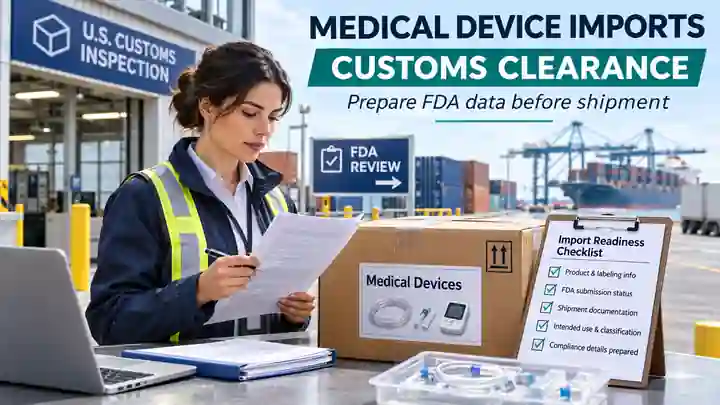
A container of finished devices lands in Long Beach, and your launch date is already set. Then ACE shows an FDA hold. Your broker asks for a 510(k) number nobody entered. Every day at the port adds demurrage, storage fees, and pressure from sales. Medical device imports clear quickly when the regulatory data is ready before the goods ship. In my experience, most clearance delays are completely preventable.
Customs clearance for medical device imports into the U.S. requires approval from both CBP and FDA. Your broker files the entry in CBP’s ACE system with the HTS code, FDA product code, manufacturer, and country of origin. FDA screens the entry using Affirmation of Compliance data. That includes establishment registration, device listing, and 510(k), De Novo, or PMA numbers. FDA may release, examine, sample, or detain the shipment. You also pay duties, including any Section 301 tariffs, and must meet labeling and UDI rules.
I’ve worked with device companies importing diagnostic housings, drug delivery components, IVD consumables, and finished point-of-care devices. The clearance problems repeat: wrong codes, missing affirmations, unready labeling, and surprise tariffs. Below, I’ll walk through the full clearance workflow, the documents your broker needs, what to do if FDA detains a shipment, and the obligations that stay with you after release. I’ll also cover the EU MDR importer rules.
How Does Medical Device Customs Clearance Work in the U.S.?
Many teams think of customs as one gate. For medical devices, there are two: CBP and FDA. A shipment can satisfy CBP on duties and paperwork and still sit on hold because FDA hasn’t released it. If your team doesn’t understand how the two agencies interact, you’ll keep chasing the wrong problem while storage charges pile up.
U.S. customs clearance for medical devices follows five steps. First, classify the product with an HTS code and an FDA product code. Second, your broker files the entry in CBP’s ACE system. Third, the filing includes FDA Affirmations of Compliance, such as registration, listing, and premarket numbers. Fourth, you pay duties and fees and post a customs bond. Fifth, FDA reviews the entry and either releases it or requests an examination, a sample, or a detention.
CBP’s Automated Commercial Environment (ACE) passes FDA-related entry data straight to FDA. FDA then screens each line using an automated risk system called PREDICT. FDA’s importing medical devices page explains the process in detail.
The Clearance Workflow Step by Step
| Step | What Happens | Who Does It | Timing |
|---|---|---|---|
| 1. Classification | Assign HTS code and FDA product code | Importer and broker | Before purchase order |
| 2. ISF filing (ocean only) | Submit Importer Security Filing data | Importer or broker | 24 hours before loading at origin |
| 3. Entry filing | File entry in ACE with FDA data | Customs broker | Before or at arrival |
| 4. FDA screening | PREDICT reviews the entry and affirmations | FDA | Usually within hours |
| 5. CBP formalities | Duties, fees, bond, document review | Broker and CBP | At entry |
| 6. FDA disposition | "May Proceed," exam, sample, or detention | FDA | Hours to weeks |
| 7. Entry summary | File CBP Form 7501 and pay duties | Broker | Within 10 working days of release |
For ocean freight, the Importer Security Filing (ISF) is often forgotten. Late ISF filings bring penalties, and they can draw extra attention to your cargo.
Importer of Record vs. Initial Importer
These roles can be different companies. The importer of record is responsible to CBP for duties and paperwork. The initial importer, under FDA rules, is the U.S. company that receives the devices and furthers their distribution. Decide these roles in your contracts before the first shipment. I’ve seen startups discover at the port that nobody had agreed who the importer of record was.
Importing Components for Your Own Manufacturing
If you import molded components for your own device assembly, tell your broker. These shipments are still FDA-screened. Describe them clearly as components for further processing by a registered manufacturer.
What FDA Requirements Must Be in Place Before a Device Ships?
The worst time to find a registration gap is when the device is already on the water. FDA screening happens at entry. If your foreign manufacturer isn’t registered, the device isn’t listed, or the premarket number is missing, the shipment stops. I’ve seen companies wait weeks because nobody checked the annual registration renewal. Fixing these gaps upstream costs almost nothing.
Before importing a medical device for commercial distribution, confirm four things. First, the foreign manufacturer is registered with FDA and has a U.S. agent. Second, the U.S. initial importer is registered. Third, the device is listed with FDA. Fourth, the device has the required marketing authorization, such as 510(k) clearance, De Novo classification, or PMA approval, or it qualifies for an exemption. All of these should be active and verifiable in FDA databases before shipment.
Registration and Listing
FDA’s device registration and listing page covers the details. Key points:
- Foreign manufacturers must register, list their devices, and designate a U.S. agent.
- Initial importers must register and identify the foreign manufacturers they import from.
- Registration must be renewed every year between October 1 and December 31, along with the annual user fee.
- A missed renewal can make your registration inactive, and that triggers holds.
You can verify status in FDA’s registration and listing database.
Premarket Authorization by Device Class
| Device Class | Typical Pathway | What to Have Ready |
|---|---|---|
| Class I | Mostly 510(k)-exempt | Listing number, exemption basis |
| Class II | 510(k), sometimes exempt | 510(k) number (K-number) |
| Class II (novel) | De Novo | De Novo number |
| Class III | PMA | PMA number |
| Investigational | IDE | IDE number and investigational labeling |
If you’re unsure which pathway applies, FDA’s premarket submission guide is a good starting point. Search cleared devices in the 510(k) database.
Quality System Compliance
Imported devices must be made under FDA’s quality system requirements. The new Quality Management System Regulation (QMSR), effective February 2, 2026, aligns with ISO 13485:2016. If a foreign site has poor inspection history, its products may end up on an Import Alert. Choose manufacturing partners with strong ISO 13485 systems. Audit them before you depend on them.
What Documents and Data Does Your Customs Broker Need?
Your broker can only file what you give them. If the invoice is vague, the FDA product code is guessed, or the power of attorney is missing, the entry is weak from the start. Weak entries get flagged. I’ve learned to treat the broker as part of the regulatory team. They need a complete, accurate data package before the goods leave the factory.
Give your customs broker a commercial invoice, packing list, bill of lading or air waybill, and the HTS code. Add the FDA product code, country of origin, and the manufacturer’s name and address. Include FDA registration and listing numbers and the 510(k), De Novo, or PMA number. Have labeling and IFU copies ready. Also provide a customs bond and a signed power of attorney. Send everything before departure so the broker can file early and catch errors.
The Broker Data Package
| Item | Purpose | Common Error |
|---|---|---|
| Commercial invoice | Value, description, terms of sale | Generic descriptions, missing model numbers |
| Packing list | Contents and weights by carton | Doesn’t match the invoice |
| Bill of lading / air waybill | Transport and ownership | Consignee mismatch |
| HTS code | Duty rate and admissibility checks | Using the exporter’s Schedule B code |
| FDA product code | Tells FDA what the product is | Wrong industry code or product class |
| Manufacturer details | FDA links entry to the registered site | Trading company listed instead of the real manufacturer |
| Registration, listing, premarket numbers | Affirmations of Compliance | Missing or outdated numbers |
| Labeling and IFU | Evidence if FDA asks | Non-English or no UDI |
| Customs bond | Guarantees duty payment | Bond not active at arrival |
| Power of attorney | Broker authority to file | Not signed or expired |
The FDA Product Code Is Not the Classification Product Code
This trips up many teams. The three-letter device classification product code (like those in 510(k) records) is different from the seven-character FDA import product code. Your broker builds the import code with FDA’s Product Code Builder. Give the broker your classification code and device description, and let them build the import code correctly.
Choose a Broker With FDA Experience
Licensed customs brokers vary widely. Ask how many FDA device entries they file each month. Ask how they handle holds. A broker who knows medical devices will catch a missing K-number before CBP does. New importers also need to get an importer number through CBP Form 5106. Many brokers handle that for you.
Manufacturer Name Accuracy
FDA matches the manufacturer on the entry to the registered establishment. If your invoice lists a trading company instead of the actual factory, screening fails. Always list the real manufacturing site.
How Do Affirmation of Compliance Codes Reduce FDA Holds?
FDA’s screening system can’t read your mind. It reads data. If the entry is missing the registration number, listing number, or premarket number, PREDICT has no proof the device is legal. So it flags the line. That flag means a manual review, a document request, and often days of delay. A few accurate data fields at filing prevent most of this.
Affirmation of Compliance (AofC) codes are data fields in the ACE entry that tell FDA how your device meets requirements. For medical devices, they typically include the establishment registration number, the device listing number, and the premarket submission number, such as a 510(k), PMA, or De Novo number. Investigational devices use the IDE number. Accurate AofC codes let FDA verify compliance automatically. That greatly reduces holds, document requests, and examinations.
What AofC Data Covers
| AofC Category | What It Proves | Where to Find It |
|---|---|---|
| Establishment registration | The manufacturing site is registered with FDA | FDA registration database |
| Device listing | The device is listed by the manufacturer | FDA listing records |
| Premarket number | The device has marketing authorization | 510(k), PMA, or De Novo database |
| Investigational device | The device is for a clinical study under an IDE | IDE approval letter |
| Radiation product data | Compliance with radiation performance standards | Form FDA 2877 and accession number |
Practical Tips From Real Entries
Build an AofC sheet for every SKU. I recommend a one-page reference for each device model. It should list the HTS code, FDA import product code, registration number, listing number, and premarket number. Share it with your broker and update it whenever anything changes.
Match the right manufacturer to the right number. If you buy the same device from two factories, each has its own registration. Mixing them up fails screening.
Don’t affirm what you can’t prove. Submitting incorrect AofC data is worse than leaving it blank. FDA treats false declarations seriously.
Watch for changes after a 510(k) update. If a device modification led to a new 510(k), update your AofC sheet immediately. Old K-numbers on new models are a common cause of holds.
One client imported three models of a diagnostic reader. Only the first model’s 510(k) number was in the broker’s system. For two months, every shipment of the other two models was held for document review. A 15-minute update to the AofC sheet fixed it permanently.
Accurate AofC data also builds a compliance history. Over time, a clean record helps your entries move through screening faster.
What Happens If FDA Detains Your Medical Device Shipment?
A detention notice feels like an emergency. Your product sits in a bonded warehouse. Storage fees grow daily, and customers ask when they’ll get their orders. Many teams panic and send FDA a pile of random documents. That slows things down further. Detention has a defined process, and a calm, organized response is the fastest way out.
When FDA reviews an entry, it can release it, examine it, sample it, or detain it. A detained shipment is given a Notice of FDA Action. You then have a limited window, often 10 working days, to provide evidence of compliance. If FDA isn’t satisfied, it refuses admission. Refused goods can be reconditioned under an approved plan, re-exported, or destroyed, usually within 90 days. Firms on an Import Alert may face Detention Without Physical Examination (DWPE).
FDA Entry Outcomes
| Outcome | What It Means | What You Should Do |
|---|---|---|
| May Proceed | FDA releases the line | Nothing; continue CBP clearance |
| Documents requested | FDA needs more information | Send exactly what is requested, quickly |
| Examination | FDA inspects the goods physically | Make goods available; check labeling in advance |
| Sampling | FDA takes samples for testing | Wait for results; prepare a response plan |
| Detention | Goods appear to violate the law | Respond within the deadline with evidence |
| Refusal | Admission denied | Recondition, export, or destroy |
How to Respond to a Detention
- Read the charge carefully. Common charges include "not registered," "no 510(k)," or "misbranded" labeling.
- Answer that charge only. If the issue is a missing 510(k), send the clearance letter and show how the device matches it.
- Use your broker. They know the FDA compliance officer’s preferences and deadlines.
- Consider reconditioning. For labeling problems, you can apply with Form FDA 766 to relabel the goods under FDA supervision.
Import Alerts and DWPE
If a manufacturer has repeated problems or bad inspection results, FDA may place it on an Import Alert. Shipments from that firm can then be detained without examination. The burden shifts to you to prove each shipment complies. Getting removed from an Import Alert usually requires fixing the root cause, and that can take months.
My advice: check the Import Alert list before you qualify any new foreign supplier. It takes five minutes and can save a whole supply chain.
How Do Labeling, UDI, and Radiation Rules Affect Clearance?
Labeling problems are among the most common reasons for FDA detention. A device can be registered, listed, and cleared, yet still be held because its label is only in Chinese, lacks a UDI, or uses outdated symbols. Radiation-emitting devices add another layer. For imports, the label isn’t a marketing item. It’s legal evidence that the device can be sold in the U.S.
Imported medical devices must meet FDA labeling rules under 21 CFR Part 801. Labels must be in English and include the manufacturer or distributor name, intended use, and adequate directions. Most devices also need a Unique Device Identifier (UDI) on the label and packaging, with data submitted to FDA’s GUDID database. Radiation-emitting electronic products, such as lasers and X-ray equipment, also require Form FDA 2877 and compliance with applicable federal performance standards.
Labeling Requirements to Check Before Shipment
| Requirement | Rule | Common Import Problem |
|---|---|---|
| English labeling | Device labeling rules, 21 CFR 801 | Labels only in the source language |
| Manufacturer or distributor name and address | 21 CFR 801.1 | Factory name missing or wrong |
| Adequate directions for use / IFU | 21 CFR 801.5 | IFU missing from packaging |
| UDI on label and packaging | FDA UDI system, 21 CFR 830 | No GUDID record or wrong device identifier |
| Prescription device statement | 21 CFR 801.109 | "Rx only" symbol missing |
| Radiation product reporting | Form FDA 2877, 21 CFR 1000-1050 | Missing accession number |
UDI Gaps During Scale-Up
I often see UDI issues when a company moves from pilot production to volume manufacturing at a contract manufacturer. The label printer changes, packaging changes, and the device identifier on the box stops matching GUDID. Do a label audit at your first production lot. Check every packaging level against your GUDID record.
Radiation-Emitting Devices
Products like lasers, diagnostic X-ray systems, and some ultrasound therapy devices fall under FDA’s radiation-emitting product rules. The importer files Form FDA 2877 at entry. The manufacturer must have submitted a product report and received an accession number. Without it, expect a hold.
Labeling for Components
Components imported for further manufacturing usually don’t carry end-user labeling. They should still be labeled clearly as components, with part numbers and lot numbers. This supports traceability and helps FDA understand the entry. When we mold and ship components at MedMoldPro, we label each carton with part number, revision, lot, and quantity to match the CoC.
How Do Tariffs and Country of Origin Change Landed Cost?
Many device teams calculate landed cost early, then never update it. Meanwhile, tariff rates can change within months. A syringe that once carried almost no duty can suddenly carry a 100% Section 301 tariff if it comes from China. If you don’t model tariffs by origin, your cost of goods can be wrong by double digits. You may not notice until the first customs invoice arrives.
Landed cost for imported medical devices includes the base HTS duty, any additional tariffs such as Section 301 duties on Chinese-origin goods, and the Merchandise Processing Fee. Ocean shipments also carry the Harbor Maintenance Fee, and then there’s freight. Country of origin is a major factor. Section 301 tariffs on Chinese syringes and needles rose to 100% in 2024, and rates on some medical gloves are increasing in stages. Some articles for persons with disabilities may enter duty-free under HTS 9817.00.96.
Landed Cost Components
| Cost Element | What It Is | Practical Note |
|---|---|---|
| Base (MFN) duty | Normal rate in the HTS | Many Chapter 90 medical items carry low or zero rates |
| Section 301 tariffs | Additional duties on certain Chinese-origin goods | Check the USTR Section 301 actions |
| Other tariff actions | Additional duties announced since 2025 | Rates have changed often; verify before each quote |
| Merchandise Processing Fee | Percentage of entered value, with a minimum and maximum | Adjusted each fiscal year |
| Harbor Maintenance Fee | 0.125% of value for ocean shipments | Not charged on air freight |
| Broker and FDA-related fees | Filing, exam, and storage costs | Rise sharply when shipments are held |
Country of Origin Strategy
Origin generally follows where substantial transformation happens. For molded components, that’s usually where the part is molded, not where the mold was built. Some companies build tools in one country and mold in another to manage tariff exposure. That can work, but only if the production is real and documented. Transshipment schemes and false origin claims bring heavy penalties. CBP actively investigates them.
The Nairobi Protocol Exemption
HTS heading 9817.00.96 lets certain articles specially designed or adapted for persons with disabilities enter duty-free. CBP generally looks for products designed for chronic disabilities rather than temporary conditions. If you think your device qualifies, check past decisions in CBP CROSS rulings or request a binding ruling.
My Advice
Rerun your landed cost model whenever tariff news breaks. Do it at least every quarter. Also, the U.S. suspended the low-value de minimis pathway in 2025, so small parcel imports of samples and spare parts now need formal or informal entries too. Plan for that in your pilot production budget.
What Are Importer Obligations Under the EU MDR?
If you import devices into the EU, you aren’t just a logistics provider. Under the EU MDR, the importer has its own legal duties. If a non-compliant device reaches the market through you, authorities can hold you responsible. Many U.S. companies setting up EU distribution don’t realize this until a competent authority audit. By then, the gaps are expensive to fix.
Under Article 13 of the EU Medical Device Regulation (EU 2017/745), importers must check several things before placing a device on the market. The device must carry CE marking and have a Declaration of Conformity. The manufacturer must be identified and have an authorized representative. The device must be correctly labeled with instructions for use and a UDI. The importer must also be registered in EUDAMED, put its own name and address on the device or packaging, and keep a register of complaints and recalls.
EU MDR Importer Checklist
| Obligation | What to Check | Practical Action |
|---|---|---|
| CE marking | Device carries a valid CE mark | Check the Notified Body c |
| number and expiry date | ||
| Declaration of Conformity | DoC exists and covers the model | Keep a copy on file |
| Authorized representative | Non-EU manufacturer has an EU AR | Confirm the AR’s name on the label |
| Labeling and IFU | In the required languages of each member state | Check language versions per country |
| UDI | UDI assigned and on the label | Verify against the manufacturer’s records |
| EUDAMED registration | Importer is registered as an actor | Obtain your Single Registration Number (SRN) |
| Importer identification | Name and address on device, packaging, or accompanying document | Add a sticker or label without covering existing information |
| Storage and transport | Conditions don’t compromise compliance | Follow the manufacturer’s storage specifications |
| Complaints register | Record complaints, nonconformities, and recalls | Share with the manufacturer and AR |
You can read the full regulation on EUR-Lex. Register through EUDAMED. Its modules are becoming mandatory in stages, so plan your registration now.
Practical Tips for EU Imports
Don’t cover existing labels. When you add your importer details, a sticker must not hide the manufacturer’s information.
Check the Notified Body certificate. Some legacy devices rely on MDR transition provisions. Confirm the device is legally covered for the period you plan to sell.
Act on suspected non-compliance. If you believe a device doesn’t comply, you must not place it on the market. You must inform the manufacturer and the authorized representative. If the device presents a serious risk, you must also inform the competent authority.
The EU system puts real responsibility on importers. Treat your import function like a quality function, not just a shipping desk.
What Are Your Responsibilities After the Shipment Clears?
Clearance feels like the finish line. It isn’t. Once devices enter the U.S. or EU market, importers carry ongoing duties: reporting adverse events, supporting recalls, and keeping traceability records. When a complaint arrives two years later, you’ll need to know which lot went where. If your records are incomplete, a small issue can turn into a broad, costly recall.
After clearance, U.S. importers must meet Medical Device Reporting (MDR) obligations under 21 CFR Part 803. That means reporting deaths and serious injuries to FDA and the manufacturer, and reporting malfunctions to the manufacturer. Importers must also report certain corrections and removals under 21 CFR Part 806. They should keep complaint files and lot-level distribution records that support recalls. In the EU, importers must keep complaint registers and cooperate with vigilance and field safety actions.
Post-Clearance Obligations
| Obligation | Rule | What Importers Must Do |
|---|---|---|
| Medical Device Reporting | 21 CFR 803 | Report deaths and serious injuries to FDA and the manufacturer within 30 days |
| Malfunction reporting | 21 CFR 803 | Report malfunctions to the manufacturer |
| Corrections and removals | 21 CFR 806 | Report certain field actions to FDA within 10 working days |
| Device tracking | 21 CFR 821 (certain devices) | Maintain tracking data for specified devices |
| MDR files | 21 CFR 803 | Keep event files and procedures |
| EU vigilance support | EU MDR Article 13 | Keep the complaints register and cooperate with authorities |
Build Traceability Into Your Supply Chain
Recall effectiveness depends on traceability from manufacturing to distribution. That starts with your supplier. A good manufacturing partner links resin lot, molding lot, assembly lot, and shipment. You then link shipment to customers. If either side of that chain breaks, recalls grow wider and more expensive.
Set Up Procedures Before You Need Them
I recommend importers write three short procedures before the first shipment:
- Complaint intake and MDR evaluation. Who decides whether an event is reportable, and by when?
- Recall and field action support. How do you identify affected lots and customers within 24 hours?
- Supplier communication. How quickly must the manufacturer notify you of changes, nonconformities, or recalls?
Choose Suppliers That Make Compliance Easier
Clearance and post-market compliance both depend on the quality of upstream documentation. At MedMoldPro, a Certificate of Conformance and traceability records are provided when specified in the quotation or quality agreement. Customs and quality teams receive consistent part descriptions and origin data. If you’re planning to import molded medical components or devices, reach out to us to review your document package before your first shipment.
Conclusion
Customs clearance for medical device imports depends on preparation. Confirm FDA registration, listing, and premarket status before shipping. Give your broker accurate HTS codes, FDA product codes, and Affirmation of Compliance data. Check labeling and UDI. Model tariffs by country of origin. Plan for EU MDR importer duties and post-market obligations. Your next step: build an AofC sheet for every SKU. Need a compliant manufacturing partner? Contact MedMoldPro.