
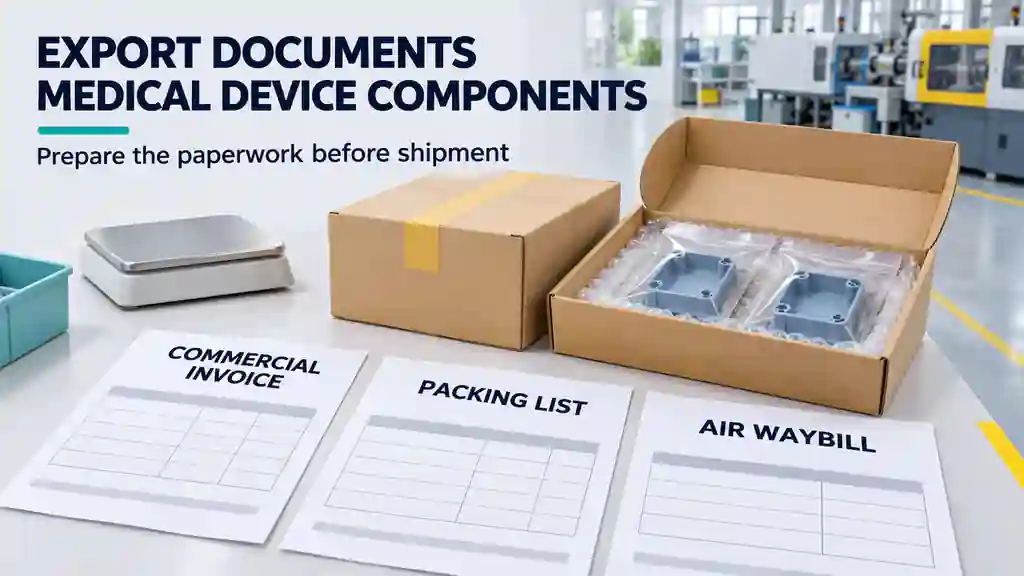
Your parts are molded, inspected, and packed. Then the shipment sits in customs for nine days because one document is missing or one code is wrong. Your buyer’s assembly line waits, and your launch date slips. I have seen this happen to good companies with excellent parts. The fix is simple: know which export documents your medical device components need before the first carton leaves the dock.
Medical device components usually need three core shipping documents: a commercial invoice, a packing list, and a bill of lading or air waybill. All three must show accurate descriptions, quantities, values, and HS or Schedule B codes. U.S. exporters must also file Electronic Export Information (EEI) in AES when one Schedule B line exceeds $2,500 or when a license is required. Depending on the buyer and the destination, you may also need a certificate of origin, an ISO 13485 certificate, lot certificates, RoHS/REACH declarations, an ECCN review, or FDA export certificates.
That is the short answer. The details are where shipments get stuck. Below, I’ll walk through each document group. I’ll explain who issues it, when buyers ask for it, and the mistakes I see most often. I’ll also cover where components differ from finished devices. By the end, you’ll have a practical checklist you can share with your supplier, your freight forwarder, and your quality team.
What Shipping Documents Does Every Medical Component Export Need?
Most export delays don’t come from complex regulations. They come from basic paperwork. A vague description, a quantity mismatch, or an invoice value that doesn’t match the packing list can trigger a customs hold. With medical components, the risk is higher because officers may assume your parts are regulated finished devices. Getting three core documents right prevents most of these problems.
Every commercial export of medical device components needs a commercial invoice, a packing list, and a transport document. The transport document is a bill of lading for ocean freight or an air waybill for air freight. These documents must match each other exactly. They should show clear part descriptions, part numbers, quantities, unit and total values, currency, Incoterms, country of origin, and the correct HS or Schedule B code for each line item.
The Three Core Documents at a Glance
| Document | Purpose | Key Data to Include | Common Mistake |
|---|---|---|---|
| Commercial Invoice | Customs valuation and duty calculation | Seller, buyer, part numbers, descriptions, quantity, unit price, total value, currency, Incoterms, origin, HS code | Using "medical device" or "plastic parts" as the description |
| Packing List | Physical verification of the shipment | Number of cartons, net/gross weight, dimensions, carton marks, lot numbers | Lot numbers missing or different from the CoC |
| Bill of Lading / Air Waybill | Contract of carriage and, for an original B/L, title to the goods | Shipper, consignee, notify party, port details, package count | Consignee name not matching the import license holder |
Write Descriptions That Customs Officers Understand
This is my number one tip. Describe what the part is and what it is for. Compare these two descriptions:
- Weak: "Medical device, plastic, 10,000 pcs"
- Strong: "Injection molded polycarbonate housing, P/N 4021-B, component for diagnostic analyzer, for further manufacturing, not for retail sale"
A few years ago, a client shipped IVD pipette tips to South America. The invoice simply said "medical devices." Customs stopped the shipment and asked for a local device registration the buyer did not have. We reissued the invoice with a precise component description and a supporting letter. The goods cleared, but only after a two-week delay.
Don’t Forget Special Cases
If your components include lithium batteries (common in wearable enclosure assemblies), you may need a dangerous goods declaration under IATA rules. Agree on Incoterms® rules before the first shipment so everyone knows who files what and who pays duties.
How Do You Classify Medical Device Components with HS and Schedule B Codes?
Classification is where many teams guess. They pick a code that "looks close" and copy it onto every invoice for years. A wrong code can mean wrong duty rates, rejected preferential tariffs, statistical penalties, or audits. Medical components are tricky because the same molded part could fall under plastics, rubber, or medical instruments, depending on how it is designed and used.
Medical device components are classified with the Harmonized System (HS). The first 6 digits are shared internationally. The U.S. uses 10-digit Schedule B numbers for exports and HTS codes for imports. Parts designed solely or principally for a specific medical instrument often fall under Chapter 90. Generic "parts of general use" made of plastic usually stay in Chapter 39. Most technical rubber parts go to Chapter 40. Confirm with a licensed customs broker and document your reasoning.
Why Components Are Harder to Classify Than Finished Devices
A finished syringe or a diagnostic analyzer has an obvious home in Chapter 90. Components do not. The Chapter 90 notes say that parts suitable for use solely or principally with a specific instrument are generally classified with that instrument. However, the same notes exclude certain items, such as "parts of general use" and technical articles of vulcanized rubber.
Classification Directions for Common Components
| Component Type | Likely Classification Direction | Reasoning |
|---|---|---|
| Generic molded clip, cap, or fastener | Chapter 39 (e.g., heading 3926) | General-use plastic article |
| Housing dedicated to one diagnostic analyzer | Chapter 90, with the analyzer’s heading | Part used solely with that instrument |
| Dedicated drug delivery or syringe parts | Chapter 90 (heading 9018 family) | Parts of medical instruments |
| Molded silicone seals and gaskets | Chapter 40 (heading 4016) | Technical articles of vulcanized rubber |
| PCB assembly for a wearable device | Chapter 85 or 90 | Depends on function and specific design |
These are directions only, not legal rulings.
Practical Steps
- Search the U.S. Census Schedule B tool for your export code.
- Check the CBP CROSS rulings database for similar products. Past rulings are excellent guidance.
- Ask your buyer which import code they use. Big mismatches between your export code and their import code raise red flags.
- Keep a one-page classification memo for each part family. Include the drawing, the material, the function, and the reasoning behind the chosen code.
From my experience, a classification memo saves hours during audits. It also prevents a new logistics coordinator from changing the code on a whim.
When Do You Need to File EEI Through AES?
Many U.S. teams assume their freight forwarder handles everything. Sometimes that’s true. But the legal responsibility for accurate Electronic Export Information often stays with you, the U.S. Principal Party in Interest. A missing or late filing can mean fines, seized cargo, and a compliance record you don’t want. You need to know exactly when the filing is required.
U.S. exporters must file Electronic Export Information (EEI) through the Automated Export System (AES) when the value of a single Schedule B classification in a shipment exceeds $2,500. Filing is also required when an export license is needed, regardless of value. Most shipments to Canada are exempt unless they are licensed or controlled. Once accepted, AES returns an Internal Transaction Number (ITN), which must appear on your shipping documents.
Key EEI Rules at a Glance
| Situation | EEI Required? |
|---|---|
| One Schedule B line over $2,500 | Yes |
| All lines under $2,500 each, no license needed | Generally no (use the correct exemption citation) |
| Export license required (any value) | Yes |
| Export to Canada, no license required | Generally no |
| Export to an embargoed or sanctioned destination | Yes, plus licensing review |
Note: the $2,500 threshold applies per Schedule B number, not to the total shipment. Five different component lines at $2,000 each may not require filing. One line at $2,600 does.
Filing Timelines
Under the Foreign Trade Regulations, EEI must be filed before export:
- Vessel: at least 24 hours before loading
- Air: at least 2 hours before scheduled departure
- Truck: at least 1 hour before arrival at the border
- Rail: at least 2 hours before arrival at the border
My Practical Advice
- Give your forwarder written authorization (a power of attorney) if they file for you. Then review their data at least occasionally.
- Make sure the Schedule B code, value, and quantity in AES match your commercial invoice.
- Keep export records for five years. Auditors will ask for them.
- In a "routed export transaction," where the foreign buyer controls the freight, clarify in writing who files. I have seen both sides assume the other party filed, which meant nobody did.
Does Your Component Require an ECCN Export Control Review?
Most teams think export controls apply only to weapons and aerospace parts. Then a wearable enclosure with a wireless module or an imaging sensor assembly gets flagged. Shipping a controlled item without the right license can lead to serious penalties. Worse, you may not discover the issue until your forwarder or a customs officer asks a question you can’t answer.
Components subject to the U.S. Export Administration Regulations (EAR) need an Export Control Classification Number (ECCN) review. Most plain injection molded plastic parts are classified as EAR99. That means no license is required for most destinations, unless the buyer is a restricted party or the destination is embargoed. Components with lasers, imaging sensors, encryption-enabled electronics, or certain specialty materials may carry a controlled ECCN and require a license.
Which Medical Components Deserve a Closer Look?
| Component Type | Potential Concern | Where to Check on the CCL |
|---|---|---|
| Molded plastic housings, caps, tubes | Usually none | Typically EAR99 |
| Laser modules (surgical, diagnostic) | Laser controls | Category 6 |
| Imaging sensors and cameras | Sensor and camera controls | Category 6 |
| Bluetooth/Wi-Fi modules in wearables | Encryption | Category 5, Part 2 |
| Specialty polymers, fluoropolymers, composites | Certain material controls | Category 1 |
You can review the full Commerce Control List (15 CFR Part 774) on eCFR.
A Real Example
One client’s wearable device enclosure included an overmolded Bluetooth module. The molding itself was simple. But the module used encryption. We asked the module manufacturer for its ECCN. It was classified under a mass-market encryption entry, so no license was needed for that destination. The key lesson: get the ECCN from the original manufacturer of any purchased electronics rather than guessing.
Screening Is Not Optional
Even EAR99 items cannot go to restricted parties. Before every new customer relationship, screen the buyer, the consignee, and the end user against the Consolidated Screening List. Document each screening. It takes five minutes and protects your company.
Build an Export Classification File
For each part number, record:
- The ECCN or EAR99 determination
- The reasoning and the date of review
- Supplier ECCNs for purchased components
- The name of the person who approved it
Update this file whenever the design changes.
Do Medical Device Components Need FDA Export Certificates?
This is the question I get most often. A foreign buyer asks for a "Certificate to Foreign Government," and the component supplier panics. Can a molder even get one? Is the part supposed to be FDA-registered? Many teams waste weeks chasing the wrong document. The answer depends on whether you are shipping a component or a finished device, and on its intended use.
Most medical device components do not need an FDA export certificate on their own. Under 21 CFR 807.65(a), manufacturers of components sold to device makers for further processing are generally exempt from establishment registration and device listing. Because a Certificate to Foreign Government (CFG) normally requires registration and listing, the finished device manufacturer usually holds it. Component suppliers typically provide a regulatory status letter instead. A Non-Clinical Research Use Only certificate may apply to components exported strictly for research.
FDA Export Documents Explained
The FDA’s CDRH issues these documents through the CECATS system as downloadable PDFs. You can learn more on the FDA Exporting Medical Devices page.
| Document | Typical Use |
|---|---|
| Certificate to Foreign Government (CFG) | Devices legally marketed in the U.S. Often requested by foreign regulators or buyers |
| Certificate of Exportability, Section 801(e)(1) | Certain devices not legally marketed in the U.S. that meet statutory export conditions |
| Certificate of Exportability, Section 802 | Certain unapproved devices exported under Section 802 conditions |
| Non-Clinical Research Use Only (NCR) Certificate | Products, materials, or components exported only for non-clinical research, not for human use |
| Export Permit Letter, Section 801(e)(2) | Required for exports under Section 801(e)(2). See FDA Other Export Documents |
| Simple Notification, Section 802 | Notification route for certain Section 802 exports |
What FDA Expects in a CECATS Request
If you are the finished device manufacturer, prepare the following (details on the FDA request guidance page):
- Registration and owner/operator numbers for all firms involved, including contract manufacturers, sterilizers, and relabelers
- Product code, marketing status, and a complete device description (trade name, type, model)
- Recall history for the past 10 years
- U.S. regulatory status (for example, whether the device is banned or investigational)
- An NLM database search statement, or documentation of an exemption
- For certain requests, a letter from the destination country’s authorized liaison, in English or with a certified translation
What Component Suppliers Should Provide Instead
When a buyer asks a component supplier for a CFG, I recommend a regulatory status letter that states:
- The part is a component for further manufacturing.
- The supplier is exempt from registration under 21 CFR 807.65(a).
- The supplier’s quality system certification (e.g., ISO 13485).
This usually satisfies the buyer’s supplier file.
Which Quality Certificates and Declarations Do Buyers Expect?
Your buyer’s supplier quality engineer opens your file and finds an expired ISO certificate or a declaration of conformity that cites the wrong regulation. Now your shipment and maybe your approved-supplier status are on hold. Buyers in regulated markets must prove they control their suppliers. Your documents are their audit evidence, so they will check them carefully.
Buyers usually request an ISO 13485:2016 certificate and a Declaration of Conformity. The ISO 13485 certificate should come from an accredited certification body, be valid, and have a scope that covers the actual work, such as "injection molding of medical device components." For finished devices sold in the EU, the manufacturer’s EU Declaration of Conformity must follow MDR Annex IV. Component suppliers generally issue a supplier declaration confirming conformity to the drawing, specification, and material requirements.
Why Buyers Ask for These Documents
Under ISO 13485 clause 7.4, device manufacturers must evaluate and control their suppliers. In the U.S., FDA’s Quality Management System Regulation (QMSR), effective February 2, 2026, incorporates ISO 13485 by reference in 21 CFR Part 820. Component manufacturers are generally outside the scope of Part 820, but their customers are not. That’s why the paperwork flows down to you.
Document Comparison
| Document | Who Issues It | When It’s Requested | What Buyers Check |
|---|---|---|---|
| ISO 13485 Certificate | Accredited certification body | Supplier qualification, annual review | Validity date, scope, accreditation |
| EU Declaration of Conformity (MDR) | Manufacturer of the finished device or accessory | CE-marked products | MDR Annex IV content, device class, standards |
| Supplier Declaration of Conformity | Component supplier | Supplier file, PPAP-style approval | Drawing revision, material, specifications |
| Regulatory Status Letter | Component supplier | Foreign buyer or regulator request | Exemption basis, intended use |
Verify Before You Send
- Check that the certificate is listed on IAF CertSearch or on the certification body’s own database.
- Make sure the scope matches the products you ship. A certificate scoped for "assembly" will not cover cleanroom molding.
- Track expiration dates. Send updated certificates to customers proactively.
Under the EU MDR (Regulation 2017/745), components are not CE marked by themselves unless they qualify as devices or accessories. If a buyer insists on an MDR declaration for a simple molded part, have a short conversation. Usually, they actually need your supplier declaration plus material compliance data.
What Lot-Specific Documents Should Ship with Each Batch?
The parts arrive at your buyer’s dock. Their incoming inspection team looks for the Certificate of Conformance and can’t find it. The lot is quarantined. Production waits. This happens more often than you’d think. Lot documents are part of your buyer’s supplier controls. Without them, perfectly good parts can’t be released into production.
Lot-specific documents commonly sent with medical component shipments include a Certificate of Conformance (CoC), a Certificate of Analysis (CoA) for the resin or material, material traceability records, and sterilization or biocompatibility reports when applicable. Each document should reference the same lot numbers shown on the packing list and carton labels. Define the exact document package in your quality agreement before the first production order.
The Typical Lot Document Package
| Document | What It Proves | Typical Source |
|---|---|---|
| Certificate of Conformance (CoC) | The lot meets the drawing and specification | Molder’s quality team |
| Certificate of Analysis (CoA) | The material lot meets resin properties | Resin supplier |
| Material Traceability Record | Links each part lot to its resin lot | Molder’s production records |
| Dimensional / Inspection Report | Measured results against critical dimensions | Molder’s QC lab |
| Sterilization Certificate | Sterilization cycle and dose or parameters (e.g., ISO 11135 EO, ISO 11137 radiation) | Sterilizer |
| Biocompatibility Evidence | Material or device testing under ISO 10993 | Resin supplier or test lab |
| Cleanroom Records | ISO 14644-1 class compliance, if specified | Molder |
A Biocompatibility Point Many Teams Miss
A resin supplier’s USP Class VI or ISO 10993 data covers the raw material. It does not automatically cover your finished part. Colorants, processing aids, mold release agents, and sterilization can all affect results. Under ISO 10993-1, the finished device manufacturer remains responsible for the biological evaluation of the final device. Your molder should support that evaluation with controlled materials and documented processes.
How We Keep Lot Documents Clean
On our projects, we send the full document package electronically before the goods ship. The buyer reviews it while the cargo is in transit. When the cartons arrive, receiving inspection only needs to match labels and lot numbers. This simple habit can cut incoming inspection time from days to hours.
Make sure every lot number on the CoC matches the packing list and carton labels exactly. One typo can quarantine an entire shipment.
Do You Need RoHS, REACH, and Conflict Minerals Declarations?
A European buyer sends you a 40-question material compliance survey before they’ll issue a purchase order. RoHS, REACH, SVHCs, conflict minerals, and now PFAS. If you can’t answer quickly and accurately, they move to another supplier. Material compliance requests are now a standard part of doing business in regulated markets, especially for electronics, polymers, and metal components.
Component exporters to the EU and other regulated markets are frequently asked for RoHS, REACH, and conflict minerals declarations. RoHS restricts 10 hazardous substances in electrical and electronic equipment, including medical devices. REACH requires disclosure when a Candidate List substance (SVHC) exceeds 0.1% by weight in an article. Conflict minerals declarations, usually on the RMI CMRT template, cover tin, tantalum, tungsten, and gold in metal and electronic parts.
Quick Comparison
| Requirement | Applies To | What Buyers Ask For | Reference |
|---|---|---|---|
| EU RoHS (2011/65/EU) | Electronic medical devices and their parts | Declaration of no restricted substances above limits | EU RoHS Directive |
| EU REACH | All articles, including polymer and metal parts | SVHC statement (>0.1% w/w) | ECHA: Understanding REACH |
| Conflict Minerals | Parts containing 3TG metals | Completed CMRT | RMI CMRT Template |
| EU MDR Annex I, Section 10.4 | Devices containing CMR or endocrine-disrupting substances | Concentration data above 0.1% w/w | EU MDR |
Why This Matters for Molded Parts
The four phthalates added to RoHS (DEHP, BBP, DBP, DIBP) have applied to medical devices since July 2021. PVC tubing and some soft-touch overmolds may contain plasticizers that need review. Under EU MDR, device makers must also justify certain CMR substances above 0.1% w/w in specific components. That is why your buyer cares about your material chemistry.
How to Prepare
- Collect compliance declarations from every resin, colorant, and insert supplier.
- Build a material compliance file for each part number.
- Recheck SVHC status whenever ECHA updates the Candidate List, which usually happens about twice a year.
- Expect PFAS questions, especially for fluoropolymers and certain additives. Regulations are evolving in both the EU and several U.S. states.
Answering these surveys within a few days, not weeks, is a real competitive advantage.
How Do Certificates of Origin Affect Duties and Customs Clearance?
Your buyer expected to pay zero duty under a free trade agreement. But the shipment arrived without valid proof of origin, so they paid full tariffs. Now they want a credit from you. Origin documents seem simple, but mistakes cost real money. They also affect whether goods can enter certain markets at all.
A Certificate of Origin confirms where your components were manufactured. It is often required to clear customs and to claim preferential tariff treatment under free trade agreements such as USMCA or the EU’s agreements with partner countries. Non-preferential certificates are usually issued by chambers of commerce. Preferential origin typically requires a certification or statement on origin that meets the specific agreement’s rules of origin.
Two Types of Origin Documents
| Type | Purpose | Who Issues It | Example |
|---|---|---|---|
| Non-preferential | Proves country of origin for customs, statistics, or letters of credit | Chamber of commerce | Generic certificate of origin |
| Preferential | Claims reduced or zero duty under an FTA | Exporter, producer, or importer (depends on the agreement) | USMCA certification of origin, EU statement on origin |
Learn more from the International Trade Administration’s Certificate of Origin guide and the USTR USMCA page.
Origin Is About Rules, Not Just Location
Molding a part in a country does not always mean it qualifies as originating under a trade agreement. Each agreement has its own rules. These are often based on a tariff classification change or a regional value content threshold. In many cases, converting resin pellets into a finished molded part meets the tariff shift rule. But metal inserts, purchased electronics, and imported subassemblies can complicate the analysis.
Practical Tips
- Keep supplier origin declarations for all inserts and purchased parts.
- Don’t claim preferential origin unless you can prove it. Customs authorities can audit you years later.
- Some destinations, especially in the Middle East, may require chamber certification or embassy legalization. Ask your importer early.
- If your parts enter the U.S., origin also affects tariff exposure. For many buyers, that is now a major sourcing factor.
What Destination-Country Rules Can Stop a Medical Component Shipment?
Everything on your side is perfect. Then the shipment stalls because the importing country wants a device registration, an import license, or a local representative. You can’t fix this from your desk in a day. Destination requirements are often the slowest documents to obtain. That’s why you should check them before you quote delivery dates, not after the cargo is booked.
Destination countries often require import registration, licensing, or a local authorized representative before medical devices can clear customs. Examples include China’s NMPA, Brazil’s ANVISA, India’s CDSCO, and the EU’s authorized representative under MDR. Components sold for further manufacturing are often outside these requirements. However, customs officers may still ask for proof. Confirm requirements with your importer and customs broker before the first shipment.
Major Market Requirements for Finished Devices
| Market | Regulator | Key Requirement for Foreign Manufacturers |
|---|---|---|
| European Union | Notified bodies / national authorities | EU Authorized Representative and CE marking under MDR |
| China | NMPA | Product registration or filing, plus a designated legal agent in China |
| Brazil | ANVISA | Brazilian Registration Holder and device notification or registration |
| India | CDSCO | Import license through an authorized Indian agent |
How Components Fit In
In most markets, a molded component for further manufacturing is not registered as a device. But the line between "component" and "device" can blur. For example, a sterile, individually packed IVD consumable sold to a lab may be a finished device. The same item sold in bulk to a kit manufacturer may not be.
My Pre-Shipment Questions for Importers
Before the first shipment, I ask the buyer:
- Does your customs authority treat this item as a device or a component?
- Do you need a registration number, import permit, or letter from us?
- Which company name must appear as consignee?
- Have you imported similar parts before without issues?
These four questions have saved our clients countless delays. If the answers are unclear, request a short written confirmation from the importer’s broker. It’s far cheaper than a returned shipment.
How Can You Build an Export Document Checklist That Prevents Delays?
You now know the documents. The challenge is managing them across buyers, destinations, and part numbers. Without a system, someone forgets the CoC or sends an old ISO certificate. Then you’re back to customs holds and frustrated customers. A simple, stage-based checklist turns export documentation from a fire drill into a routine process.
Build your export document checklist in four stages: before quoting, before the purchase order, before the first shipment, and with every shipment. Assign each document to an owner, such as quality, logistics, regulatory, or the supplier. Store master documents in one controlled location. Review the checklist whenever you add a new destination country, a new part number, or a design change.
Stage-Based Export Document Checklist
| Stage | Documents and Actions | Owner |
|---|---|---|
| Before Quoting | Destination requirements, HS/Schedule B code, ECCN review, restricted party screening | Logistics / Compliance |
| Before PO | ISO 13485 certificate, quality agreement, RoHS/REACH/CMRT, regulatory status letter | Quality / Regulatory |
| Before First Shipment | Certificate of origin setup, Incoterms confirmation, importer requirement confirmation, first article report | Logistics / Quality |
| Every Shipment | Commercial invoice, packing list, B/L or AWB, EEI/ITN when required, CoC, CoA, traceability records | Logistics / Quality |
| Annual or On Change | Certificate renewals, SVHC updates, classification memo review | Quality / Compliance |
What to Ask Your Molding Partner
If you are sourcing components, your supplier should be able to answer these questions without hesitation:
- Can you provide CoC, CoA, and full resin-to-part lot traceability for every shipment?
- Is your ISO 13485 scope a match for our parts?
- Can you supply RoHS, REACH, and CMRT declarations within one week?
- Do you document HS codes and ECCN determinations for each part?
- Will you send lot documents before the goods arrive?
A supplier who struggles with these questions will likely struggle with validation and audits too.
At MedMoldPro, we build the export document package into the project from the DFM stage. We treat it as part of the product, not an afterthought. If you’re preparing to ship components across borders and want a second set of eyes on your document plan, send us your drawings and destination details. We’re happy to help you map out exactly what you need.
Conclusion
Export documents for medical device components fall into five groups: shipping documents, export filings and controls, regulatory status documents, quality and lot records, and material compliance declarations. Most delays come from vague descriptions, mismatched data, and unconfirmed destination rules. Start with the checklist above. Confirm requirements early with your buyer and broker. Need a compliant molding partner that ships with complete documentation? Contact MedMoldPro today.