
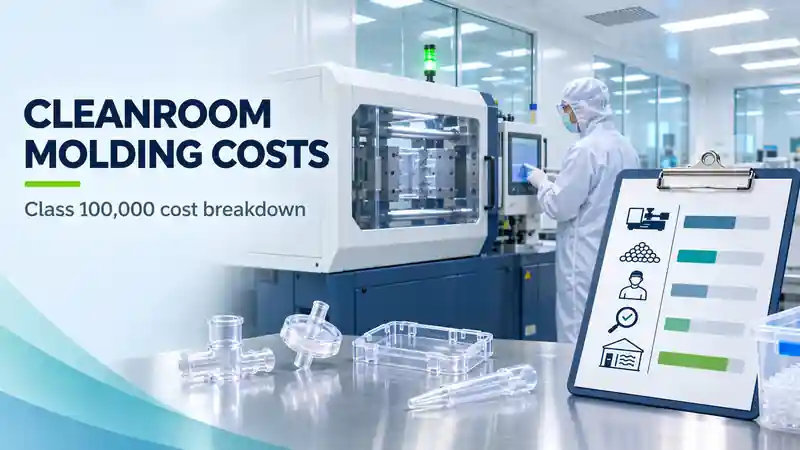
Your supplier sends a "cleanroom" quote that is 25% higher than the standard molding quote, and you can’t tell what the extra money buys. It could be the room, the gowns, the paperwork, or just margin. Without a clear breakdown, you either overpay for years or pick the cheapest molder and risk a failed audit. Below, I’ll break down the cost line by line so you can budget with confidence and question each quote.
A Class 100,000 (ISO 8) cleanroom molding program has three cost layers. Construction usually runs about $75–$300 per square foot, and HVAC plus HEPA filtration takes 40–50% of that. Operating costs include energy, filter changes, gowning, cleaning, particle monitoring and recertification. Compliance costs cover IQ/OQ/PQ validation, documentation and traceability. If you use a contract molder, these layers usually show up as a 5–20% premium on part price plus one-time validation fees. Tooling and resin costs stay mostly the same.
Those numbers are only a starting point. Your real cost depends on room size, air change rates, press type, validation scope and how well your part is designed for clean production. I’ll go through each layer and show where the money goes, where it gets wasted and which decisions you need to make before you request quotes.
What Does Class 100,000 (ISO 8) Actually Mean for Medical Molding?
Many RFQs still say "Class 100,000" while suppliers talk about "ISO 8." Some buyers think these are two different levels. Some suppliers take advantage of the confusion to sell a cleaner room than the part needs. Paying for ISO 7 when ISO 8 is enough can roughly double your facility cost per square foot. So let’s get the definition right first.
Class 100,000 is the old US FED-STD-209E name for what ISO 14644-1 now calls ISO Class 8. It allows no more than 3,520,000 particles ≥0.5 µm per cubic meter of air (about 100,000 per cubic foot). It is the least strict classified environment commonly used for medical injection molding. It suits IVD consumables, device housings, drug delivery components and parts that will be cleaned or sterilized later.
Where the Number Comes From
The current standard is ISO 14644-1:2015, which classifies air cleanliness by airborne particle concentration. The FDA’s aseptic processing guidance includes a handy table that maps the old names to ISO designations. In that table, Class 100,000 = ISO 8 = 3,520,000 particles ≥0.5 µm per m³. The FDA also notes that its classifications are based on measurements taken near exposed products during periods of activity. That detail matters for molding.
"At Rest" vs. "In Operation"
A room can pass ISO 8 when it is empty and fail once presses are running and operators are walking around. When you specify a cleanroom, ask which occupancy state the certificate covers. For molding, you want evidence from the operational state with the presses running.
How ISO 8 Compares to Other Options
| Environment | Max particles ≥0.5 µm/m³ | Typical air changes/hour | Typical medical molding uses | Relative facility cost |
|---|---|---|---|---|
| Controlled, not classified (CNC) | No formal limit | General HVAC | Non-patient-contact housings, parts cleaned later | Lowest |
| ISO 8 (Class 100,000) | 3,520,000 | ~10–25 | IVD consumables, drug delivery components, device housings, primary packaging | Baseline |
| ISO 7 (Class 10,000) | 352,000 | ~30–60+ | Fluid path parts, some implant-adjacent components | ~2x ISO 8 |
Who Decides the Class?
You do, not your molder. ISO 13485 requires you to control the work environment and contamination where they affect product quality. It does not assign a class to your part. Base the decision on your risk analysis, bioburden limits, sterilization validation and end use. I’ve seen teams specify ISO 7 because it "sounded safer," then pay for it on every part for years. Write down why you picked the class you picked. Auditors will ask.
How Much Does It Cost to Build an ISO 8 Molding Cleanroom?
Facility budgets often get set before anyone has priced the HVAC. Then the mechanical quote arrives, and the "simple cleanroom" costs twice what was planned. Projects stall, and the press sits in a warehouse. If you plan to build your own room, or want to judge whether a molder’s cleanroom adder is fair, you need realistic construction numbers.
An ISO 8 molding cleanroom typically costs about $75–$300 per square foot installed. Softwall enclosures sit at the low end. Hardwall and modular panel systems sit at the high end. A 1,000 sq ft room usually lands around $100,000–$200,000 turnkey, not counting presses, automation or tooling. HVAC and filtration take about 40–50% of the budget. Walls, ceiling and flooring take 25–35%, and engineering and validation cover the rest.
Where the Construction Money Goes
| Cost element | Share of CapEx | What’s included |
|---|---|---|
| HVAC, filtration, pressure control | 40–50% | Air handlers, HEPA filters or fan filter units, ductwork, temperature/humidity control, pressure cascade |
| Walls, ceiling, doors, flooring | 25–35% | Modular panels, ceiling grid, flush doors, pass-throughs, seamless flooring |
| Engineering and project management | 10–15% | Layout, mechanical design, utilities routing, permits, site management |
| Commissioning and certification | 5–10% | Airflow balancing, filter leak tests, particle counts, pressure verification |
These shares match real project data. American Cleanroom Systems, for example, reports ISO 8 rooms at roughly $75–200 per sq ft with standard HVAC and modular walls, around 20 air changes per hour and an 8–10 week modular build.
Choosing the Enclosure Type
| Enclosure type | Relative cost | Best for | Watch out for |
|---|---|---|---|
| Softwall (curtain) | Lowest | Single press, pilot runs, localized zones | Harder to hold pressure; less robust in audits |
| Hardwall modular | Medium | 1–4 presses, programs that may grow | Ceiling load limits for FFUs |
| Modular panel (walkable ceiling) | Highest | Multi-press production, long-term programs | Longer lead time, higher upfront cost |
Molding-Specific Cost Drivers
Molding rooms cost more than assembly rooms of the same size. Presses need tall ceilings, heavy floors, crane or mold-change access, and wall openings for water, power and resin lines. A gowning room and airlock add 10–20% more floor area. My advice: draw the press layout before you get HVAC quotes, because every square foot you don’t classify is money you never spend.
Why Is HVAC the Biggest Cost Driver in Cleanroom Molding?
Most teams focus on wall panels and floor finishes. Meanwhile, the air handler quietly eats half the budget and keeps running 24/7 for the life of the room. Worse, many rooms get specified with "safe" air change rates that are far higher than ISO 8 needs. That mistake doesn’t show up on the build quote. It shows up on every electricity bill.
HVAC and HEPA filtration are the biggest cost because ISO 8 rooms usually need about 10–25 air changes per hour, plus cooling to remove press heat. Fan power scales roughly with the cube of airflow. Doubling the air change rate can raise fan energy by up to 8 times in theory. Setting air changes far above what ISO 8 needs adds lifetime energy cost without a meaningful contamination benefit.
The Cube Law in Plain Numbers
Here is the theoretical fan power relative to a 20 ACH baseline. Real systems vary with filter pressure drop and duct design, but the trend holds.
| Air changes per hour | Airflow vs. 20 ACH | Approx. fan power vs. 20 ACH |
|---|---|---|
| 15 | 0.75x | ~0.42x |
| 20 | 1.0x | 1.0x |
| 25 | 1.25x | ~1.95x |
| 30 | 1.5x | ~3.4x |
| 40 | 2.0x | ~8x |
Rules of Thumb Are Often Wrong
Research from Lawrence Berkeley National Laboratory notes that recommended cleanroom air change rates were set somewhat arbitrarily as rules of thumb rather than optimized. Excess airflow costs money and can even disturb production. My recommendation: size airflow from particle-generation data, room recovery tests and heat load, not from a number someone remembered.
Press Heat Is the Hidden Load
Molding differs from assembly cleanrooms. Heater bands, motors and hot molds release heat into the room, so cooling can drive airflow more than particle control does. In one diagnostics project I supported, the HVAC was oversized by almost 40% because the designer assumed hydraulic presses. Switching to all-electric presses and moving the temperature controllers outside cut the cooling load enough to downsize the air handler.
What to Specify
- Target ACH with a documented basis (particle data plus heat load)
- Recovery time to class after a door-open or setback event
- Pressure differential to adjacent areas (commonly about 0.02–0.05 in. w.c. / 5–12 Pa)
- Temperature and humidity tolerances your resin and part actually need
What Equipment Costs Come With a Cleanroom Molding Cell?
The room is only the shell. Buyers often forget that presses, dryers, robots and conveyors must also suit a controlled environment. A hydraulic press dripping oil or a dryer venting resin dust inside the room can fail your particle counts. Then you pay twice: once for the equipment, and again to fix the contamination.
A cleanroom molding cell usually needs all-electric presses, auxiliary equipment placed outside the classified area, part-handling automation and environmental monitoring. All-electric presses cost more upfront but remove hydraulic oil contamination and cut energy use. Putting dryers, hoppers, chillers and temperature controllers outside the room, with material fed through wall openings, shrinks the classified area and lowers the particle load inside.
Equipment Cost Impact Table
| Item | Cost impact | Cleanroom requirement | Practical tip |
|---|---|---|---|
| All-electric press | Higher upfront, lower running cost | No hydraulic oil mist, low particle generation | Ask for cleanroom-ready finish and covered drives |
| Resin dryer and loader | Moderate | Keep outside; filtered, closed conveying | Feed through sealed wall openings |
| Chiller and mold temperature controller | Moderate | Keep outside | Run water lines through sealed wall openings |
| Robot or sprue picker | Moderate to high | Low-particle design, cleanroom lubricants | Cuts operator contact and gowning entries |
| Conveyor and part chute | Low to moderate | Covered, easy to clean | Drop parts straight into bags or trays |
| Laminar flow hood over mold | Moderate | HEPA unidirectional flow over open mold | Protects the most critical zone |
| Particle counters and sensors | Moderate | Continuous or periodic monitoring | Log the data. Auditors want trends. |
Why All-Electric Makes Sense
Hydraulic presses can work in ISO 8 if they are well maintained. But every oil leak becomes a contamination investigation. All-electric machines also put less heat into the room. Over a 7–10 year program, the energy and HVAC savings often recover much of the price premium.
Moving Equipment Out of the Room
This is one of the best cost moves I know. A typical press cell with a dryer, temperature controller and chiller inside can need 30–40% more classified floor space than a cell with those units outside. Every square foot you avoid saves construction cost, airflow and cleaning labor every year.
Dedicated vs. Shared Presses
A press dedicated to cleanroom work is easier to validate. But if it runs half-empty, its fixed cost lands on your part price. Ask your molder how they schedule cleanroom presses and how they control changeovers between programs.
What Are the Recurring Operating Costs of an ISO 8 Cleanroom?
Construction is a one-time hit. Operating costs keep coming whether the presses run or not. HEPA filters load up, gowns get used up, the floor needs cleaning every day, and particle counts must be logged. If your budget ignores these, the cleanroom becomes a cost surprise every quarter, and someone eventually cuts corners.
An ISO 8 molding cleanroom’s recurring costs include HVAC energy, prefilter and HEPA replacement, gowning consumables, cleaning labor and supplies, particle and pressure monitoring, calibration and periodic recertification. For a 1,000 sq ft room, a realistic planning range is about $25,000–$65,000 per year, depending on staffing, shifts and energy prices. Reducing airflow during non-production hours can cut HVAC energy by an estimated 30–50%, if recovery is validated.
Illustrative Annual Operating Budget (1,000 sq ft, ISO 8)
| Cost item | Planning range per year | What drives it |
|---|---|---|
| HVAC energy (fans + cooling) | $4,000–$12,000 | ACH, press heat load, electricity rate, hours |
| Prefilter and HEPA replacement | $1,000–$4,000 (averaged) | Dust load, prefilter discipline |
| Gowning consumables | $5,000–$15,000 | Headcount, entries per shift, reusable vs. disposable |
| Cleaning labor and supplies | $8,000–$20,000 | Daily/weekly cleaning SOP, room size |
| Monitoring and calibration | $2,000–$6,000 | Continuous vs. periodic counting |
| Recertification | $2,000–$5,000 | Third-party testing scope and frequency |
| Preventive maintenance | $2,000–$5,000 | Door seals, FFU service, repairs |
These are planning figures from projects I’ve supported, not quotes. Use them to sanity-check budgets, then replace them with site data.
Gowning Is a Labor Cost, Not Just a Supply Cost
Each entry takes about 5–10 minutes per operator. With six operators entering three times per shift, you lose 1.5–3 labor hours every shift. Automation that cuts entries saves more than gowns.
Night and Weekend Setback
People are the biggest particle source in most cleanrooms. When no one is inside and the presses are idle, you can lower airflow, as the LBNL setback research above describes. The catch: you must validate how long the room takes to return to ISO 8 before production restarts, and write that into your SOP. Skip that step and the savings become an audit finding.
How Much Does Cleanroom Molding Add to Your Part Price?
You’re comparing three quotes. One molder adds 8%, another 22%, a third hides the adder inside the machine rate. Without knowing what a fair premium looks like, you can’t tell who is efficient and who is padding. And if you pick on price alone, you may end up with a molder whose "cleanroom" is a curtain around a hydraulic press.
Class 100,000 cleanroom molding typically adds 5–20% to part price over conventional molding. Some published guides put it at 15–25% when inspection and documentation are charged per part. The premium covers facility overhead, gowning, environmental monitoring, controlled packaging and documentation. Highly automated, high-volume parts sit at the low end. Low-volume, hand-handled parts with heavy paperwork sit at the high end. Validation and tooling are usually quoted separately.
The Cost Stack
Part price = standard molding cost + cleanroom facility allocation + gowning/labor + controlled packaging + inspection + documentation + validation/maintenance allocation
Worked Example: IVD Cartridge Base
Assumptions: polypropylene, 6 g part, 4-cavity tool, 20-second cycle, about 700 parts per hour, 1 million parts per year.
| Cost line | Conventional | ISO 8 cleanroom |
|---|---|---|
| Resin (medical-grade PP) | $0.024 | $0.024 |
| Machine + labor ($45/hr vs. $52/hr) | $0.064 | $0.075 |
| Packaging (bulk vs. double-bagged at press) | $0.004 | $0.007 |
| Inspection | $0.004 | $0.006 |
| Lot documentation | — | $0.002 |
| Total per part | $0.096 | $0.114 (~18% higher) |
How did I get the $7/hr rate adder? Take a $150,000 room plus $20,000 in certification, spread over 7 years, and add about $35,000 per year to run it. That’s roughly $59,000 per year. Spread across three presses running 6,000 hours each, it comes to about $3.30 per press-hour, plus gowning time and monitoring labor.
Why the Percentage Varies
| Scenario | Typical premium | Reason |
|---|---|---|
| Large housing, expensive resin, automated | 5–10% | Resin dominates price; cleanroom adder is small by comparison |
| Small consumable, high volume, robot handling | 10–18% | Machine time is a bigger share of price |
| Low volume, manual handling, heavy documentation | 18–25%+ | Gowning, inspection and paperwork spread over few parts |
Remember: tooling is a separate line. For mold costs, see our injection mold tooling cost breakdown for medical devices.
What Validation and Compliance Costs Should You Budget For?
Teams often budget for the cleanroom and the mold, then discover validation late. The FDA submission is weeks away, and nobody has written the OQ protocol. Rushed validation costs more, fails more often and pushes back launch dates. Validation isn’t paperwork overhead. It’s the evidence that your clean process actually works, every lot.
Budget for two layers of validation. First, the cleanroom itself: installation checks, airflow and filter tests, and particle counts at rest and in operation. Second, the molding process: IQ on the press and equipment, OQ to set a robust process window and PQ to prove repeatable production. Process validation costs vary widely with part complexity, cavity count and test scope. Plan for it as a separate one-time project cost, not part of piece price.
The Regulatory Backdrop
In the US, the FDA’s Quality Management System Regulation (QMSR) took effect on February 2, 2026. It incorporates ISO 13485:2016 by reference. That means your supplier’s environmental controls, process validation and traceability now sit inside a framework US and international auditors share. ISO 13485 requires validation for processes whose output can’t be fully verified afterward. Injection molding usually falls into that category for critical features.
Validation Activities and What They Prove
| Activity | What it proves | Typical owner | When |
|---|---|---|---|
| Cleanroom qualification | Room meets ISO 8 at rest and in operation | Molder / facility | Before production |
| Equipment IQ | Press, robot and auxiliaries installed correctly | Molder | After tool arrival |
| Process OQ | Process window produces good parts at edges | Molder, approved by OEM | After tool qualification |
| Process PQ | Repeatable output over multiple runs/lots | Molder, approved by OEM | Before launch |
| Ongoing monitoring | Room stays in class over time | Molder | Continuous |
| Recertification | Classification still valid | Molder / third party | Periodic, often annual |
How to Keep Validation Costs Under Control
- Agree on who owns each protocol before tooling starts
- Define critical-to-quality dimensions early. Don’t validate every feature.
- Freeze the design before OQ. Changes reset the clock.
- Ask for a documentation matrix up front
At MedMoldPro, we plan this through our process validation and production documentation workflow. We review protocol ownership and deliverables before quoting, not after the mold is built.
How Can You Cut Cleanroom Molding Costs Without Adding Risk?
Cost pressure is real. But the wrong cuts, like skipping recertification, relaxing gowning or running a hydraulic press with a leak, create nonconformances that cost far more than they saved. The goal isn’t a cheaper cleanroom. It’s a cleanroom sized to the risk, with fewer square feet, less airflow and fewer human touches.
The safest ways to cut cleanroom molding costs are: choose the lowest class your risk analysis supports; put localized HEPA laminar flow hoods over the mold and part-removal zone instead of classifying an entire hall; move dryers, chillers and temperature controllers outside; use all-electric presses; automate part handling; reduce airflow during idle hours with validated recovery; and design parts that need no manual secondary operations.
Cost-Reduction Strategies Compared
| Strategy | Typical savings | Risk if done poorly | What to validate |
|---|---|---|---|
| Right-size the class (ISO 8 vs. ISO 7) | Up to ~50% facility cost | Under-specifying for fluid path parts | Risk analysis, bioburden data |
| Local HEPA hood over mold + CNC or ISO 8 room | Avoids classifying a whole hall | Weak airflow at the critical zone | Particle counts at the part exit |
| Auxiliaries outside the room | 30–40% less classified area | Material contamination in conveying | Filtered, closed conveying |
| All-electric presses | Lower energy and HVAC load | Higher upfront cost | Cleanroom-compatible lubricants |
| Airflow setback off-hours | Est. 30–50% HVAC energy | Restart before recovery | Recovery time to class |
| Automation to bag at press | Fewer entries, less handling | Robot particle generation | Particle data near the robot |
| DFM: degate in tool, no trimming | Removes manual steps | Gate vestige issues | Dimensional and cosmetic checks |
My Favorite Example
A point-of-care startup I worked with planned to classify a 4,000 sq ft hall to ISO 8. We redesigned the cell instead: a hardwall ISO 8 room around two presses, auxiliaries outside, and a HEPA hood over each mold. The classified area dropped by more than half. The particle counts at the part exit were better than the original plan would have delivered.
Start With the Part, Not the Room
Many cleanroom costs come from the design: parts that need trimming, manual assembly or extra inspection. A good DFM and Moldflow review before tooling can remove these steps, and every step you remove is one fewer human touch inside the cleanroom.
Should You Build Your Own Cleanroom or Outsource to a Contract Molder?
Owning a cleanroom feels like control. But it brings a $100,000-plus build, a yearly operating budget, validation work and a staff that has to keep the discipline every shift. For many device companies, the room ends up underused. Outsourcing avoids that, if you choose a molder who can prove their cleanroom performance, not just claim it.
Build your own ISO 8 cleanroom only if you have steady, high-volume demand, in-house quality staff and a strategic reason to own the process. Otherwise, a qualified ISO 13485 contract molder with an existing ISO 8 room spreads the facility cost across many programs, so you pay only a part-price premium and one-time validation fees. Whichever route you take, ask for operational-state certification, monitoring data and an itemized quote.
Build vs. Outsource at a Glance
| Factor | Build in-house | Outsource to contract molder |
|---|---|---|
| Upfront investment | $100,000–$200,000+ room, plus presses | Usually none for the room; tooling only |
| Time to production | Months for build + qualification | Weeks once tool is qualified |
| Ongoing costs | You carry all operating costs | Built into part price |
| Control | Full | Through quality agreement and audits |
| Best for | Stable, high-volume, strategic programs | New products, pilot runs, variable demand |
Questions to Ask Every Cleanroom Molder
- Does your ISO 14644 certificate cover the operational state, and when was it last renewed?
- Can you share 3–6 months of particle, pressure and temperature trend data?
- Is cleanroom molding included in your ISO 13485 certificate scope?
- Where are dryers, chillers and temperature controllers located?
- Are your cleanroom presses all-electric? How do you control changeovers?
- What is your gowning SOP, and how do you train and qualify operators?
- Can you itemize part price, cleanroom adder, packaging, inspection and validation?
For a deeper checklist, including how to assess cleanroom infrastructure on a supplier audit, see our guide on how to vet a Chinese medical injection molding supplier.
What I Recommend
Start by outsourcing through pilot production and early launch. Track your real annual volume and cost for 12–24 months. If the numbers clearly support an in-house room, build it then, using your actual data instead of forecasts.
Conclusion
Class 100,000 cleanroom molding costs come from three layers: construction, operation and compliance. Most of the waste comes from oversized rooms, excess airflow and unplanned validation. Choose the class from your risk analysis, demand itemized quotes and design your part for minimal handling. Want a line-by-line cleanroom molding quote for your part? Send your drawings and annual volumes to MedMoldPro.